For those acquainted with Jonathas de Andrade’s short film O Peixe (The Fish, 2016), it is difficult to approach his new series of photographic prints, O espírito das águas (The Water Spirits, 2017), with neutral eye and mind. Indeed, the artist (b. 1982, Maceió, Brazil) extracted the imagery found within the seven works shown at Alexander and Bonin from O Peixe. The film, which addresses the dense, provocative issues inherent in anthropological examinations of culture, race, and male sexuality, leaves viewers – or perhaps more accurately voyeurs – in varying states of internal conflict. With de Andrade’s prints redirecting our focus towards isolated images, this sense of conflict lessens and a curious study of human response to nature emerges.
O Peixe, shot along a river in the northeast of Brazil, presents the activities of ten fishermen who employ various tools and their own bodies to catch and kill large, glistening fish. One by one, the men – dark-skinned, impressively muscled, and clad only in shorts – draw their prey from the water and subsequently press the creatures against their chests. As the fish’s physical struggle subsides, the men bestow caresses and kisses upon them until they die from suffocation. The repetition of this process over the course of 38 minutes, along with de Andrade’s adherence to the stylistic codes of ethnographic documentary, leads the viewer to question whether or not the fishermen’s actions constitute a local ritual. This peculiar routine, however, is the artist’s invention.
These captivating vignettes of man slowly dominating nature – embedded within gliding panoramas of verdant tropical shores – are further enlivened by a luscious array of sounds. Together, the musical chirping of insects and birds, water droplets plopping back into a rippling river, and the raspy pumping of fish gills, produce an immersive, hypnotic environment.
Upon descending into the lower level gallery where O espírito das águas is installed, the viewer who has first seen O Peixe may feel overwhelmed by silence, by the ample white wall space between contained imagery, by the hardness of the gray concrete floors and the industrial rigidity of a black iron railing. In stripping the film’s visual material of its cinematic components (motion, sound, narrative), de Andrade at once eliminates many of O Peixe’s problematic aspects and offers a broader reading of his subject matter. The seven prints retain the grainy quality of his 16-millimeter film and are almost exclusively portraits of men holding fish. The bodies of these two beings often remain within the artist’s focal plane and also lie at the physical center of each work. While the fish figure prominently, they seem to serve as foils to the human protagonists. The fish, unable to emote, accentuate the range of human sentiment as expressed through men’s faces, torsos, and limbs. Yet, as the unassuming catalysts behind various human psychological states, the fish also lend an air of absurdity to their captor’s expressions – harkening back to the film’s trope of fact versus fiction.
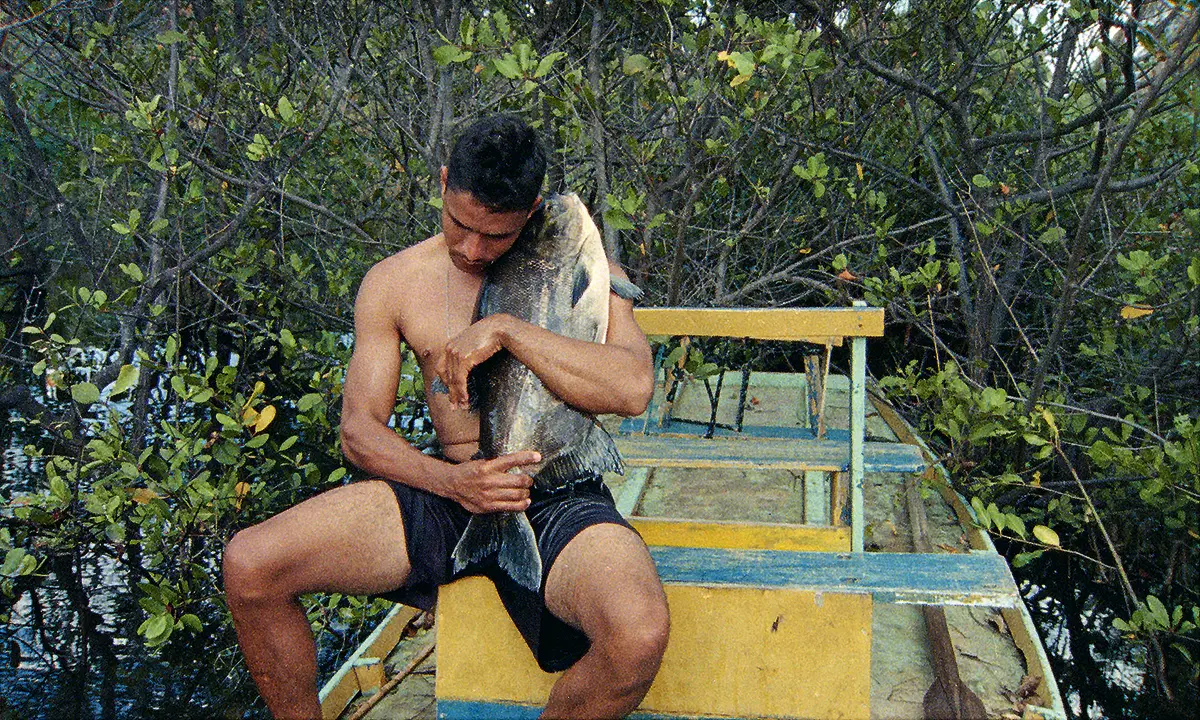
At the bottom of the staircase, the viewer first encounters a single framed print (O espírito das águas – 6) containing the image of a young man perched on the edge of a bench spanning the width of a brightly-painted yet weathered wooden boat. The man uses the fleshy inside of his left forearm to press a fish against his torso, while his right hand encircles its tail. Evoking the arrangement of figures in a Pietà, the man – with head tilted forward and eyes cast down – seems to be mourning the death of a cherished friend.
Continuing around the gallery, the viewer will find other oddly tender depictions of loving predator and dying prey, with human cheeks and lips pressed near gaping, silvery mouths. One man, with a slightly furrowed brow, shows contemplative concern for his prey’s physical state. The setting sun illuminates another fisherman – with goggles atop his head and water droplets clinging to his skin – whose closed eyes and barely parted lips exude a sensuality so spirited that it verges on exaggeration.
But the artist’s portrayals of man and fish together are not limited to tranquil, compassionate relations. A set of two prints mounted side-by-side, O espírito das águas – 4 and – 3, show a man gaining control over a fish measuring roughly the same length and width as his own torso. The print on the right (– 4) depicts a particularly athletic wrestling match, likely occurring right after the captor has pulled his prey from the river. In the print on the left (– 3), however, the man confidently dominates the fish, with both his countenance and his elegant, angular postures conveying determination and self-assurance.
As if to emphasize man’s psychological reliance on nature, de Andrade includes a single print in which there is no fish, and the fisherman’s body is almost entirely submerged in water. Here, nature has subsumed the predator. The object and integrity of human expression have dissolved with man’s body, and for a moment we can imagine that human exertion of control over nature has been reversed.
SUSAN BREYER