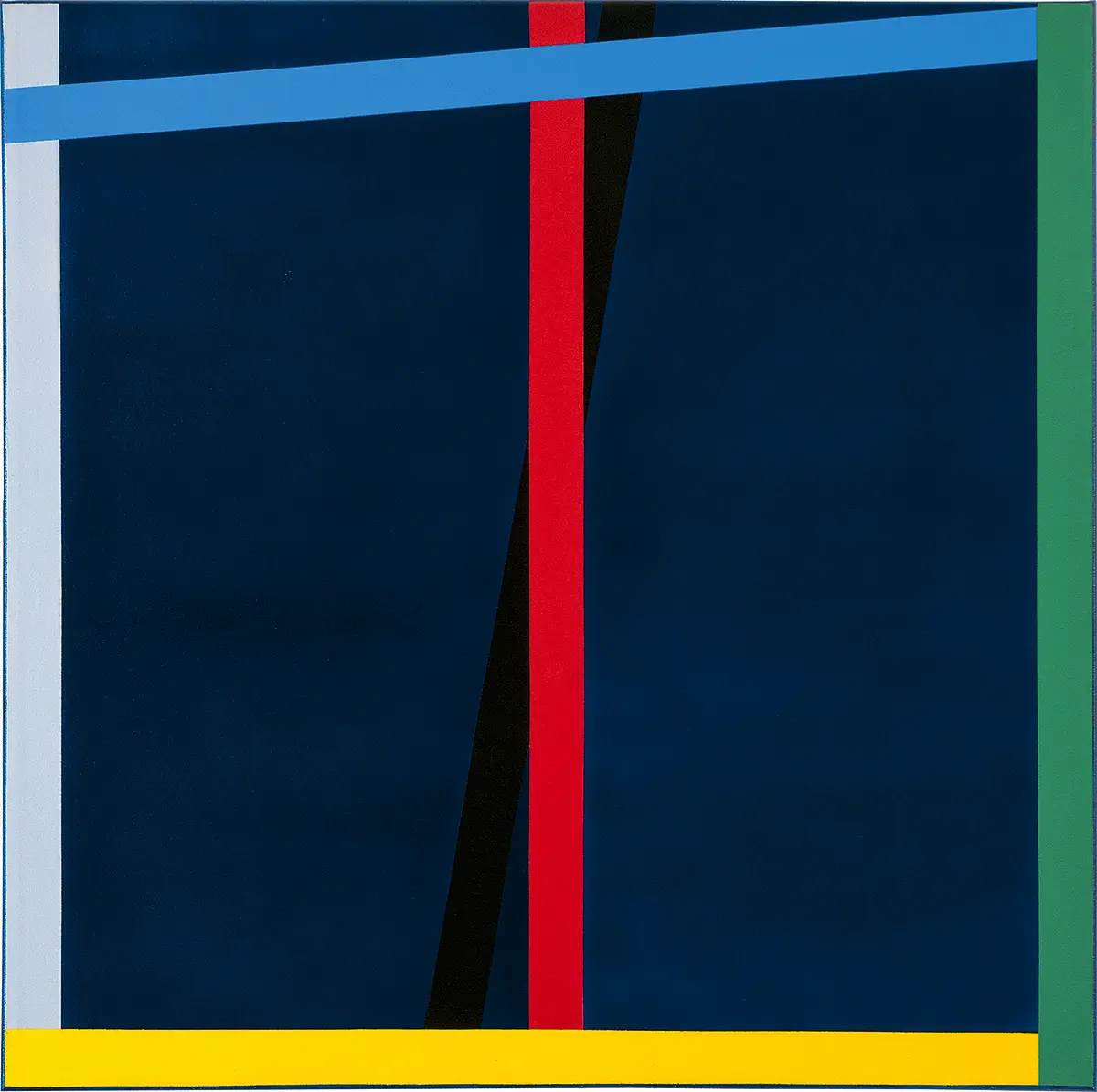
The recent work of Javier Vivas posts new notions of abstract geometric art. The exhibition Javier Vivas. Pintura concreta bring together a group of paintings comprised of the series Unstable Bars, Formas concretas (Concrete Forms), and Vibraciones inducidas (Induced Vibrations), all from 2017. Vivas proposes an encounter between modernity and postmodernity by revisiting the pioneers of geometric abstraction, adding new meanings to their unique language inscribed in the modes of representation that are characteristic of the contemporary era.
Vivas resorts to the repertoire of emblematic geometric abstraction works in order to expand our conceptual understanding of this movement and to propose other approaches. His emphasis on formal language is intended to break the ties that bind painting to the figurative narration. Composition, color, and shape are no longer the visual alphabet for the development of a painting. These elements contain in themselves the visual narrative of synthesis and essence of the universal that arouses sensorial and occasionally emotional effects, as well as perceptual relationships to create “new realities.” In the case at hand, the exhibition titled Pintura concreta, Vivas’ work harks back to an approach towards the visibly concrete, this is to say, the elements of expression. The artist takes as his reference the work of Alejandro Otero, Jesús Soto, Max Bill, Blinky Palermo, and Sol Lewitt, among others, and it is on the basis of this return to the sources that Vivas moves his work forward.
The series Unstable Bar starts from a revision of the work of Piet Mondrian and Alejandro Otero’s later approach to the Dutch artist in his series Ortogonales (Orthogonals). Mondrian built a style characterized by compositional balance with his use of a grid of black horizontal and vertical bands on white grounds, and the dynamization of the plane with small color segments (yellow, red, blue, and black). In turn, Otero saturated the compositional plane with interwoven horizontal and vertical stripes, with tension points growing in their intersections. On the platform of these two proposals, Vivas shifts Mondrian’s and Otero’s stylistic foundations by taking the balance between ground and figure to its limit. He gives the ground a substantial chromatic presence with dark or bright colors. He alters the balance between the stripes by placing them in the outer limits and at slight tilts, and creates unexpected chromatic combinations in tertiary colors. Similarly, the chromatic references that Vivas makes to the work of Max Bill clearly stand out in this set of works.
In Formas concretas, Vivas articulates visual tensions between form and figure, a Gestalt that, in this case, starts from the graphic language used by artist and designer Gerd Leufert in his series Nenias. These are flat figures in irregular shapes that function as emblems. The central image, like an arrow, plays—in a uniquely, austere, and seemingly simple way—with the directions generated by the angles that prod the gaze into different sides, thus creating flight points that break slightly with the stability of the composition. On the one hand, the bright planes of the ground, in combination with the black, flat color of the figure, induce a high contrast and perceptual competence.
The series Sistema rojo (Red System) includes a tendency towards the baroque and an element of compositional chaos. Here, Vivas develops grounds filled with oblique lines, some of them combined with fractured color planes; the figures in the foreground are in a precarious balance and the bold chromatic combinations produce a visual explosion that does not go unnoticed. Vivas's formal solutions break with the restraint of his previous series. Sistema Rojo was conceptualized in mid-2017 and reflects the imbalances in the Venezuelan context of the period.
Vivas’ geometric abstraction takes as its starting point the explorations, discoveries, and displacements around a revision of abstract art that is ongoing in the contemporary context. It posits a revision on the basis of his unique chromatic selection of secondary and tertiary colors that emphasize striking and unusual combinations that signal in the direction of imbalance and, in some instances, chaos. Perhaps without intent, Vivas’ delving into the study of landmark artworks, sets out anew on the path followed by his predecessors since the 1920s, in connection with the definition of a Latin American identity in abstract art and the contributions made in the region to an artistic legacy known, depending on the location, groups, or individual artists, constructivism, neoplasticism, concrete art, or suprematism. Venezuelan artist Alejandro Otero referred to the situation of the earliest generation of Latin American artists to assimilate geometric abstraction as a group situated between two worlds, one coming to an end and struggling to survive, and another one—the Latin American region’s—that opened up as a new possibility.
ANNY BELLO