The exhibition Iraida Icaza and the Forgotten Museum refers to more than one collection or one place. The idea stems from photographs she took in Panama’s old Museum of Natural Science, which has since closed its doors to the public. For several years, Icaza photographed its unusual interior spaces and its collections in the fields of geology, paleontology, marine biology, and entomology. The small museum also had sections that displayed vertebrate animals and foreign fauna, as well as its own taxidermy laboratory. In the exhibition at the Museum of Contemporary Art, Icaza presented those images together with photographs taken in other museums she has visited in Europe and the United States over the years.
The concept of a museum as a collection of things or images from the past or the present also relates to Iraida Icaza’s photographic archive. She has explained that, although she lets intuition be her guide when she takes a photograph, creating her images involves a detailed subsequent process. It is based on the careful classification of her images, which she later edits and combines to produce her prints. She recomposes and resurrects photos taken in earlier phases because she sometimes discovers that they foreshadowed ideas that germinate at a later date. She is a meticulous researcher, a refined artist, and an incessant collector of images; her organizational tenet is on the basis of long-term concepts, rather than time-restricted series.
Displayed in the exhibition spaces on the MAC’s ground floor were black and white photographs that reflect Iraida Icaza’s lifelong fascination with science and nature, and constitute parts of her own personal, carefully-curated museum. She showed views of monumental Mexican landscapes with unusual geological formations, as well as dark, dramatic pictures of caves and Etruscan tombs that she discovered in southern Italy. It was also there, specifically in Sicily, that she photographed an unusual series of carved stone heads with grotesque faces that reveal different personality traits, that she refers to as Mental States.
Although some visitors thought it resembled a retrospective, the exhibition was more like a variety of collections linked to a museological theme. The artist showed part of her Darién Project with scenes from the jungle and herbal specimens, as well as compositions that she has gathered under the title Forensic. They are works in which she records traces of human activities or fortuitous compositions she discovers in nature. Other photographs reveal her interest in capturing the ephemeral, for example, the way in which tracks in the sand are erased by the elements, or how ice slowly vanishes. At times, she photographs random splashes of light in amorphous spaces, creating compositions that are almost abstract.
In Icaza’s oeuvre, the contrast between light and shadow is both visual and subjective. She seeks “the magical moment that holds the unknown when lights and shadows fluctuate between positive and negative...I explore the space between reality and illusion.” That dream-like space to which Iraida Icaza refers can be seen in some beautiful photographs she took of veiled and mysterious plastic-covered statues in some European museums, such as a sculpture of Eve by Auguste Rodin in the cellar of the Southampton Museum.
The conceptual links between real objects and photographic prints continue on the museum’s second floor, where visitors enter a magical space that recreates the feeling of an old museum. It included a collection of color photographs that Icaza took inside the closed-down Panamanian museum and at other international institutions. Her images of dioramas are striking, a perfect example of that space between the real and the imaginary that she seeks to capture. There are striking photographs of preserved animals, from splendid birds to large mammals. The installation also included some three-dimensional specimens borrowed from the Panamanian museum: an antelope, a raccoon, a macaw, and a tamarin monkey all add depth to the exhibition. There are strange and nostalgic photos of the taxidermy lab and other parts of the Science Museum. There is a surprising photograph of an embalmed heron exhibited above a white washbasin, as well as images that record some of the overfilled and heterogeneous exhibition rooms.
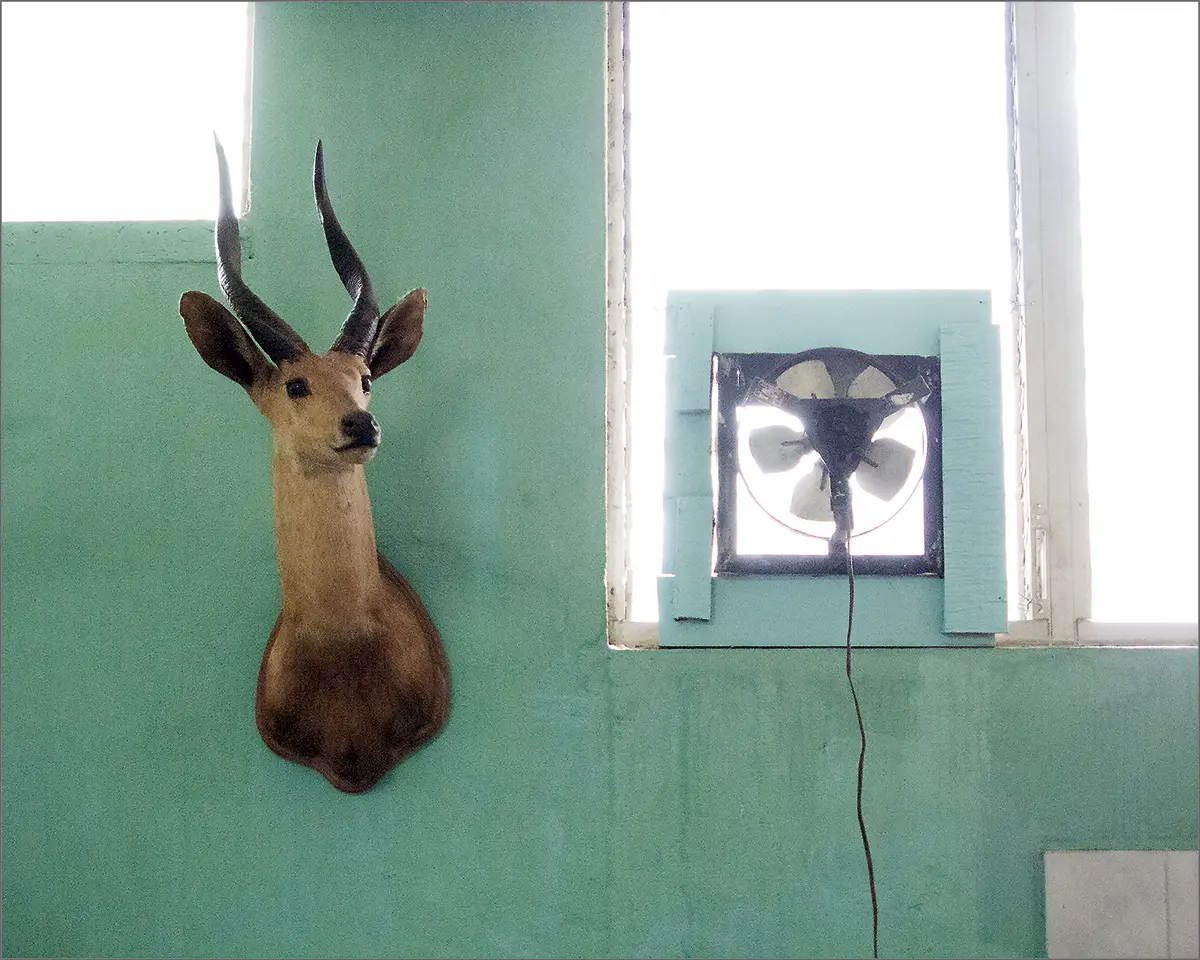
A deer’s head is mounted on the wall in another part of the exhibition, in an installation next to a curious photograph that Icaza took of the same animal in the old museum where it was mounted next to an electric fan. Her photographs reveal a real cabinet of curiosities. Finally, we come to a small room, with a sequential installation of some twenty portraits of embalmed animals. Their faces reveal almost human features and different characters, an effect achieved through the combination of the taxidermist’s work and the photographer’s clever eye. It is a worthy tribute to the surreal character of the forgotten museum that Iraida Icaza managed to capture with such sensitivity.
MÓNICA KUPFER