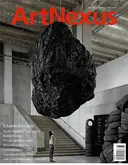
The retrospective exhibition by Ignacio Iturria at the Neuberger Museum of Art, Purchase College of the State University of New York (SUNY), is an experience that offers a window into Iturria’s life and also serves an important educational function. Curated by Patrice Giasson, the Neuberger Museum’s Alex Gordon Curator of Art of the Americas, with the assistance of Marianelly Neumann, and accompanied by a catalog with inspiring illustrations, the exhibition showcases the presence of one of the important Latin American artists with a four-decade professional career that has never fallen for the trends dictated by the market. Titled A Studio in the Gallery: The Playful Universe of Ignacio Iturria, the show was displayed in the large exhibition area that usually contains the institution’s collection. Within this perimeter, an area was assigned so Iturria could temporarily set up a studio. For the duration of the exhibition, he completed a residency that was very different from those usually mentioned in several places of the international art scene. It is not that the painter lived and worked for a while in a place conditioned for such purpose, or that Iturria had to enter a competition to be there, or that it was a space in which to lock himself into work so the product of that effort would eventually be presented alongside works by other residents at the end of an agreed period, as it generally occurs. There, he was all alone. There were no other participants, the study was enormous and was only enclosed by two supports like those placed to form lines in front of movie theatres. And a poster in the adjacent wall indicated that the studio was opened to the public only when Iturria was in it. People entered naturally, driven by curiosity and a desire to be surprised and performing a walk through the space that was different from the usual visit to an exhibition. The connection between the creation of the work of art and the finished piece exhibited in the museum is, in Iturria’s case, proposed as a generous circle in terms of the discovery and understanding of artistic creation.
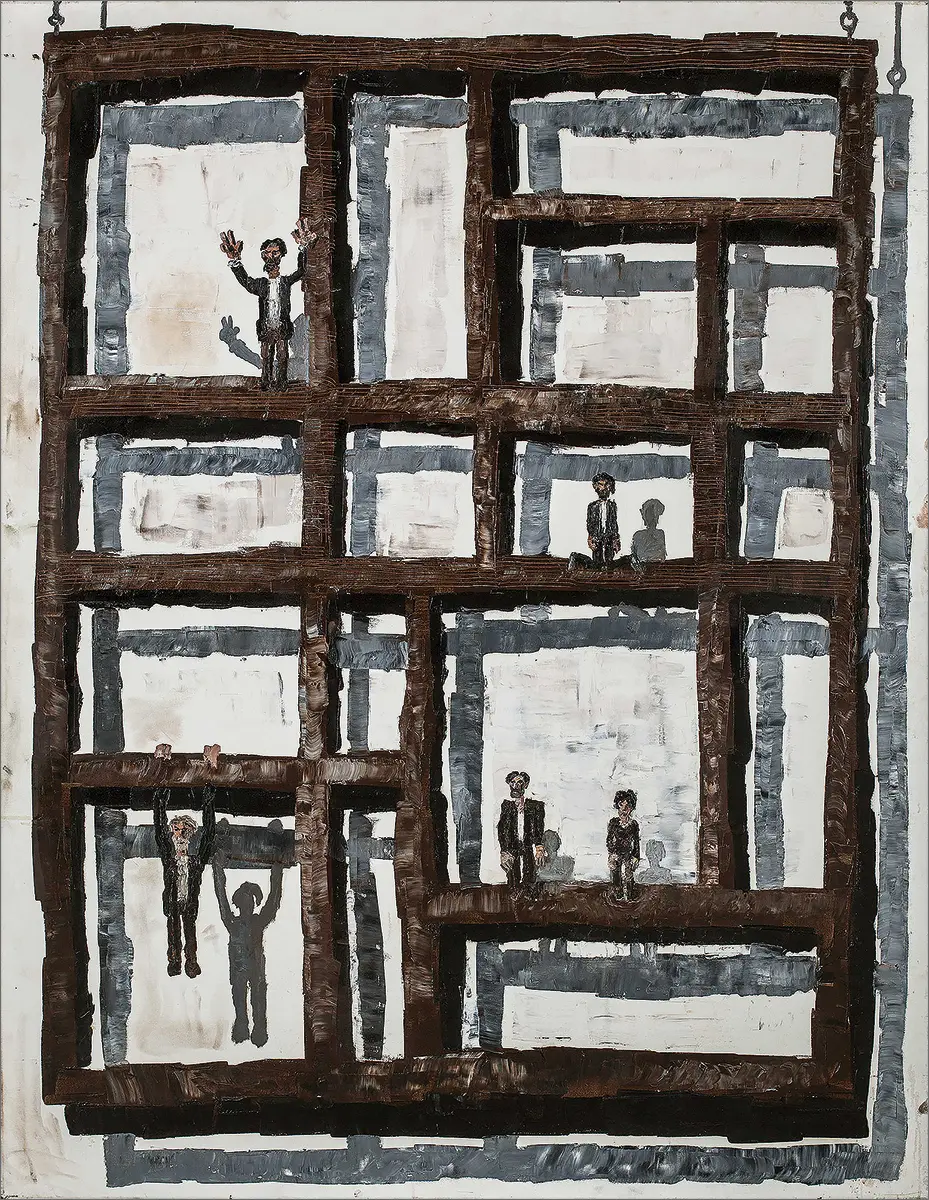
All the studio walls were covered with cardboard, one of Iturria’s favorite materials. In this manner, boundaries were established, the walls were protected from paint splatters, and it became possible to enjoy a warm and unexpected theatrical environment. While the exhibition relied on traditional walls, there were paintings created directly on the cardboard. Other works were hung, and the show also included reliefs and objects. Iturria is partial to all these expressions in which painting focuses on a two-dimensional gesture, or rather inhabits interactions with the environment, furniture, interventions; rescuing found elements, turning reality areas into projected games of shadows, like in the piece titled El ruso (The Russian). The experience lasted six months. During this time, the exhibition was attended by a large and diverse public. It is meaningful that not only the general public attended the exhibition at the Neuberger Museum but also the students and teachers of Purchase College. This defines the point in which A Studio in the Gallery: The Playful Universe of Ignacio Iturria also became part of the scenography class for theatre students. The process of seeing the painter arrive, get used to space, resume a project or initiate a new one, became a daily event for the public and the students. At the same time, some of these people who attended the show several times got to occasionally deal with works that they intimately knew because their process of creation unfolded before their eyes as Ignacio Iturria created them in the studio. This circle in time and space was an activity reaffirmed by the idea that being an artist has a lot to do with hard work and very little to do with fleeting moments of inspiration (as many people still believe).
Lines, strokes, and stains are a triumvirate that has marked Ignacio Iturria since an early age and that has accompanied him throughout the development of his highly recognized artistic maturity. From his native Uruguay to the Venice Biennale in 1995, Iturria has been the semi-figurative painting that has led to a very personal form of naïve expressionism. While continuously reaffirming with his work the relevance of painting as an artistic discipline, Ignacio Iturria has also created several installations that combine painting with other artistic manifestations.
More than painting themes—because Iturria reveals them with a multiplying, three-dimensional, and modular lens—the exhibition showed that he approaches every “issue” by impregnating the canvas, cardboard, or tables with visual and/or factual insights. It is appropriate to use the term trompe l’œil when describing what the Uruguayan artist confronted us with. Something that initially appeared to be a two-dimensional painting with a few lines rendered in black, upon closer inspection was revealed as black wire inserted in the cardboard to interact with other lines that had been painted. In this manner, Ignacio Iturria played with space, with light, and with shadows. Without forgetting the important role played by the Fundación Ignacio Iturria, in a conversation during the time of this show-residency, Iturria, who worked at night and arrived at the studio in the museum at 12:00 pm, said: “Just let me paint, I cannot take care of all the aspects of the exhibition.”
GRACIELA KARTOFEL