The aesthetic simplicity involved in the creation of a work of art can actually be very complex from a conceptual perspective, as demonstrated by Marcel Duchamp over a century ago. The works presented by Hisae Ikenaga (Mexico, 1977) definitely make a case for such simplicity, at least aesthetically speaking. But, are they also conceptually simple?
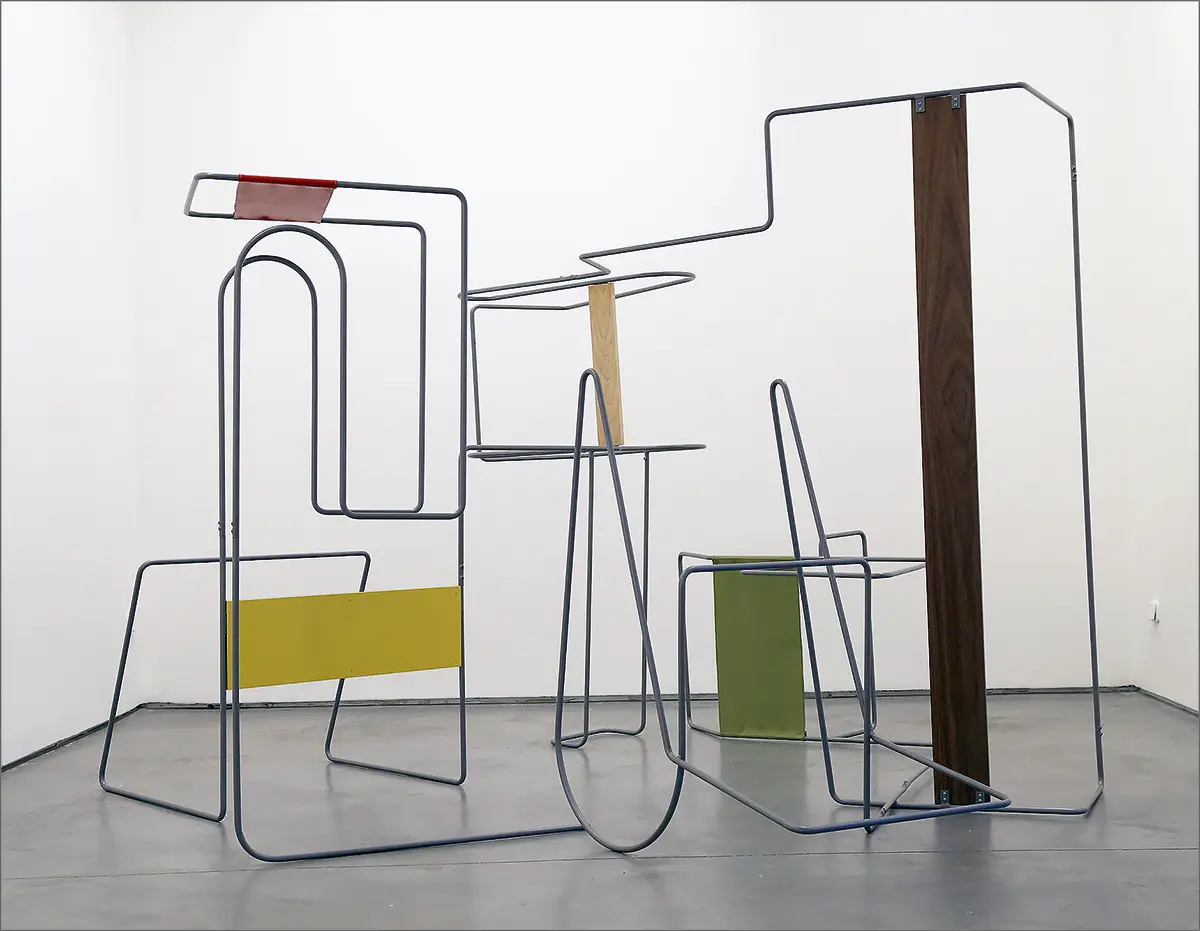
Subtle Oblivion consists of sculptures and installations that use common domestic furniture as a point of departure for conceptual and physical deconstruction. With chairs, tables, shelves, and the alteration and alliteration of their parts, Ikenaga forms free-standing and wall-mounted sculptures. This repurposing was inspired by the artist’s visit to a flea market. There, she bought a replica of the Wassily armchair for her home. The oddity of this tubular chair that began to appear, as if by magic, in many homes during the 1960s, led the artist to visit a chair factory in Guadalajara (Spain), in an attempt perhaps to understand the massive appeal of this elitist and vanguardist object originally designed by Marcel Breuer in the 1920s.
This boundary between the artistic object and the mass-produced functional piece of furniture is the communicating vessel that connects Breuer and Ikenaga. The Mexican artist takes on the persona of a Breuer who has fallen victim to a “subtle oblivion:” It is as if the creator of the chair no longer remembered how to connect the various elements that shape his chair, forming instead a useless material monstrosity. Rather than giving the resulting object a different type of usefulness, she confers it to one that reverts the weirdness of its existence. To reinforce this idea of a cozy piece of furniture whose usefulness has been forgotten, Ikenaga presents different unequivocally functional artifacts: an umbrella, a set of keys, or a cane rests on or accompanies the sculptures as reminders of their pragmatic failure.
Surrealist echoes of René Magritte and Salvador Dalí reverberate on the walls of the gallery. Another possible reading, less infused of surrealist skies and more earthly, is one that can be established through Ikea assembly manuals; a reference that, incidentally, I also witnessed in another exhibition at the same venue but by another artist: The 2017 exhibition titled The Ornament of the Masses by Javier Arce also proposed useless things, although in that instance the relentless jabs at Ikea were less merciful and more literal.
Ikenaga’s reconstructions refer us to constructivism because of the way she uses color and form—which connects this exhibition with another I also reviewed for this edition of the magazine: the exhibition by Andrea Canepa. Only that, while subversion, playfulness, and perversion abound in the case of the show at the Galería Rosa Santos, in Ikenaga’s exhibition we simply find “another version.”
In Elena Vozmediano’s review of Subtle Oblivion, the art critic warned that the exhibition would “feel a little cold to those who are not fans of geometry and constructivism.” She also pointed out that it likely had to do with the few works in the exhibition space. I would suggest that it is not about quantities but about the deliberate minimal content in the pieces. In the face of so many other artistic proposals based on similar guidelines, her works are guilty of what I have already mentioned: conceptual simplicity. In this “subtle oblivion” I forget all about oblivion and I am left only with the subtle. On earlier occasions, Ikenaga has accommodated those wishing to sit on a pile of possible interpretations (like in her resounding invasion of the Tabacalera space, or in Case Encendida, both in Madrid). But here, she played a joke on us by removing the chair just before we sit on it. And, perhaps, something this simple is no longer funny.
JUAN JOSÉ SANTOS