Memories of childhood, music heard casually on the radio, and Modernist decorative tiles were all part of the thematic mosaic in Fiz ele soletrar o seu nome (I Made Him Spell His Name), Dable’s exhibition at Anita Schwartz Gallery. Curated by Daniela Name, the show featured previously unseen recent works by an artist active in the national and international circuit.
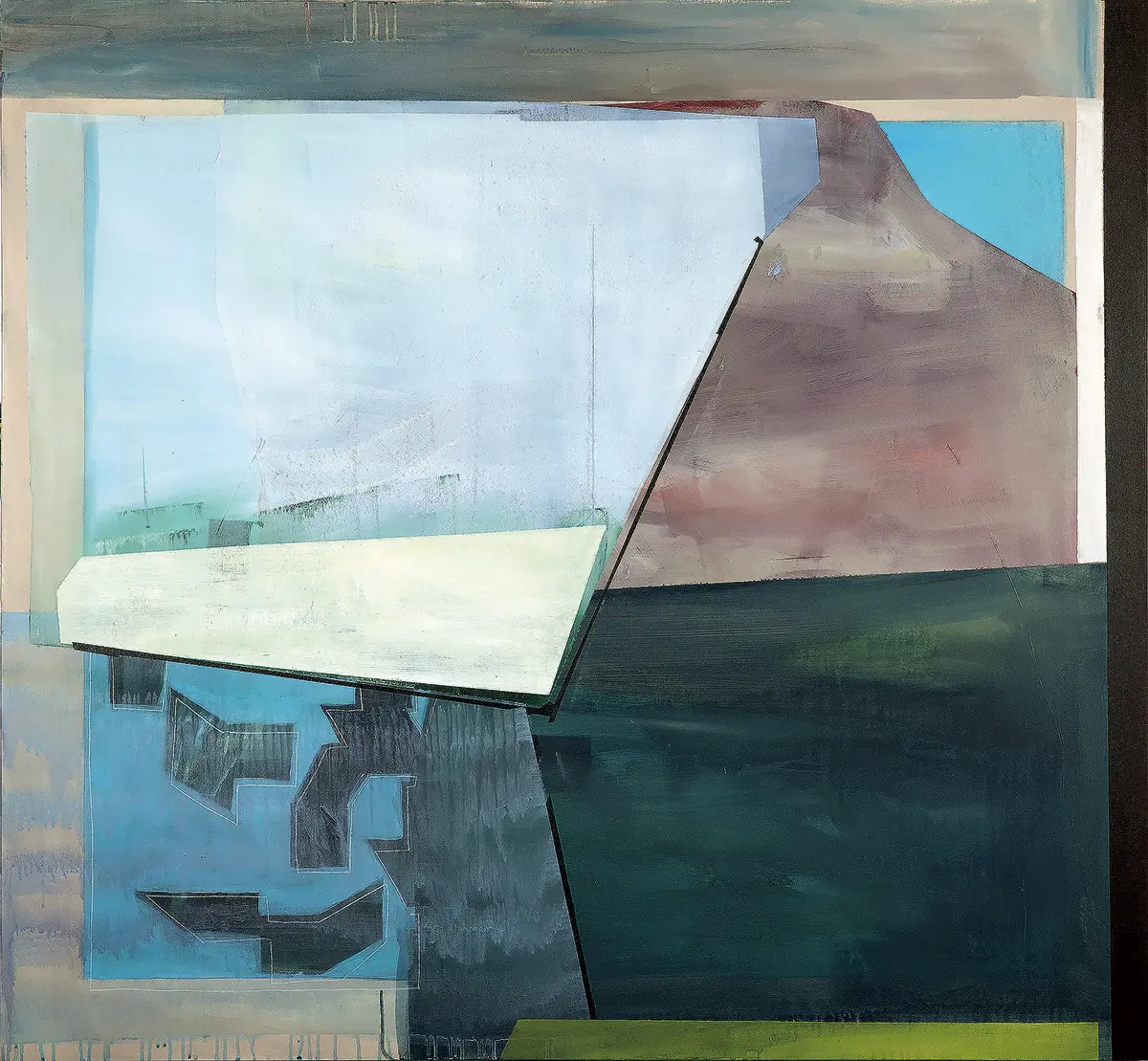
Twenty paintings in a variety of formats evinced the aesthetic power of Dable’s production. These are spatial situations in discreet colors, subdued tones, and monochrome effects that distill an idea of timelessness. Meanwhile, references to architectural elements, as well as perspective effects, evoke the real substratum of their images; these emanate a “landscape metaphysics” that is even more forcefully expressive in Dable’s large-format works.
The artist also created a site-specific intervention on the glass wall that partitions the upper-level space from the gallery’s exterior area, which exhibited, in a container, the video O rádio sempre estava ligado na cozinha (ou) the hammer of the gods (The Radio was Always Plugged In In The Kitchen (or) The Hammer of the Gods), the centerpiece of the exhibition of the same title presented in 2016 at Belmacz Gallery in London. That same year, Dable participated in Em Polvorosa: um panorama das Coleções MAM Rio (A Flurry: A Panoramic of The MAM Rio Collections), a group show at the Rio de Janeiro Museu de Arte Moderna, curated by Fernando Cocchiarale and Fernanda Lopes.
Dable’s style can be understood in connection to Latin America’s constructivist language, from its purist origins to its most flexible unfoldings. The artist seems to incorporate this entire historical range, bringing in, from a formal point of view, figures, symbols, and blotches whose imprecisions are naturally allied with a more rigorously geometric repertoire, thus bringing to the fore the paradox that characterizes constructivism in the tropics.
To this selection Dable adds his personal repertoire, extending an interestingly idiosyncratic point of view over Brazil’s history and the social issues that are represented by the country’s national aesthetics. As curator Daniela Name observes, “Dable’s been building his career on the basis of combining the languages of painting and drawing with hybrid works that are heavily influenced by music and eventually permeated by everyday objects”.
Name explained that, in his site-specific intervention at the gallery, Dable connected childhood memories with the very popular vibrant designs of the tiles that decorated bathrooms and kitchens throughout Brazil in the 1970s, combining those images with his transformation of tropical vegetation into blinds and stained glass work for the exhibition space.
Dable remarked that those tiles are deeply connected to the radio to which video exhibited inside a container refers. “There are tiles that, in a way, belong squarely within the Brazilian Modernist project, with Athos Bulcão. In the subtropical area where I grew up, such tiles were practically nonexistent: the Modernist aesthetic lived in the loud colors and the 1970s geometry of the kitchen tiles, which echoed the sounds of popular radio and “sweated hot soup vapor,” as a Rômulo Fróes song has it.”
The curator highlighted the “interesting way in which the artist bridges a personal, subjective archive to a kind of seismograph of the country’s current moment”. She writes, “There is a Brazil that is systematically brushed aside by the elites yet nevertheless infiltrates and comes to dominate not only these works, but also, through them, Dable’s entire history as an artist. The radio played by household workers, the sounds of Odair and Roberto Carlos coming from the service areas and mixing with an explosion of folk colors that is so characteristically Brazilian yet not always comfortable for the self-appointed ‘national intelligentsia’. That smothered country boils like the teapot featured in the exhibition. The seemingly random noises we hear indicate that the social and symbolic cauldron can spill over at any point.”
A co-founder of Atelier Subterrânea, an independent space in Porto Alegre, between 2006 and 2015 Dable taught Visual Poetics at the Universidade Federal do Rio Grande do Sul (UFRGS), and in recent years has gained renown in the art scene with his presence in group shows like Secret Gardens at the NARS Foundation in New York City and others at Belmacz Gallery and Gallery Nosco, in London. In 2015 he was a fellow at the Vermont Studio Center and won the acquisition prize at the Luiz Sacilotto Contemporary Art Salon in Santo André. In 2011, Dable was one of two artists selected by Itaú Cultural’s Rumos Artes Visuais program, and in 2013 he was shortlisted for the Marcantonio Vilaça/FUNARTE Award. In 2007 he was named a noted artist by the Iberé Camargo fellowship.
Throughout his career, Dable has presented works that engage mainly the languages of painting and drawing, with a special interest in the representation of natural landscape and modern architecture, the possibilities of which he investigates by means of found references or through his own direct connection to a specific place. These are works where a limited range of colors, interplays of precise contrasts, and geometric perspective interventions interact to reveal, underneath the appearance of abstraction, almost real scenes, fully formed memories of a landscape whose ultimate meaning harks back to a nostalgia for painting and for figures in the work of art.
ALESSANDRA SIMÕES