The retrospective of Gonzalo Fonseca at the Noguchi Museum is revelatory for numerous reasons. One has to do with its contemporaneity underscored in the exhibition’s most recent sculpture titled Self-Portrait (1996) created some 22 years ago. Fonseca’s art has aged well and is imbued with the historical assertion that could be attributed to his erudition and artistic demeanor that is visionary, impassioned, and totally committed. Born in Montevideo in 1922 and trained as an architect, Fonseca’s prolific output in painting, drawing, and ceramics commenced in the mid-1940s as a member of Joaquin Torres-García’s Workshop. But it was his stone sculpture initially influenced by Constructivism that he transformed into something uniquely his own that situates Fonseca as an important artist of the twentieth century.
Constructivism’s genesis resides with Vladimir Tatlin but codified in 1920 when Russian artists sought to liberate Constructivism from its metaphysical leanings exemplified in Wassily Kandinsky’s expulsion from their collective. In the ensuing development of pure abstraction there developed two trajectories that were philosophically incompatible: idealist, non-objective art such as Piet Mondrian and Neo-Plasticism that drew from Theosophy and antecedents including Kandinsky and Kazimir Malevich and Suprematism, and the materialist, critical Constructivism espoused by revolutionary Soviet artists that were becoming international in its varied developments outside of Russia. Once it crossed the Atlantic to Uruguay and mediated by Torres-García, it was recast anew as Universal Constructivism.
As members of Torres-García’s Workshop, Fonseca and his Uruguayan colleagues expanded Constructivism’s purview vis-à-vis their engagement with pre-Hispanic art. The difference between them and their international contemporaries was that the former were cognizant of the context of the indigenous sources they were deploying, unlike their European and North American counterparts who stripped “non-Western” art of any semblance of its meaning. After Torres-García’s death and the end of his historically important Workshop, Fonseca set out on a kind of artistic pilgrimage throughout South America and onto Old World archaeological sites expanding and building upon the formal and conceptual innovations he absorbed in Montevideo. In the interim between his peregrinations and arrival in New York City in 1958, Fonseca devised an altogether new sculptural aesthetic differentiating him from the Workshop and his European and North American contemporaries. In New York City Fonseca was never beholden to the city’s artistic trends, and his research led him to an encyclopedic approach to sculpture via the myriad sources he reconfigured into it. One sculpture in the retrospective titled Stele (Carved stone, 1962), for example, drew from many cultures and histories: for the Maya, a stele was an upright sculpture that commemorated elites; in Old World contexts, stelae served as grave markers, foundations for the erection of laws that were often carved onto them, and as designations for boundaries. What Fonseca offered in Stele was possibly an aspect of all its previous incarnations in which any essence shared was sculpted down to something totemic and archetypal.
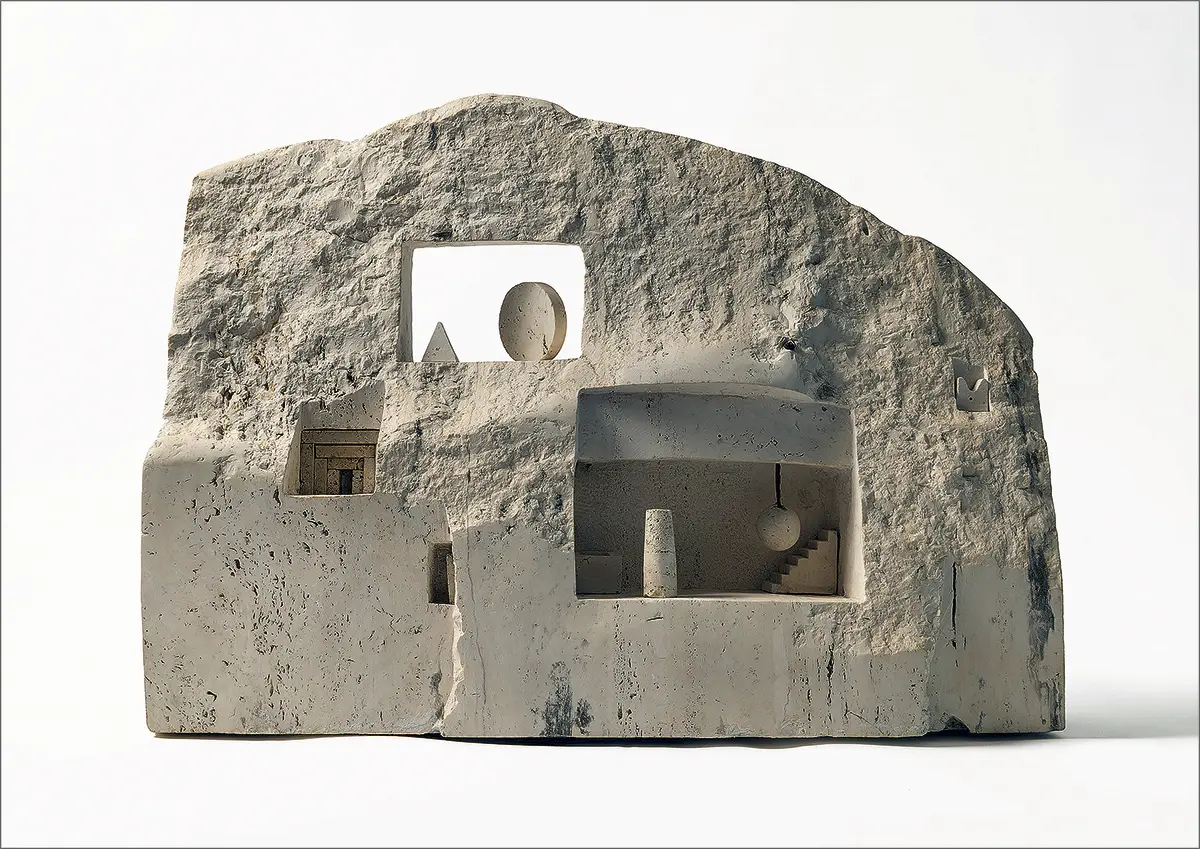
There are other works in the exhibition such as Ludovosi (1975), and Haute Lieu VI (1989-90) that dovetail on ancient cultural signifiers filtered through Fonseca’s unique artistic vision. Both works are horizontal in structure and sparse yet volumetric and dense but not anything that could be confused with textbook Constructivism. A dominant feature of Fonseca’s sculpture is its internal, formal logic in which space is a dichotomy of a material’s concomitant presence and absence. Cuts into stone, for example, are an index of the artist’s hand as they are positive and negative features of the sculpture’s composition akin to both mark-making on canvas and the negative space on which those marks are made. Germane to both sculptures is a phenomenological Constructivism that is literal on the one hand and linked to its Russian originators, and on the other, rife with a metaphor that triggers in the viewer a myriad of cultural and historical associations that could ostensibly evoke the spiritual. The works in the exhibition, however, convey so many ideas with an economy of means that they reveal the modus operandi of an artist who thinks with his hands, eyes, and, of course, an unfathomable intellect.
Fonseca’s sculpture is imbued with a literary sensibility and a sense of world history that teeters between non-fiction and mythology and made manifest with a conscious and subconscious will to art. Travertine, limestone, marble, and brownstone all in various hues and occasionally cement and wood are what constitute Fonseca’s sculptures that articulate a poetics of form and content. Sculptural configurations are seemingly protean in their visual intricacies and textural permutations. His aesthetics is a dialectic of positive/negative space, solidity/plasticity, verticality/horizontality, geometric/biomorphic, micro/macro, and levity/gravity. Some works are primarily oriented upright and allude to columns, towers, pillars, monoliths, grave markers, and monuments, yet are also punctuated with elements that offset their verticality. Others are horizontal and appear more like tableaux, amphitheaters, or settlements for primeval or futuristic inhabitants. And others still appear like Haute or bas-relief whose imagery oscillates to and fro from representational motifs to abstracted configurations of some other-worldly mise-en-scène.
Apart from reminding us of the importance of an artist who seemed to play by his own rules, the thoughtfully curated retrospective solidifies Gonzalo Fonseca as a rare and consummate artist, who produced a body of work that is astonishingly diverse in its singularity of media and material inventiveness.
RAÚL ZAMUDIO