It is difficult today to find an artist who is defined as part of a particular art movement. There are, of course, groupings. “Aesthetic of extreme economy,” “archaisms,” and “minimal objects” are some of the more frequent terms used when attempting to define the work of Brazilian artist Fernanda Gomes (Rio de Janeiro, 1960). And, yes, the critics have labeled her work with terms like abstraction, minimalism, povera, or neo-concrete. Gomes herself is used to shake the ties of classifications loose.
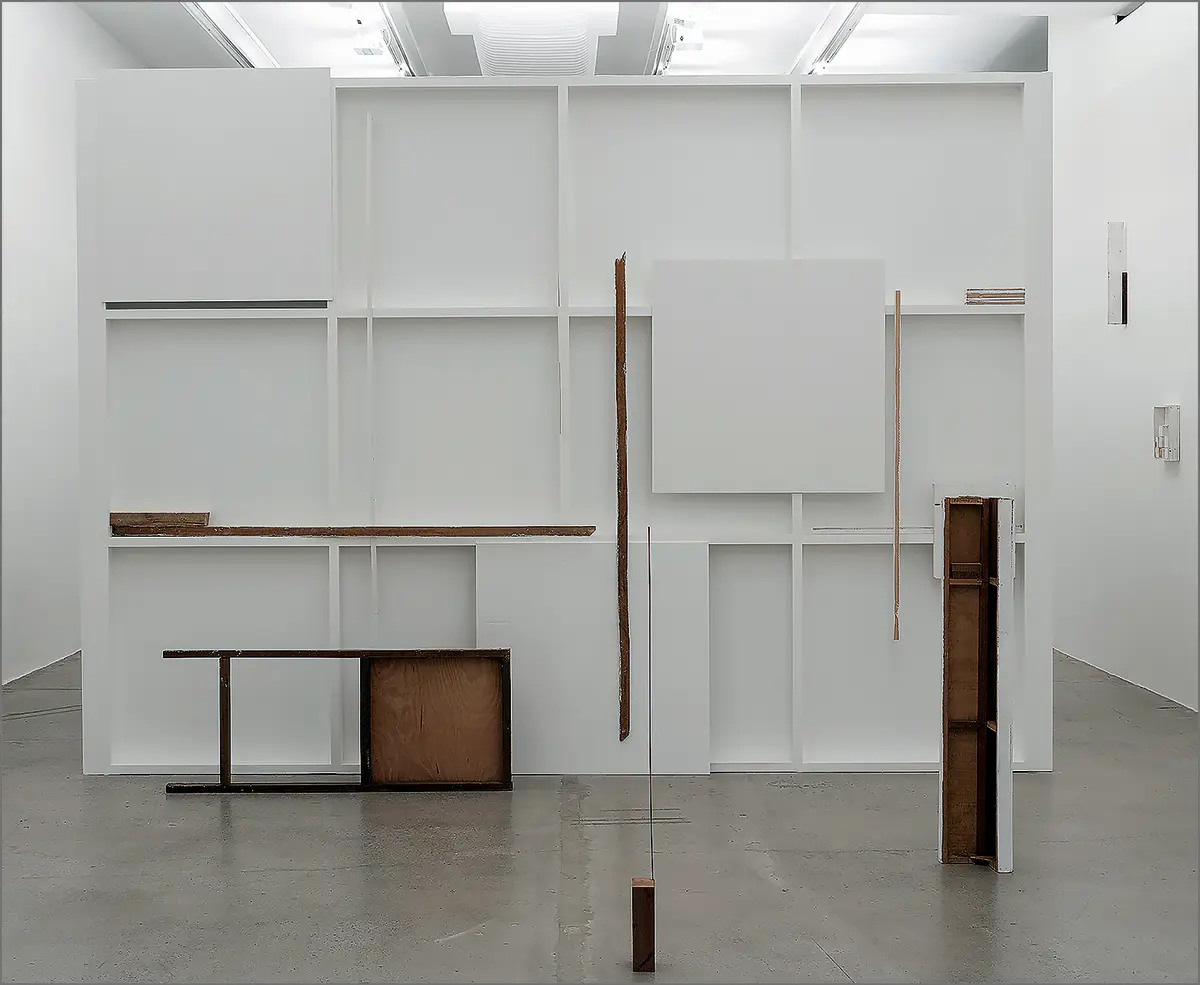
French art critic Nicolas Bourriaud described the art of the 1990s generation as disengaged from the great revolutions and, consequently, its artistic explorations find refuge in that which he calls relational micro-territories. Gomes incorporates these coexisting relationships in every single one of her installations. Everything visible converges for the ephemeral instant of seeing. Materials like wood, wire, nuclei isolated from the general space through the translucency of fabrics, walls showing their reticulated frames, cornices, objects, in short, all share the neutral effect of the color white and an unwillingness to being categorized as painting, sculpture, or architecture; instead, they belong to the spatial domain and its possible interferences. All these presences—I will call them that—were extracted either from elimination processes that had discarded them or from the act of collecting. Found, handmade, rescued from storage areas in the gallery that they occupy; painted or unpainted, they have emerged, from incubation in Gomes’s notes or from the studio space, to be incorporated into the locus of the exhibition. As presences, they place viewers before dilemmas like whether to use or disregard certain norms or before notions of, for instance, specific spaces or Walter Benjamin’s concept about the aura of the work. This micro-territory created by Gomes is drawn not from issues regarding the boundaries of art but rather, like it occurred in the art from the 1960s and 1970s, from a dialog with the here and now. “When the exhibition is ready—explains Gomes—everything is configured in such a precise manner that it becomes impossible to modify it. It is a dynamic in which things find their place and their relationships.”
For this exhibition, Gomes has conceived a meticulous project of expography. Dividing walls were specially erected to demarcate groups of two or more pieces that she calls “flexible groups of autonomous works.” The lighting, for the most part, applied with extreme precision, was specially designed to avoid any possible shadows created by the objects. In this sense, the work by the gallery entrance stands out for being the only piece “contaminated” by the large windows of the gallery’s façade, establishing a before and after of that conditioned and spasmodic space, we immediately enter.
Another meaningful piece in the exhibition is Sem Título (Light Specific Ensamble) [Untitled (Light Specific Assembly)]—ink, wood, nails, fabric, seven elements, and living room, measuring 300 x 400 x 400 cm. This sort of cubicle, whose typology appears for the first time in her work presented at the 30th São Paulo Biennial, in 2012, deserves special attention. Fernanda Gomes has mentioned her fascination with light-based architecture, like the painting studios with large upper windows or those old galleries where perfectly diffused lighting filters through white fabrics. It is precisely in this manner that Gomes has conceived this work, with four walls and a canvas cover. Once inside, it is impossible not to be reminded of the penetrable by the greatest representative of Brazilian neo-concrete art: Hélio Oiticica (1937.1980). The penetrable series from the 1960s and 1970s proposed then an unprecedented departure in the way viewers and art interact, an immersive experience of color, or the experience of swallowing, listening, or seeing. In this instance, it is the ideal clarity produced by the canvas that leads to the encounter with viewers. But unlike Oiticica, Gomes’s process is eminently retinal. Nonetheless, the minimal structures that were suspended or hung there appear to acquire qualities that they did not possess before or outside of this space.
All in all, the result of an exhibition like this one ends up being somehow porous and slippery at the same time. Mounting and unmounting the works to complete cycle evidence their ability to adapt to diverse scenarios, which is perhaps the most admired quality of Gomes’s work. The relationship with the persona of the gallerist also plays a very important role here. Several are the terms through which such a relationship is evidenced. First, because Fernanda Gomes’s process involves transferring her atelier to the gallery for one month. Then, because in the contract between the two parties, some works survive the exhibition while others disappear when it ends. Those that survive are necessarily accompanied by assembly instructions, as they must have a life of their own, but without breaking with the idea that they originally owe their life to Gomes.
As far as words, and their possible arrangements, is concerned, Fernanda Gomes appears to exclude them altogether from her process. The works are invariably untitled in an effort to prevent them from being classified. However, in 2003 she participated in the Venice Biennale with a proposal titled The Structure of Survival, curated by Carlos Basualdo, which had at its epicenter the inventiveness of an extreme situation contextualized by the chaos of economic tension between the periphery and the center. Since then, the etic and adoption of a precarious art has been a constant element that has defined her work on the international stage.
Throughout this process, no less prestigious have been her most recent inclusions in exhibitions like A History. Art, Architecture, and Design from the 1980s Until Today (Centre Georges Pompidou, Paris, 2014), or in the book Vitamin P3: New Perspectives in Painting (Phaidon, London, 2016); undeniable formulas to validate an artist in the ever-shifting map of contemporary art.
XENIA BERGMAN