Eduardo Romo is among those conceptual artists who can be seen as sculptors, even as he treads on the exterior and interior spaces of architecture. Romo disables representative forms in order to give meaning to each series in diverse materials (some constructive, others natural); he also works in drawing, digital photography, installation, and a number of traditional media, which he undoubtedly alters. Romo’s works are contradictory, his titles are deconstructive. They encompass a diverse range of aspects and dimensions and move away from aestheticism as such. With his series Obra Negra (Black Work), Romo received a fellowship from the National Art Creators System, SNCA-FONCA 2015-2017. That series expanded and became more diverse as it focused on construction surveying as well as on processes of remodeling and finishing. Within the framework of Obra Negra, Romo creates drop ceilings, foundations, assemblages, debris, and more.
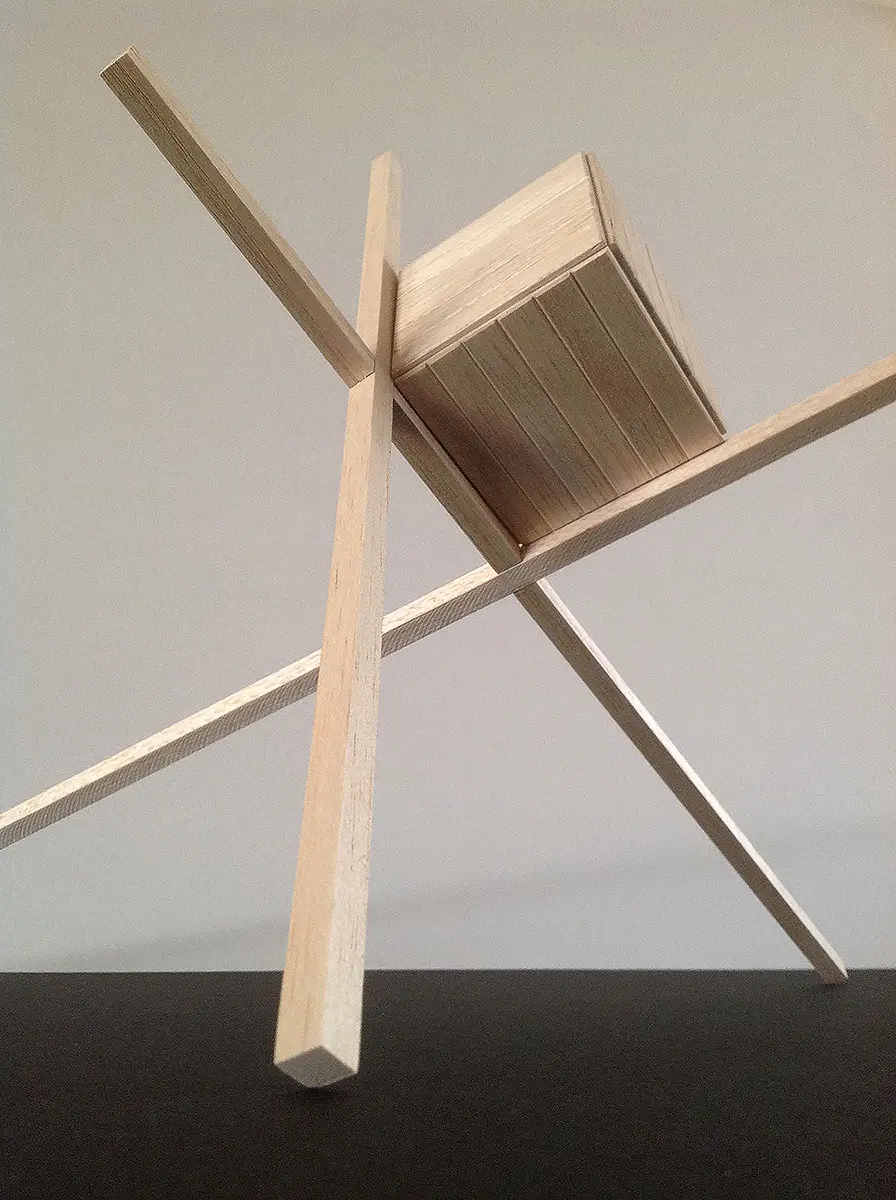
Romo works mostly with wood, but not exclusively nor with the same characteristics. When he makes a relief, he is able to do it constructively, via the superposition of parts, rather than by smoothing the material down. The cuts in Encofrados (Planked) are visualized as though we were listening to sawing in a woodshop. At the same time, Romo articulates shapes to a human scale or larger. His work was on exhibit within a few months in two separate Mexico City shows, at Museo Trotsky and 90° Fast Gallery, Encofrados encompasses the characteristics we have mentioned so far and is not devoid of a spark of Chaplinesque wit. The exhibition at the gallery included drawings that Romo presented in 2017 in Italy. In terms of materials, Eduardo Romo works with paper, cardboard, rock, concrete, wood, and has later moved on to clay tiles, partition walls, assemblages of various plaques, screws, steel cables, bolts, and other elements of construction work, left in plain view and used as vectors for shapes. Occasionally he wrapped structures on paper, but most often nothing is hidden away. It is as though we were in an architecture studio, with samples of building materials lying around, like examples of corner shapes or structures between planks.
At Museo Trotsky, only two structures demarcated the space, highlighting the reference to empty? allusive? for transport? Containers. At 90° Fast Gallery, in the second room, a small-format work—its cubicity is approximately 12 cm on each side—points to the instability that inhabits the world and the asymmetry that is reflected in coeval architectures. In the first room, a tall, thin structure, definitely a castle construction, a constructive column in plain view, functioned as a central axis for space, at almost two meters in height. In two of the walls, Romo’s drawings represented metaphorical black-on-white commas. Eduardo Romo has been a working artist for thirty years. His series vary in terms of their materials and creative processes. With regards to the latter, Romo identifies basically three: to observe, to understand, and to respond (create). “For me, everything starts with form and comes down to a reinterpretation of form,” he adds. In that sense, he declares his admiration for Joseph Kosuth, the US artist who insisted on art as the production of meaning, not of shapes and colors. Although Romo does not use letters and words in the manner of Kosuth, he conceptualizes in this production of meaning and reinterprets form on the basis of its aspects constructive of interior and exterior spaces. In Romo’s exhibitions, viewers are invited to participate in unusual experiences that are sensible in the way in which they bring perception closer and concentrated on referring materiality. One must understand that his processes include disciplined research, photographs, and drawings. Whites, blacks, natural woods, industrial metals in nuts and bolts, all exude spatial references. Against the grain of usual exhibition practice, Eduardo Romo presents his audiences with some aesthetic irreverence. This is not an indicator of precariousness; on the contrary, it contributes a delicate sturdiness and even some instances of remarkable solidity. Romo’s works can bring together questions about the spaces of human experience. Above all, what this artist’s exhibition prize is the hollowness of traditional sculpture in comparison with his own archi-sculpture, bringing forth elements of interior and exterior vacuum. Works that are formulated as orthogonal systems alternate with others in asymmetrical compositions and fragile placement. In the same way, objects that lean or half-lean on the floor, or that are suspended (like a ceiling or a recessed fixture) interfere conceptually with one another, and Romo’s installations here reach their highest expressive heights.
GRACIELA KARTOFEL