The widespread and growing recognition achieved by the work of Eduardo Basualdo (Buenos Aires, 1977) is based on his evident talent, on a philosophy that is as solid as it is interesting, and in the way in which his art brings together different disciplines. Basualdo’s art orbits around the fiction of rules and boundaries, questioning the reality principle and the concept of the limit. For Basualdo, in a symbolic sense, the body is a limit. But the head’s boundary is much wider. Starting from this premise, he continues to experiment with structures of thought and also of architecture, inhabiting contradiction and more. His flourishing effort is a sustained interrogation of life itself. Last year, Buenos Aire's audiences were fascinated by two magnificent installations and intrigued visitors to the Art Basel Miami Beach fair with two sculptural objects that are difficult to define.
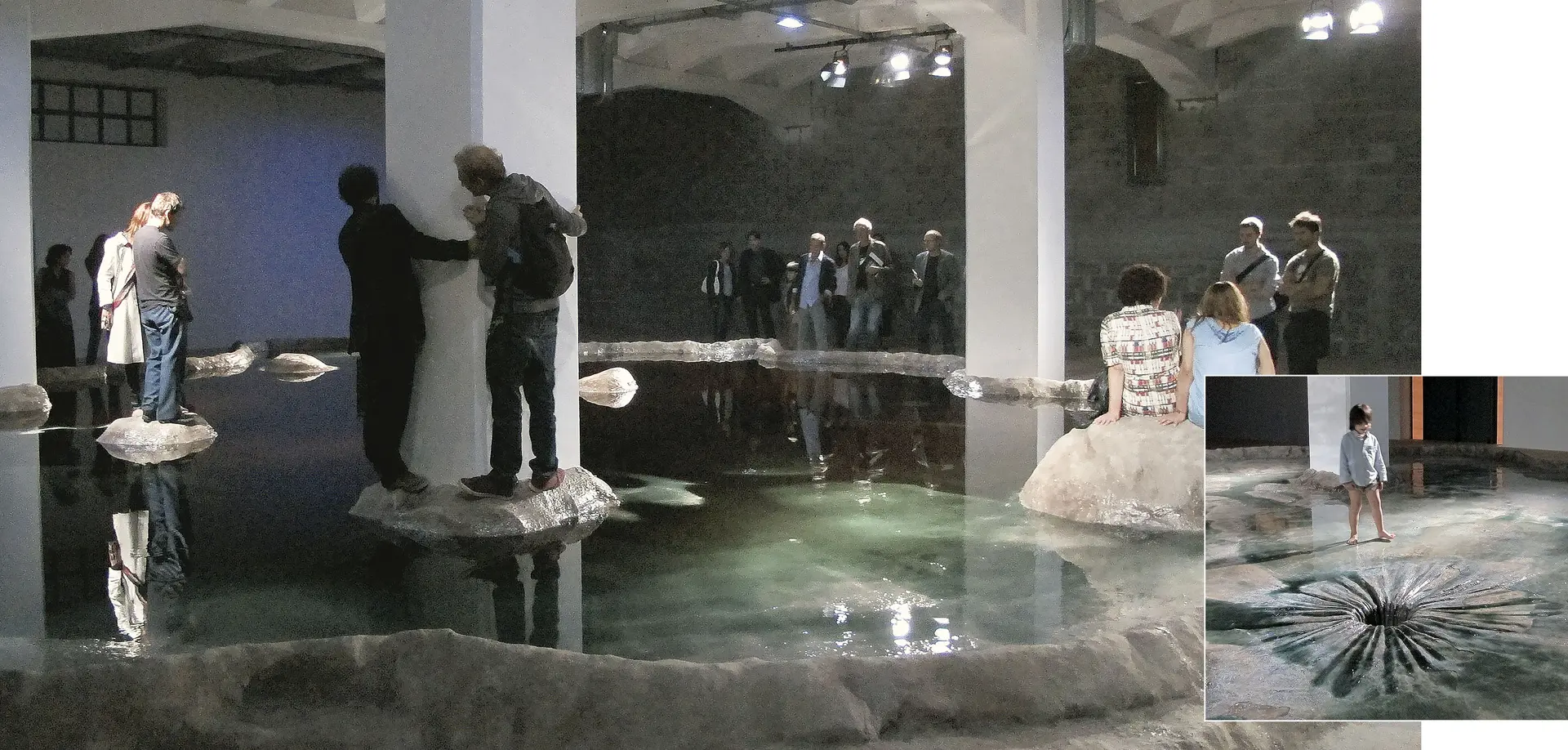
For example, Basualdo’s marvelous installation El silencio de las sirenas (The Silence of the Sirens) was featured in the exhibition El museo de los mundos imaginarios (The Museum of Imaginary Worlds, at Centro Cultural Recoleta (2017). Presented for the first time at the Lyon Biennial in 2011 and at the Museo de Arte Contemporáneo (MAR) in Mar del Plata, the work is comprised of a site that resembles a lagoon with several protruding rocks that visitors can climb. In a cyclical and alternating way, the water recedes and forms a whirlpool, only to return unnoticed and mysteriously to fill its dry bed. This hypnotic work of art makes a reference to Franz Kafka’s story of the same title. Like Homer’s Ulysses, who in his return home plugged his ears with wax in order not to hear the magical song of the beautiful Sirens who would lead him astray, the simple solution for members of the audience in order to avoid getting splashed is to climb the rocks; but there is more.
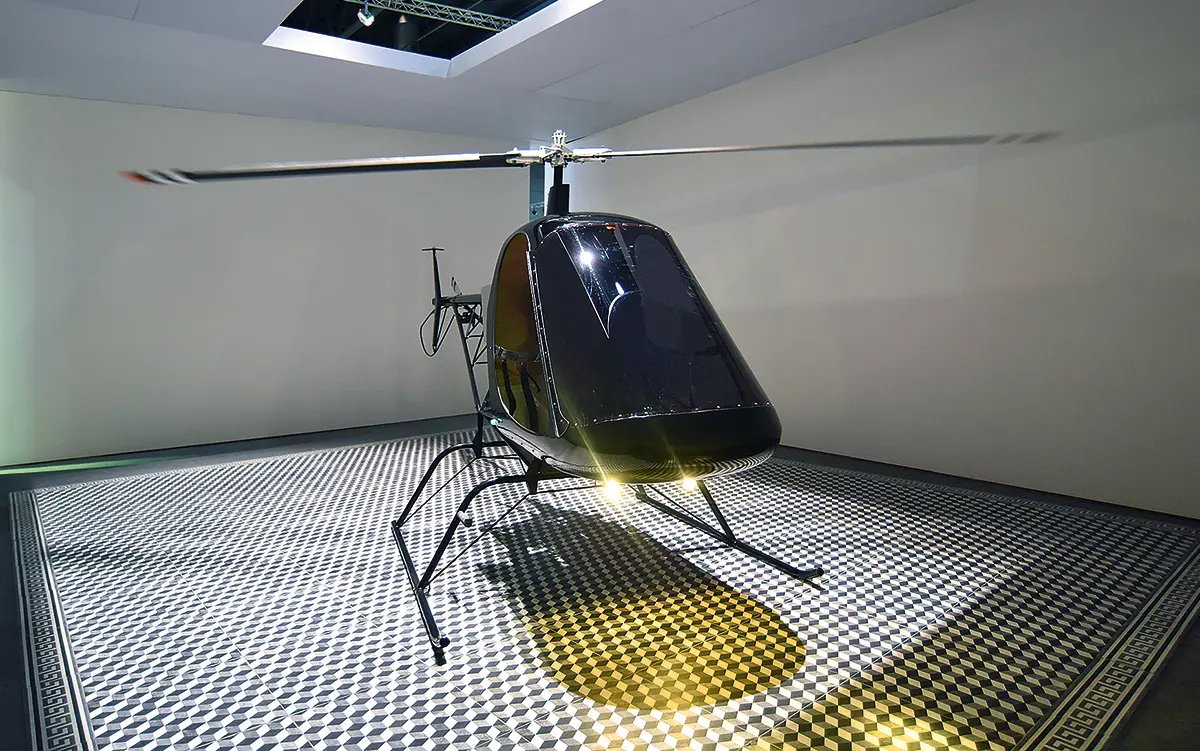
Also in Buenos Aires, the spectacular Freelancer was one of the most interesting and talked-about works on exhibit at the arteBA fair, where the young but already established artist intervened at Espacio Chandon, the entryway to the Chandon Youth Neighborhood section of the fair. Basualdo enacted a fantasy of escape, of flight, perhaps, from everyday routines, from conflictive personal or social situations. He set up a life-sized helicopter, its rotor in permanent motion, inside a room with only a small entryway fitting just one person at a time and an opening in the ceiling. The outsized machine—which rested on a tile floor in the chessboard design that is typical of older homes in the city (in reference to the home where Basualdo began his career)—was destined to transgress the space; had it risen in flight, it would have destroyed the ceiling. The helicopter did not take off and the exhibition space’s structure was not destroyed, but the thought did not escape its viewers, intervening into their existential fears and their desire for freedom. Already from its very title, Freelancer alluded to independence, to freedom but also to the precariousness of work in general and of many artists in particular, who, in Basualdo’s words, “put together a career in the air.” And what about Chandon? The bubbles struggle against the sealed bottle, like the helicopter that wants to rise above the urban grid.
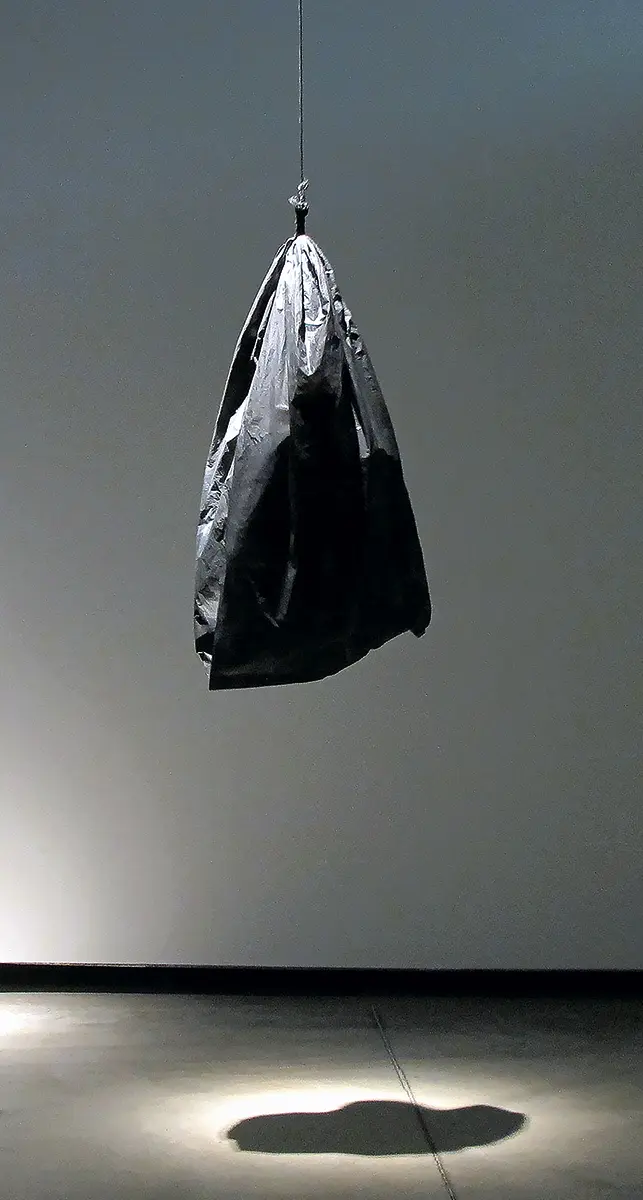
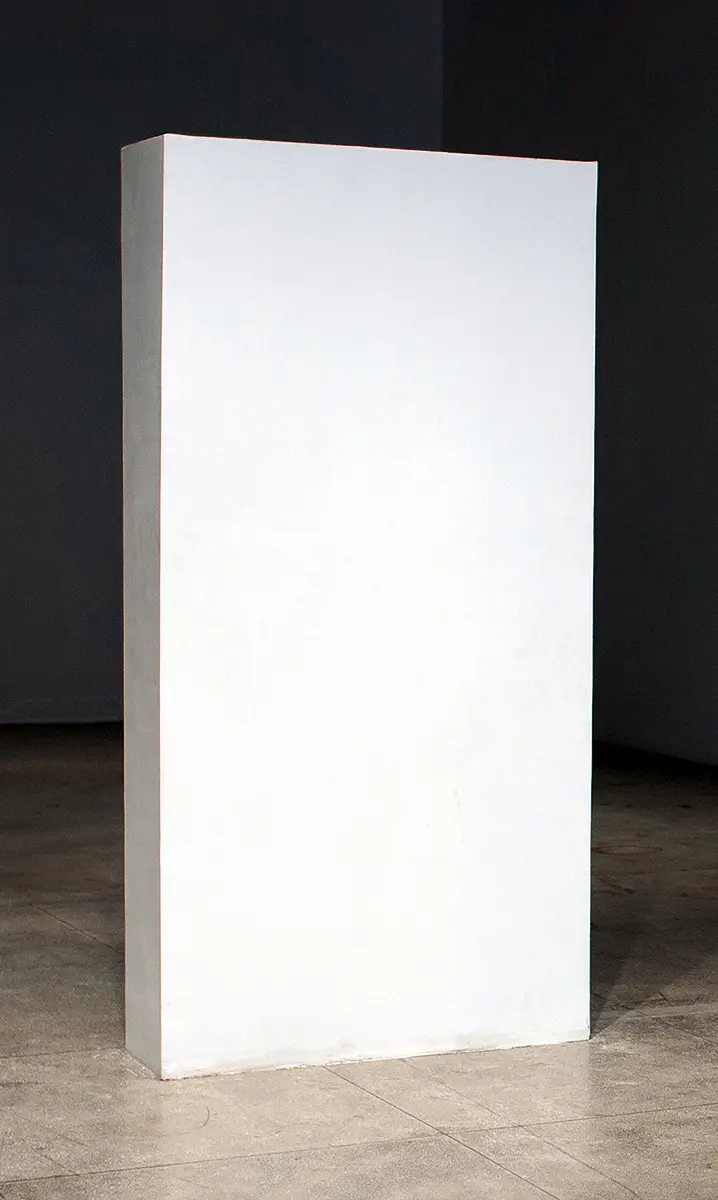
A constant tapping called visitors to the Ruth Benzacar Gallery stand—organized almost as three separate shows by Basualdo, Liliana Porter, and Jorge Macchi-Nicolás Fernández Sanz—at Art Basel Miami Beach 2017. The tapping came from a kind of double white wall, two meters tall. Was someone trapped inside its narrow, 20-cm hollow? This work, Siesta (Nap), provoked a degree of fear, along with the desire to explore its mysteries. What was the sound coming from the seemingly empty interstice? What was causing it? Innombrable (Unnameable), presented at the Proa Foundation (2012) posed a similar mystery, although that black plastic garbage bag in unexplained motion generated even greater anxiety in the viewer. What is hidden inside and why does it move like that? Why is it surrounded by rocks? Is it a live animal or a hobgoblin?
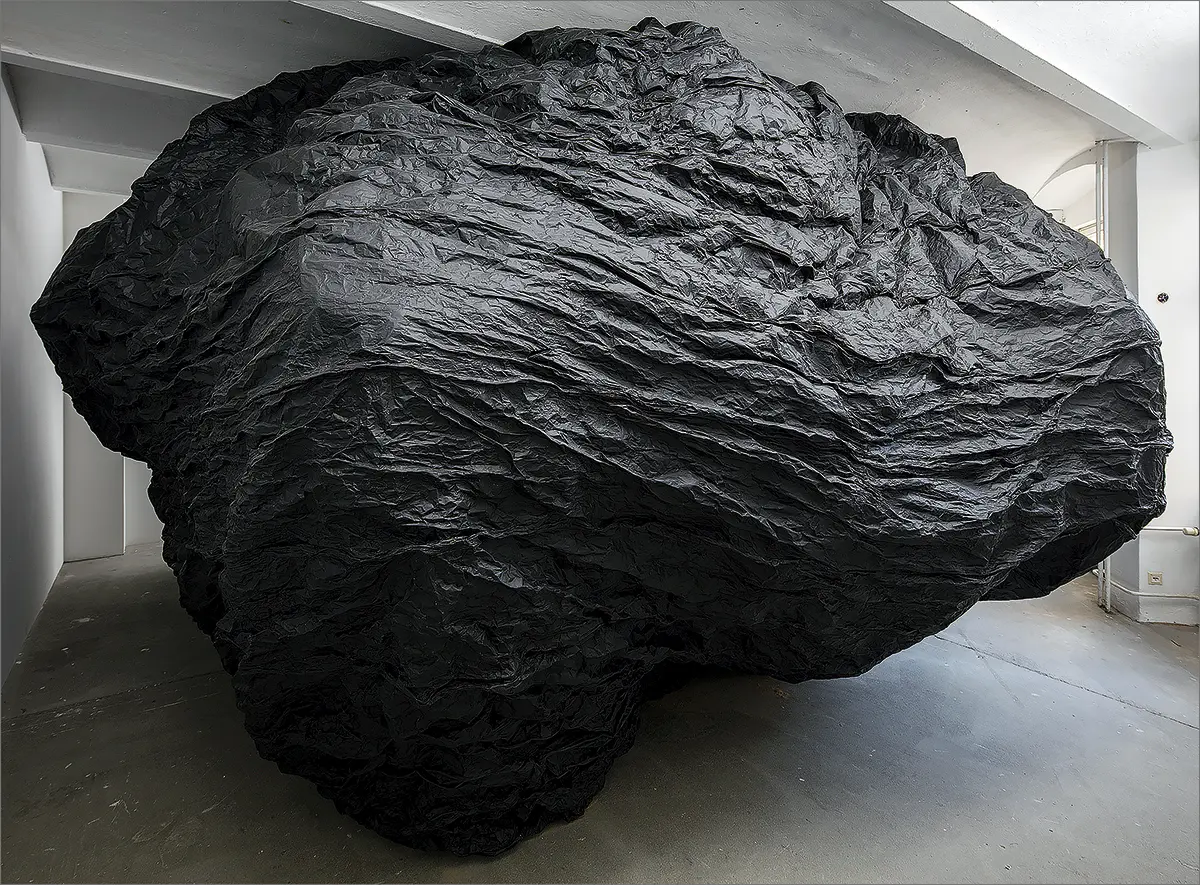
A black volume, Floresta (Glade), similarly hanging from the ceiling, accompanied the haunting white wall at the most recent edition of Basel. Although smaller, Floresta has one element in common with Teoría (La cabeza de Goliath) [Theory (Goliath’s Head)], the appearance of a large and very heavy black rock (6 x 4 m) that hung from a rope from the ceiling of the Palais de Tokyo (2014); made from aluminum, it was exhibited as part of the residential program SAM Art Projects (a private French foundation devoted to the development and circulation of contemporary art). Does Teoría (La cabeza de Goliath) hark back to Newton’s ideas about gravity? To Einstein’s? Is it an allusion to Argentine writer Ezequiel Martínez Estrada’s essay of the same title, which describes the city of Buenos Aires as gigantic, foreshadowing its nadir? Or is it to Caravaggio’s David With the Head of Goliath? Is what it exposes the fragility of the visitor?
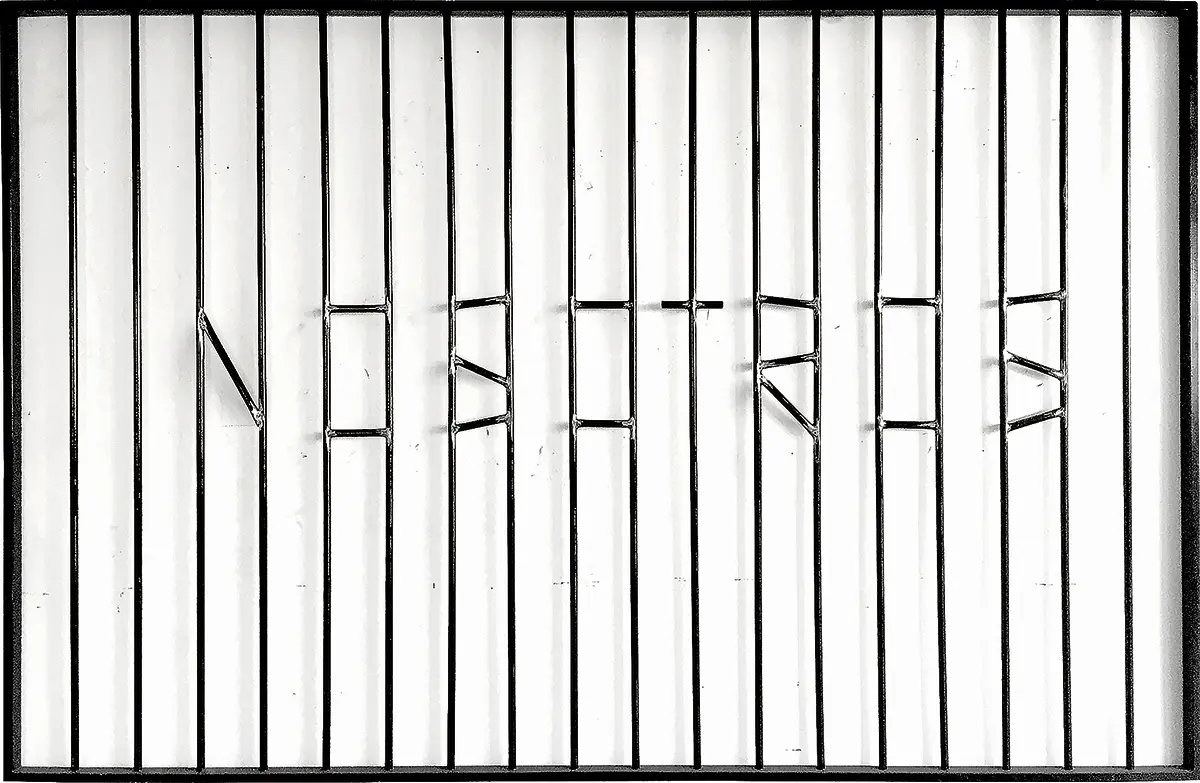
Often, Basualdo’s large-format works are very complex productions made using a range of materials that include engines, software, drywall and paint, iron fences, and even glass and LEDs. His smaller works also escape simplification, even those of seeming material simplicity—those where small gestures on paper, threads on glass, a swaying lamp, metal bars that set a boundary, or the cage that presumably encloses space also demand a commitment by the eye that sees them. Basualdo’s works with fences, for example—be it penetrable structures or smaller formats—refer, again to the matter of boundaries. Basualdo works with fences because he deems the way in which this mode of boundary-setting particularly strange, including the way in which this naturalization is almost invisible both in homes and in public spaces, no longer only in incarceration establishments. Devoid of definitive demarcations, more than once the bars of his cages open as if by magic as viewers approach.
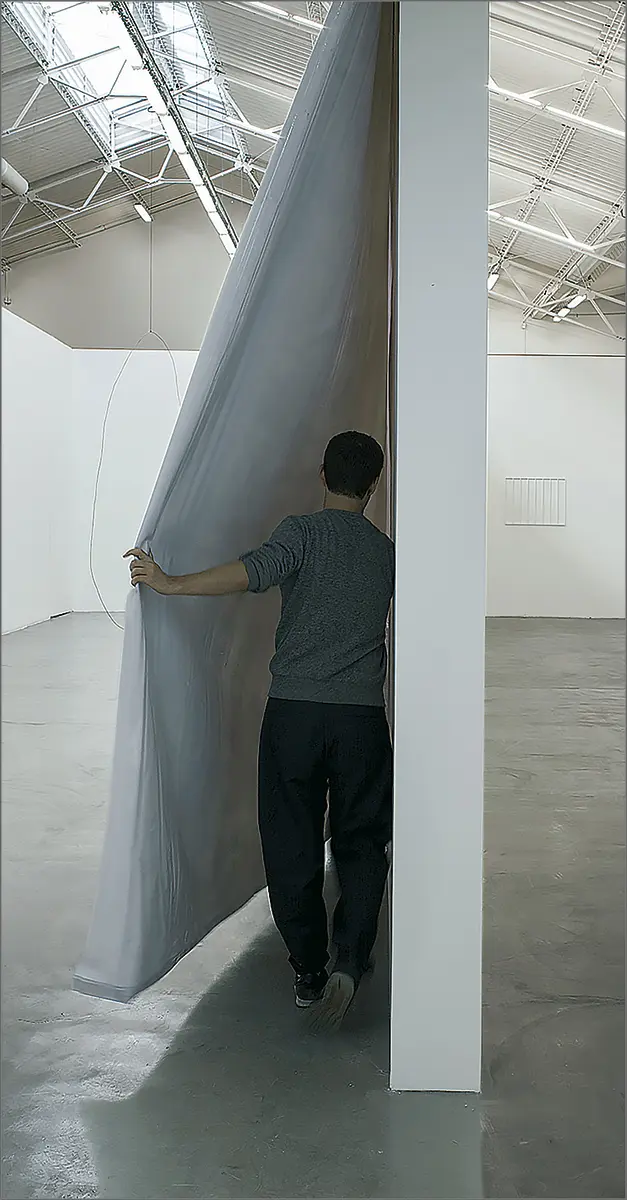
I believe that my works have emerged from a vacuum, from time itself,” Basualdo says. “More and more I trust that code, that conversation with the viewer, and am able to do less so that, indeed, the viewer arrives at these conclusions on the basis of almost nothing—on the basis, for example, of a ring.” Nothing is resolved and everything is yet to be discovered in Indivisible, a line that generated a new dimension on a large wall covered by a white plastic sheet of the same size. Visitors were able to peel the plastic off like skin and creating a new, penetrable dimension that they could enter, without anyone knowing what awaited at the end of the path.
Basualdo, who studied Fine Arts and Drama and was a recipient of the Kuitca Fellowship (Universidad Di Tella, 2011), has been a member since 2003 of Provisorio-Permanente (Provisional-Permanent), alongside Victoriano Alonso, Hernán Soriano (with a refined oeuvre of his own), Manuel Heredia, Pedro Wainer, and Brazilian artist Artur Lescher. This experimentalist group, educated in a variety of disciplines, launched and fueled Basualdo’s practice, The group’s initial project was a movie; in the end, the movie was never made, but the ideas evolved using models and dolls as scenes were composed on a large table. There, the group built Nocturnidad (Nocturnality), a beautiful installation referencing El Eternauta (The Eternaut), the mythic late-1950s science fiction comic by Héctor G. Oesterheld, who in 1977 was kidnapped by the military dictatorship along with his four daughters and never seen again. El Eternauta tells the story of an alien invasion in Buenos Aires, which begins with an unexpected snow blizzard. Nocturnidad received an award in the Currículum Cero contest organized by Ruth Benzacar Gallery, and it depicts the battle fought by the comic’s hero, Juan Salvo, and his ragtag army against the aliens in Barrancas de Belgrano. The 2005 exhibition made the group known, particularly Basualdo. In parallel to his solo work, Basualdo remains an active participant in the collective, which also delves into drama, film, and literature.
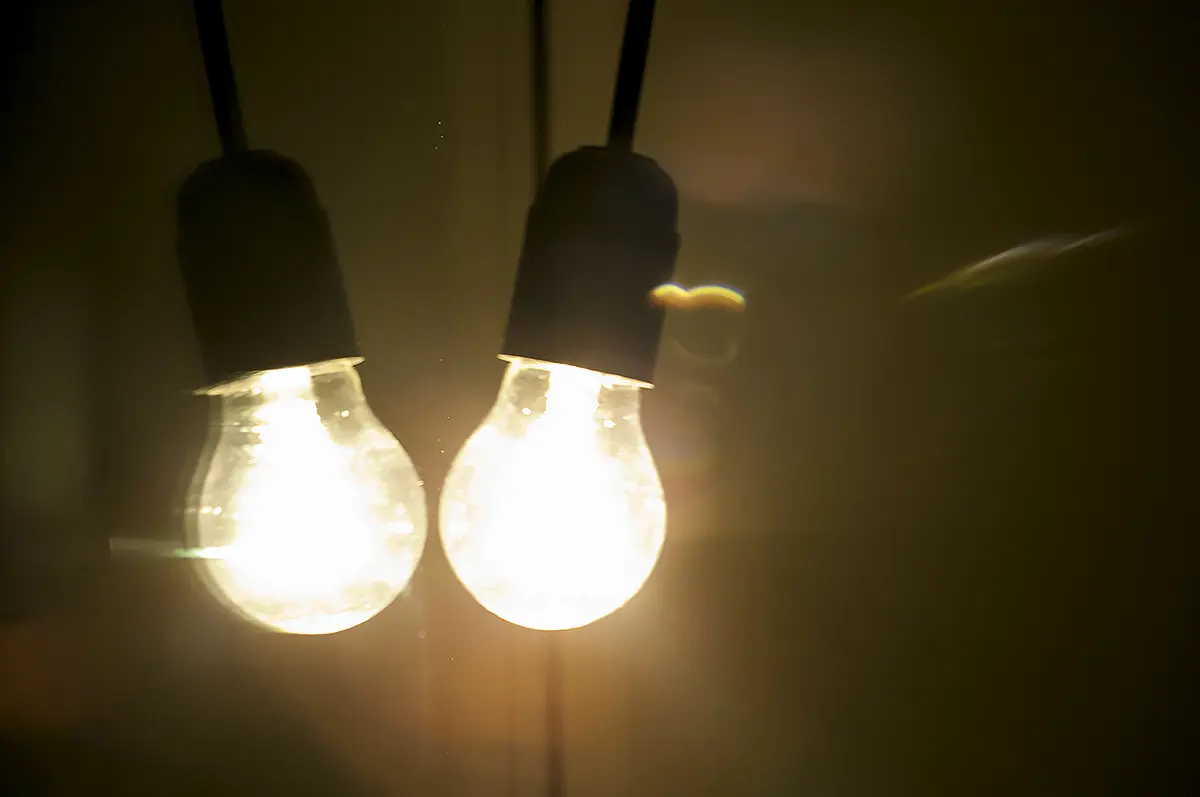
Even if Basualdo wanted to escape with a helicopter from his well-deserved fame and the resulting exposure, he would no longer be able to. In the eight years since his first solo exhibition at Ruth Benzacar Gallery (2009), Todo lo contrario (On The Contrary)—featuring mechanical automata, motion devices, and lights; it was like a “chamber” that could very well have been the artist’s own head (or the viewer’s), the skull as the tomb inside an Egyptian pyramid, the innermost space—his work has traveled the world. Basualdo has exhibited in international galleries, at biennials like Venice and Havana (2015), and in museums like the Hirshhorn in Washington D.C., which now holds The end of ending (2012), the artist’s exploration of the physical measurements and psychological extension of edges and boundaries. Basualdo lives and works in Buenos Aires, where La cabeza de Goliat —accompanied by the sound composition La inquietud (The Restlessness), by Nicolás Varchausky—has just opened at Usina del Arte. An architectural icon, the Usina now serves as a cultural center in the La Boca Art District, inside a remodeled early-Twentieth Century electrical station.
VICTORIA VERLICHAK
The author of biographies of Marta Traba, Roberto Aizenberg, Martha Peluffo, and others, she is working on a project about the life and work of Argentine artist Mildred Burton.