Cuba is a militaristic country by excess and a civil country by default. It is an obscene country by excess and an erotic country by default. A brave warrior of the independence struggle against the Spanish occupation in Cuba once said: “Cubans either falls short or overshoot the mark.” Such axioms, translated into visual gestures, help Cuban artist Dennis Izquierdo (Holguín, 1980) to articulate a productive methodology that facilitates leaving behind the definition of means as ends so pervasive in the exotic fallacy.
Safe from the predominant identity neurosis of the 1990s, the work by Izquierdo, a graduate of the Instituto Superior de Arte (ISA), went from conceptual mutation to a visual transition. Thus, the dramatic and funny elasticity of his pieces oscillates between collective epic and intimate obsession. And he achieves this through an unprejudiced approach that favors his personal beliefs over any momentary trend.
Characterized by an ambiguity that caused uneven readings, the most recent exhibition by Izquierdo, titled Coup de Grâce, successfully managed to maintain its thematic core, and no subject matter was spared for the sake of seductive effects.
On the one hand, Dennis Izquierdo drew inspiration from the 1913 mega exhibition by European and US artists titled Armory Show presented at the 69th Regiment Armory of the National Guard in New York City. On the other, he mounted the exhibition at half-light to dismantle the usual traumatic undercurrent of leadership and faith crises that follow any apparent thawing period.
Armory Show is the title of a floor piece included in the exhibition. The installation consisted of a barricade of sugar sacks with a shotgun at the top, in the manner of a symbolic guard. Without the privilege of offering a commanding position height-wise, the instinct of self-preservation as an unpronounceable principle makes it an easily evadable retaining wall. It is an attempt to stop the useful chimera of the old enemy, turned into (almost from one day to the next) another accomplice.
The unexpected and vertiginous “Obama era” prompted Cuba to focus on an agricultural sector—particularly, the sugarcane industry—whose recovery, in the context of the Antillean economy, could only occur with the help of a powerful external force.
Coup de Grâce implied an open, yet ambiguous, wink to the protagonist role of the drama of the Cold War in Cuba’s developmental frustration. Whether in the “Obama era” or in the “Trump era,” “Armory Show” is activated through several pretexts.
On April 16, 1961, Fidel Castro-Ruz announced that the Cuban Revolution was taking the socialist path. Appropriating this crucial date, Dennis Izquierdo conceived a metaphor about the abrupt turns of history, in which the voluntarism of the Great Chief prevails over the goodwill of the leader.
16 de Abril de 1961 (April 16 of 1961, 2017) consisted of a tower of books peppered with shots from a 38 caliber revolver. But the shots had to first go through a cushion used as a silencer for the point-blank firings. Confronted with the radicalization of the revolutionary process, the cognitional module from the Republic had to be replaced or annihilated.
The philosophy of the soviet manual fulfilled the purpose of eliminating the Trotskyists in favor of a legion of young Stalinists that imposed socialist realism as an aesthetic doctrine. The silent crime became the manipulation or disappearance of knowledge without the need to provoke the slightest short or long-range racket.
The red velvet cushion as a receptacle of chaos in the official and inconsistent “Post-Castro era” once again became a central element in Morir Es Vivir (Dying Is Living, 2017). A silicone heart rested on the soft object atop a pedestal. The curious thing is that it was a cushion with sound, an effect achieved through an automatically pulsating mechanism inside of it. Even stranger was the fact that the sound in question was a tap, a bugle call played during a funeral to honor a high-ranking military officer that died.
The scene represented a mythopoetic ceremonial alluding to the death of Fidel Castro, to a virtual death in the mind and body of a nation, of a war islet that for over half a century revolved around one man. An extrapolation of a being in the space that continues to rule over hegemonic decisions and the fearful passing of his body from another world that immortalizes him.
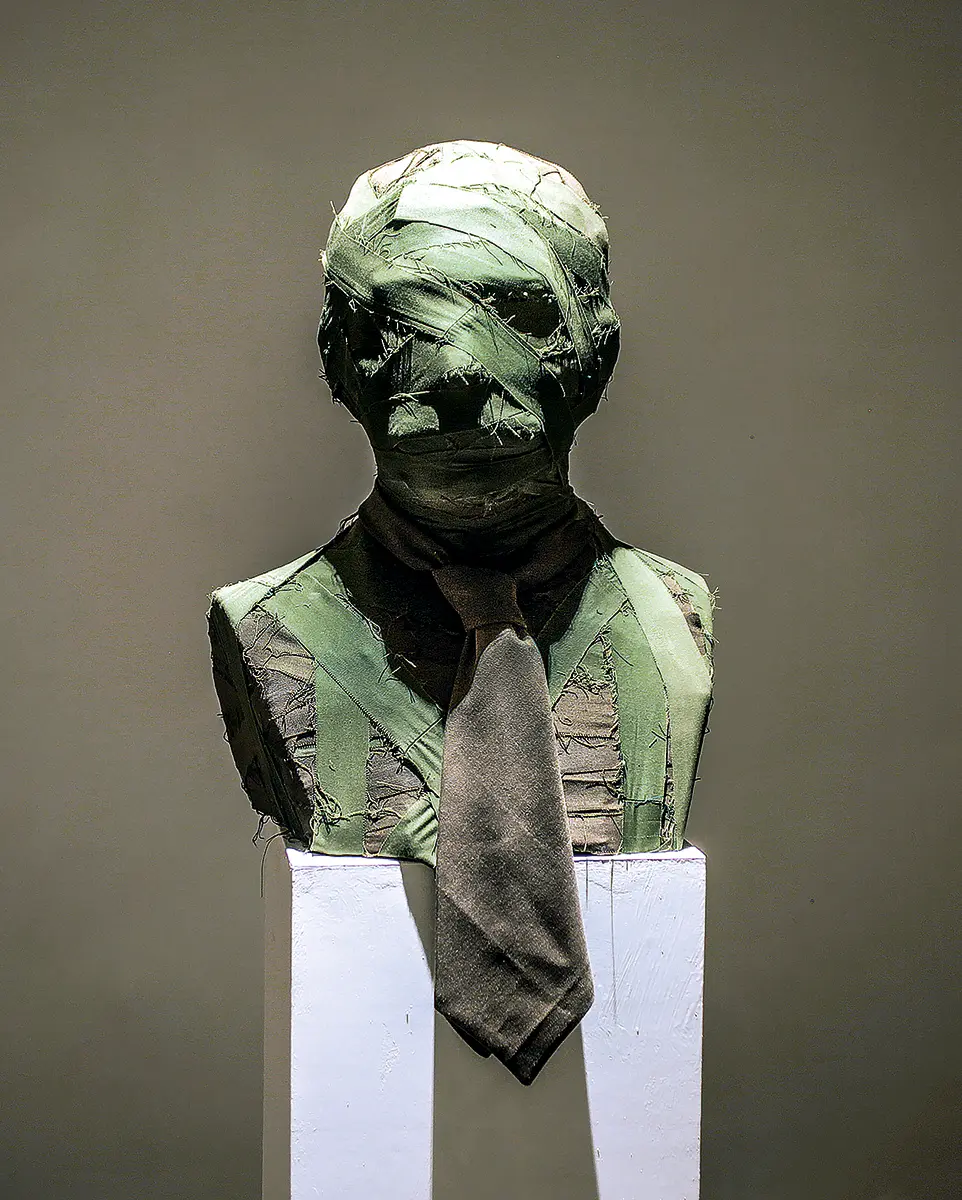
The shared intimacy in Coup de Grâce reached a better definition in El Líder (The Leader, 2017), a bust of José Martí mummified with fabric from military uniforms. Once the fabric was turned into a tie that materialized and also gagged, the martyr, the figure of “the greatest among all Cubans” was reduced to a myth exposed to other types of interpretations “with all, and for the good of all.”
The preservation of the image and legacy of a leader that did not survive to be in charge leaves the symbolic realm to represent a real person. Patriotic utilitarianism often leads to a Machiavellian certainty: “It would be best if you and your ideas find rest in another world. We will make sure to keep you in the memory of those who will always be willing to revive you.” This is what happens to enlightened beings; they become uncomfortable to have around during dark periods.
El Líder envisioned by Dennis Izquierdo confirmed the universalism of José Martí, someone who reached beyond the caudillo-styled localism of a cloned Fidel Castro—a palpable point of view today. Through José Martí or any other precocious martyr, it becomes possible to justify a “clean slate,” the go-to approach that is so popular in the sociopolitical jungle.
The “Eggun” (the spirits of the dead in Yoruba tradition) embody a myth of Cubaness. It is enthroned as the conceptual basis for the imaginary superstructure proposed in Coup de Grâce, a visual dramaturgy where the theatricality of sacrifice equals, even surpasses, the postmortem significance of man and his circumstance.
HÉCTOR ANTÓN