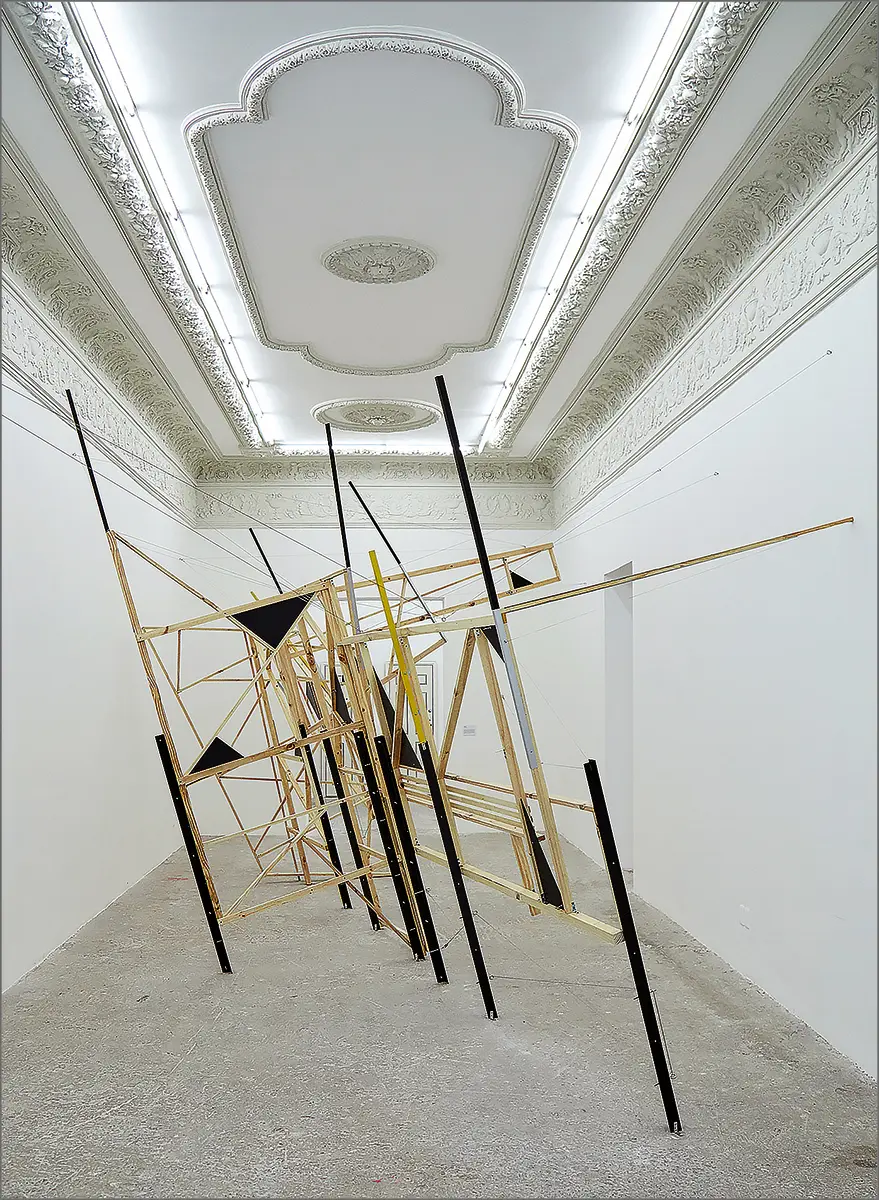
A structure that slides in process between a “scaffolded” construction and a subtly organic growth covers vertically almost the entirety of the space for transit in the first room of El Cuarto de Máquinas Gallery—Hedera, by Anibal Catalán. A construction comprised of very thin wooden beams with angular edges in different lengths and thicknesses registers between its diagonal assemblages a number of yellow, black, and white metallic sheets. The composition seems to presuppose a dialog coded into an indiscernible geometric pattern, asserting itself on the basis of directives interposed as an architectural-sculptural body, the invasive structure of which one needs to traverse in order to access the rest of the exhibition. In this way, the exhibition Delirios urbanos (Urban Deliria), curated by Josefa Ortega, receives/confronts the viewer, arranging the (in)determination that underlines the discursive drive of its proposal, which commissioned the seven works that comprise it ex profeso.
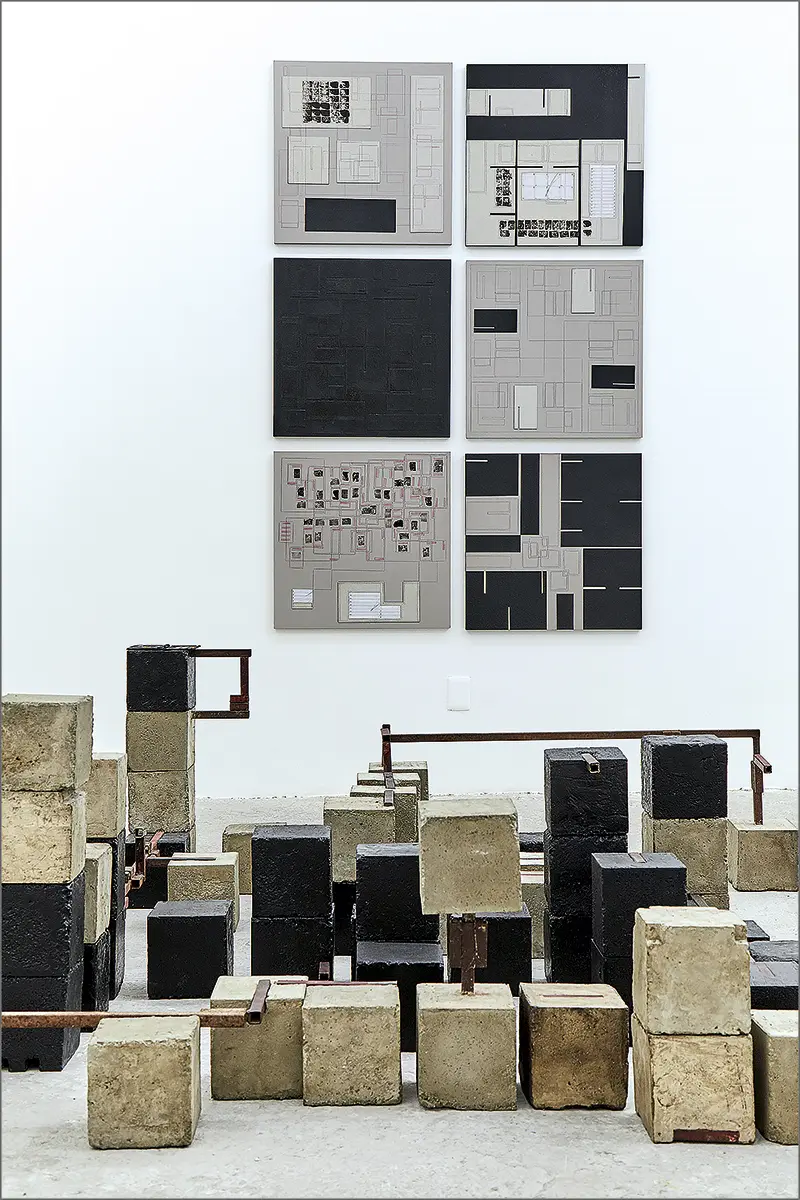
The exhibition puts on display “in the raw” the same cynical yet accurate essence that the prelude to the curatorial text anticipates, in an eloquent caveat, with a quotation from architect/theoretician Rem Koolhaas: “BIGNESS is no longer part of any issue. It exists; at most, it coexists. Its subtext is fuck context.” The apparent grandiloquence of Catalán’s work, the use or purpose of which is as uncertain as it is fragile, unveils the risky incertitude of an unending number of urban buildings. A constructive sensation and sententiousness that, in the next room, Daniel Ventura’s Vértices (Vertices) seem to illustrate “on the floor” via a composition set up using gray and black cubes of concrete punctured through by copper tubes that, by design, (dis)connect the blocks only inefficiently, signaling their “model”-being at scale in a growth that, we imagine, could also expand through the entire room to push the space and the inhabitant-body into an impenetrable, unbreathable corner—despite its “modest” dimensions—in comparison with Catalán’s work. But it is in the containment of its concrete modulation that Ventura’s works are undeniably effective in convoking meaning. In turn, Catalán’s intervention—despite his intention of invading the room “minimalistically” (this is to say, with minimalistic touches that are inevitably related to the work of Sol LeWitt)—remains in measurable and “mediatable” dimensions; this is why the relational-structural-dependent perception—the presence of which plays between the integral and the unsustainable—sees its risk impact diminish between the structure, the container space, and the transit of the body-viewer.
For his part, Ventura’s work functions as a matter-centrifugal-node, its range unfolding towards other authorial aesthetics, anchoring an interlocution with painting and drawing, whose (seeming) two-dimensionality populates the walls around. One standout is the dialog it incites with Blanca González’s drawings, descriptive urban fragments that reach almost all the way into formal abstraction. Paisajes invisibles is the title of the series of geometric overhead images whose lines guide a kind of memory of the tubing-in-concrete of ancestral lake canals that in pre-Hispanic/Colonial times coursed along what is now our contemporary “vialities”. Those flows transformed into viaducts and avenues are proved to be demonstrative not only of the effects of an efficient urban “modernity”, but also of its capacity for destruction—literally “draining”—at every ecosystemic level involved.
The appealing aesthetic-in-abstraction of González’s “landscapes” in turn leads us into a pathetic historical reminder of the city and connects figuratively with Rolando Jacob’s pictorial work, Proyección inversa (Inverse Projection), eight multi-dimensional frames that, clear-mindedly executing a tonal and figurative economy, exhibit an anodyne visuality between blocks and shadows. Mnemonic configurations of countless perimeter and adjacent “residential” blocks in the direction of which the country’s most important cities continue to systematically expand. As the only housing on offer for low-income sectors of the population, this appropriation translates into an interminable legacy of monthly payments stoked by the dream of “the acquirable” and the truculent promise of bridging/closing the gap between property and proprietor.
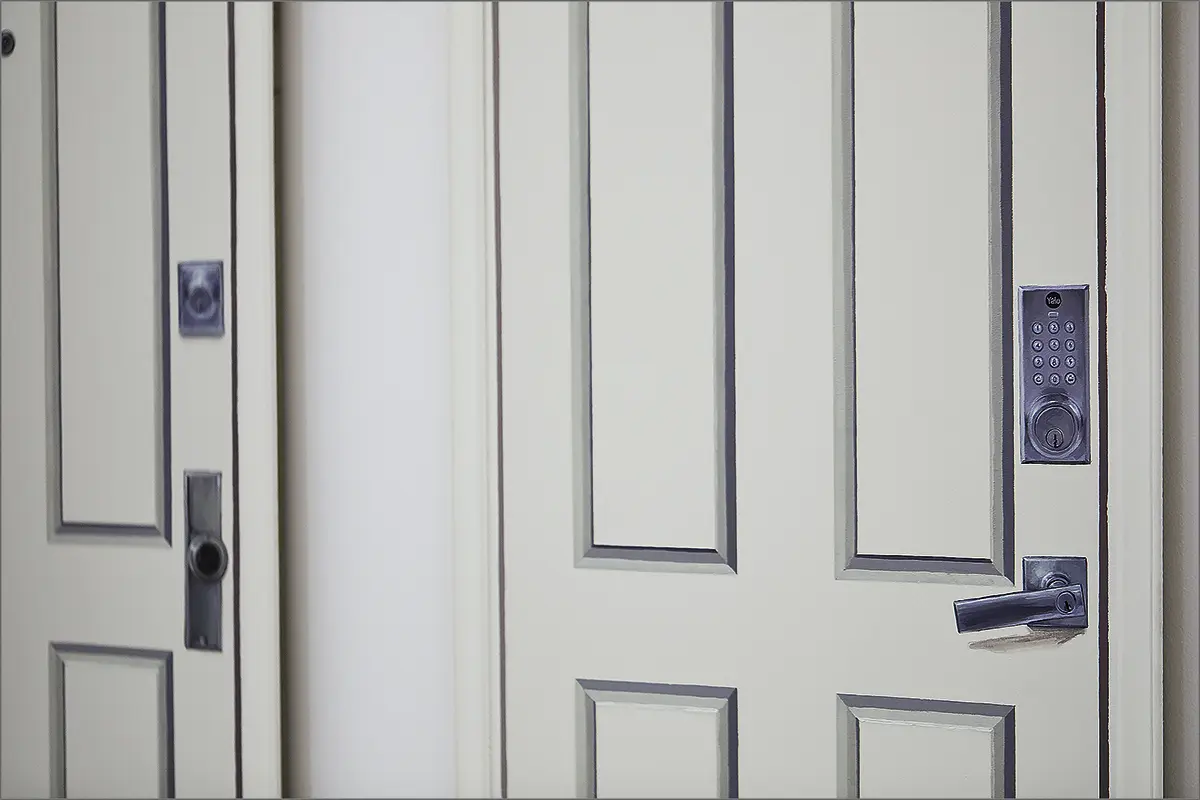
The show confronts us with such an inhospitable geometrization by means of a sequence formation of four identical access doors of the kind common in middle-class dwellings: Puertas blancas de estilo americano (American-Style White Doors), by Circe Irasema. Mounted on two walls at an angle from each other, the prefab doors prefigure unending passageways and streets “dressed” in the indifference of this “style” whose function would open up space—not a place—for the affirmation of the possibility of, at least, an appropriable residue whose sole differential of singularity is “exercised” in the selection of the lock and/or security system chosen by the owners to outline a puny domain of singleness that defines “their” door.
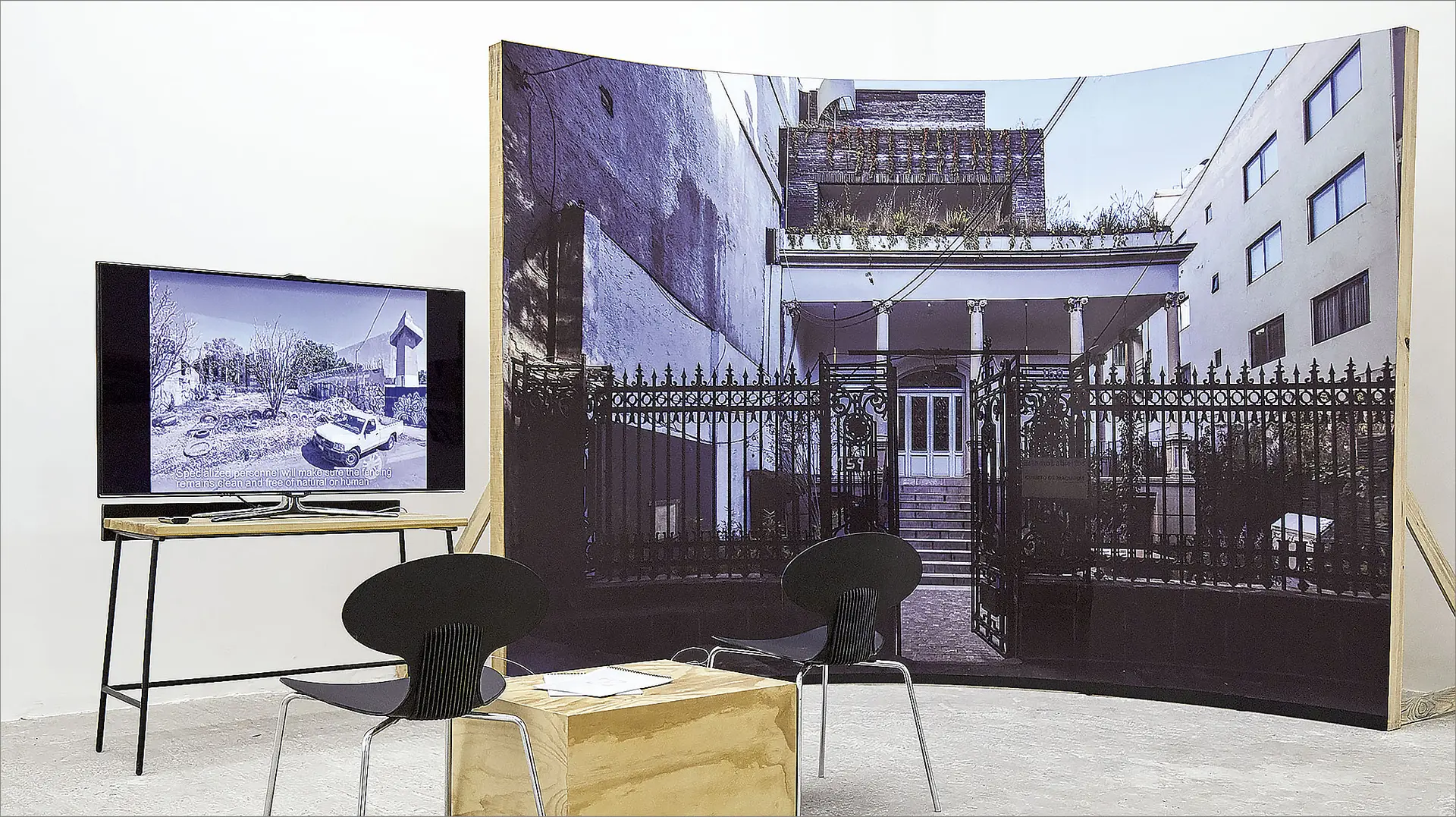
Among Irasema’s inhospitable thresholds, the exhibition’s last two works, the fruit of collaboration between the Operación Hormiga collective and Jetro Centeno, their proposal—critical and ironic—is a “visual cleansing” of the public space. A project of urban “embellishment” offered in a video and in illustrative dossiers, metaphorically as strategic placement of instances of lobotomy-blindness in the face of unsolvable germinal problems in a society that is wholly polarized in economic, social, and cultural terms. Walls and fences covered by replica-images of “aesthetic/stylistic quality” that set up a border and exile behind them, like an insulation band, all those “other” areas that are alien to the visual standards cataloged in the proposal. What comes together here are the essential conceptual and problematic premises that the exhibition engages, anticipating delirious phantasms that in good/tragic measure, anchor real cases and conditions that are (in)tangibly projected in extenso inside the “darkroom” that holds Jimena Schlaepfer’s installation. Her projections of shadows suggest morbid icons of a fetid present that overevinces the terrifying—because they are uncontrollable—“crossed times” we inhabit; perhaps, it is to be supposed, on the basis of a surviving enclave of common sense.
MARCELA QUIROZ