The work of Décio Pignatari (1927-2012), interpellated as visual art, took place invariably in the form of participation in group exhibitions. A vertex of the concrete poetry movement—alongside the de Campos siblings, Augusto and Haroldo—rather than a “visual artist” properly speaking, Pignatari was to keep a distance from the gallery circuit. The exhibition Na Arte interessa o que não (What Matters In Art is What Doesn’t), curated by João Bandeira, came to fill the gap. Of course, it is important to recall Pignatari’s previous appearances in high-level exhibitions, such as the historical Exposiçao Nacional de Arte Concreta (National Exhibition of Concrete Art, MAM São Paulo-Río, 1956/57) to Brazilian Concrete Poetry (Tokyo, 1960) and Between Poetry and Painting (ICA, London, 1965). Or, in the 1980s, Idehologia (MAC, São Paulo, 1987), which focused on binomial Art/Technology and shone a spotlight on new forms of text in motion like holography and computer-based animation.
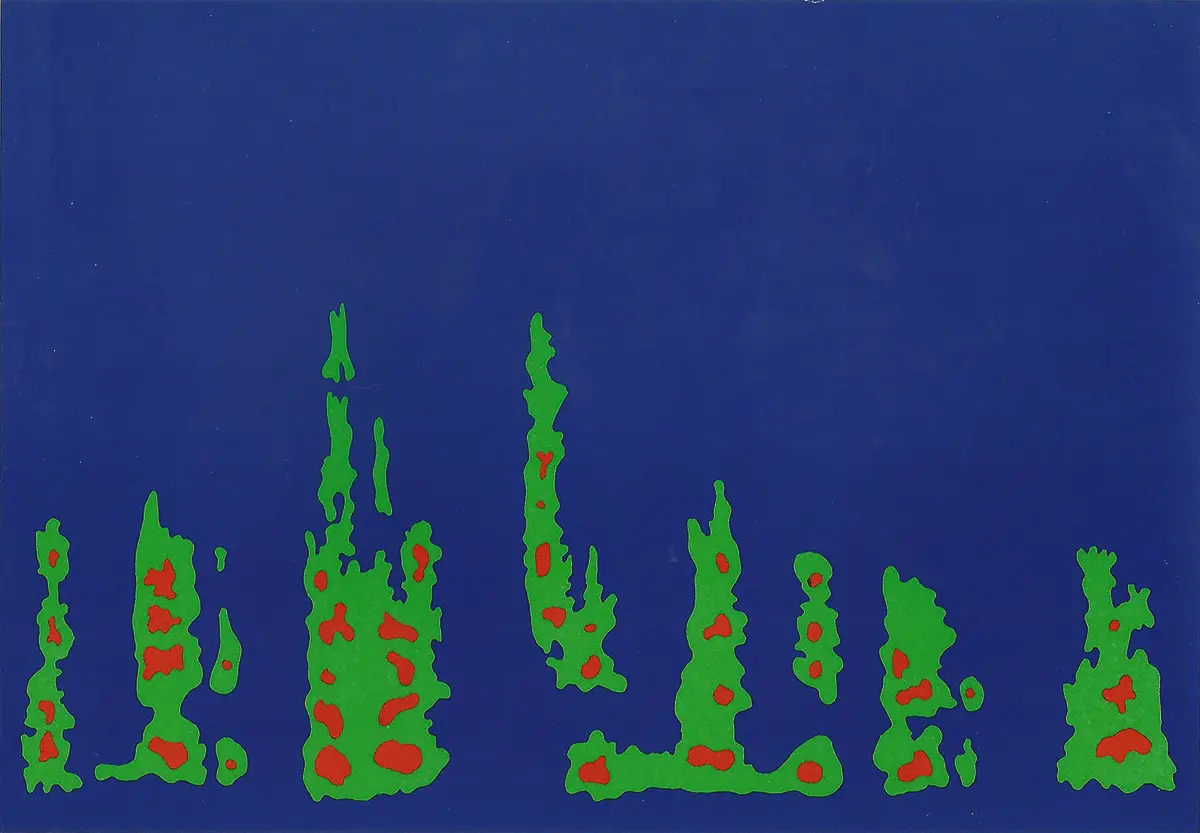
A "poem-object", Alfabeto vertical (Vertical Alphabet, 1979/2007), installed in the entryway, welcomes visitors to the exhibition. After that, inside the first large room, is a selection covering a seven-decade arc, organized here around a variety of typologies. It begins with the “poem-billboards”, so-called due to their standard dimensions and their style favoring reproducibility, such as terra, a motion, and drink Coca-Cola, from 1956. Then come Pignatari’s “photo-montages”, an archetypically modern genre that the Brazilian artist practices intermittently in the 1950s. After those, the “book-poems” of the 1960s, like organism and LIFE, with pages that resemble the script for a “videopoem” or “clip poem”, their most natural successors in the 1990s (to which the show also devoted a space.) Contrasting with these typologies is the Semiotic poem, from 1964, where viewers decode the text using lexical keys. Also on display is Vocogram, a Technicolor graphic in which each image corresponds to a Latin American phoneme captured using sound-measurement devices, a work that could very well be described as a fossil of Brazilian cyber-art, precociously produced in 1985.
Identifying for this exhibition iconic rather than verbal matrices, even though those two spheres were closely intertwined in Pignatari’s work, brings to mind the longstanding parallel between the arts and the maxim ut picture poiesis, translated as “in poetry as in the painting”). Regarding the concrete concept operated here in what is known as the arts of the time, such as lyric poetry and music, it is on the basis of the combination of their constitutive elements that the image is generated. In this way, poetry comes closer to a visual language, as happens in the case of ideograms; according to the Pilot Plan for Concrete Poetry, from 1965, “Ideogram, non-verbal communication. The concrete poem communicates its own structure. Structure content.” Since then, visual arts paradigms such as the abolition of subject matter and Gestalt-like compositional sobriety became central to the movement, with the same standing as the poetic frameworks previously explored by Mallarmé, Cummings, or James Joyce, thus producing the visual poem.
Some time before the date that is officially assigned to the birth of the Concrete movement in Brazil, with the 1956 exhibition, these ideas had begun to crystallize among a number of abstract painters. Such was the case of the Ruptura group, established years before by the painters and sculptors Luiz Sacilotto, Geraldo de Barros, Waldemar Cordeiro, and Willys de Castro, all adherents to the school of thought. Among them, as with the poets, Max Bill’s programmatic drive would result in a full-blown movement, with all that implies. There is also evidence that the word concrete returned to Brazil in Décio’s luggage, after a European sojourn in the late 1950s intended to network with the postwar avant-garde. At the Ulm School of Design (Hochschule für Gestaltung Ulm, in Germany), Décio met Swiss-Bolivian poet Eugen Gomringer, then Max Bill’s secretary, and with the Argentine artist Tomás Maldonado. Upon his return to Brazil, those contacts helped establish a relationship with experimental German musicians affiliated with the movement, and with them and with painter Willys the Castro Décio began to conceptualize the earliest “oralizations” of poems. Those were veritable performance-art experiences, launched at the Ars Nova Festival in 1955. This is how the verbivocovisual project emerged (the term conflates the words verbal, vocal, and visual), the keystone to Pignatari’s initiatives, and the axis for the Concrete Art manifesto written years later.
Ultimately, the exhibition takes us on a tour of the documents, photographs, letters, and publications that reconstruct this little-known facet of Pignatari’s career. In this way, it shows us how the artist was involved in the projects towards the implantation of semiotics, and in his later periods was committed to relationships with underground film and happenings.
We do infer, regardless of this diversity, that the letter is the bond tying together Pignatari’s work. As he put it in his description of one of his most emblematic poems, terra, the poem is “a verbal object, a self-controlling organism that should self-realize automatically without it being possible to take one of its elements away.” As a result, a block of text formed by the letters and intercepted by spaces gives shape as a diagonal, the Gestalt’s preeminent dynamic element. Another instance is one of Piganatari’s first discoveries with the letter “M”, treated as a female personification, in the memorable verse “your legs make an M”, en Jogral e a Próstituta Negra, from 1950. The same letter reappears in the “physiognomic typologies” of Pignatari’s man/ woman/ man, where it serves as a fitting for the words. Already in the poem titled motion, the letter “M” outlines a central axis for the lines that move to create a horizon that separates a skyspace and an earth space, in the manner of a landscape.
The parallel between the visual and the textual language in the work of Décio Pignatari is also connected to his idea of the poet as a designer. Under this simple premise, words, in the end, diverge from both the pictorial writing of his automatism-influenced predecessors and the intuitive, gesture-oriented calligraphy of his contemporaries, the letristas. This poetry was the result of a crossbreeding of semantic, visual, phonetic, and kinetic codes, from optical principles or as a result of technology. Along the way, Pignatari found—to the delight of critics and audiences—followers all over the world.
XENIA BERGMAN