X-Museum is a site-specific project by Argentinean artist Cristian Segura (Tandil, 1976) installed in the hall of the Museo de Arte Contemporáneo (MAR) in the city of Mar del Plata, Argentina. It will remain on display for the entirety of 2018, offering during that time a few occasions in which Segura will be available in-person to narrate the details of the extreme experience that he meticulously planned. It centers on a performance on the rooftop of the same museum on a windless day, which became an unsettling exploration for the artist in connection with the institutional element in art.
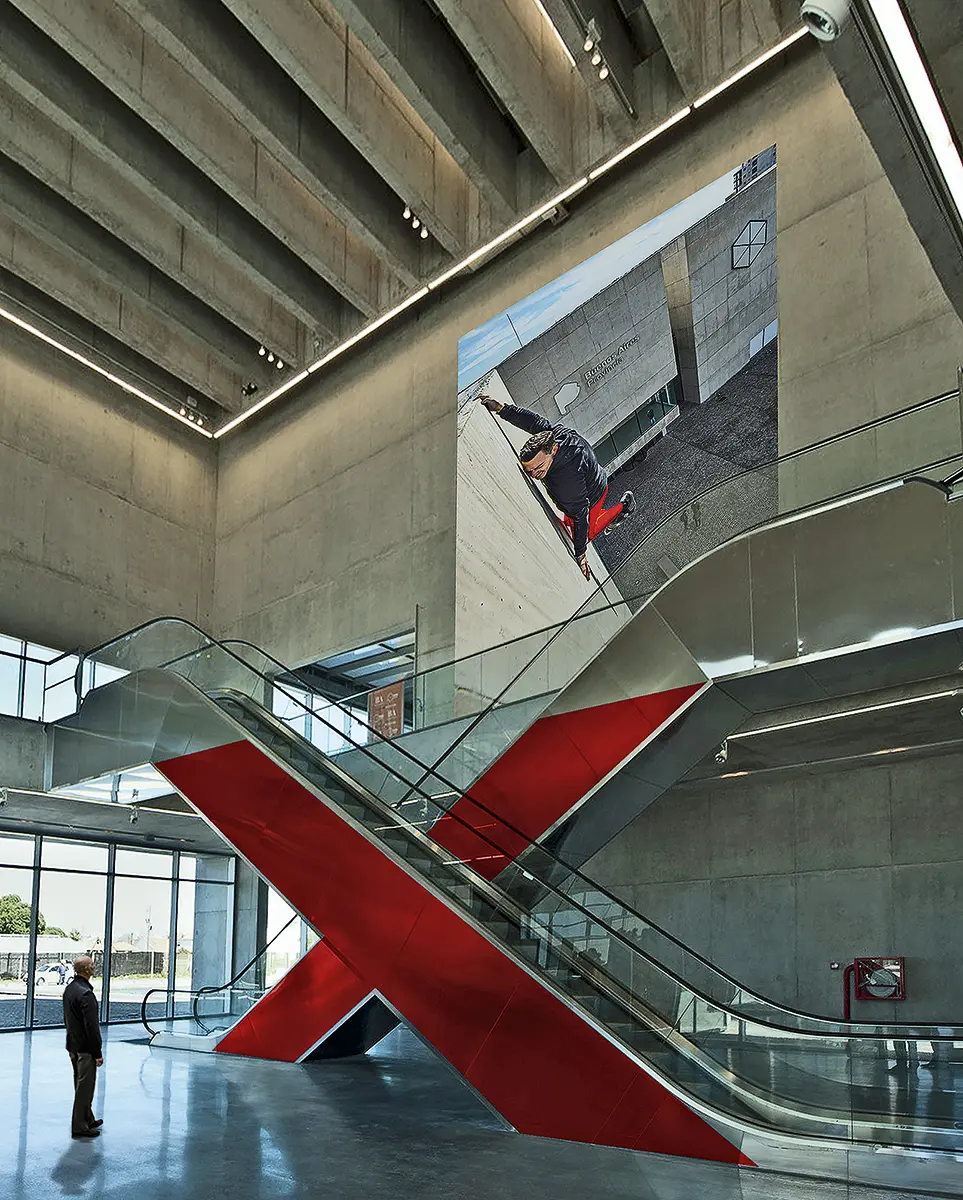
Exploring the architectural elements of the space, Segura designed a distribution strategy for the three giant prints encountered upon entering the museum that altered the regular use of that area. He did not use the surface of the floor and instead took advantage of the extremely high walls, transforming them into the central axis of the work. In doing so, Segura underscored their obvious function—separating the interior space from the outside space—to layer several levels of meaning that will be included in an upcoming book with three critical texts.
The idea was to perform an extreme practice known as rooftopping, consisting of hanging from the top of a very tall building with nothing but one’s hands. It is part of a series produced by Segura in which he continues to explore the relationships between the museum (as architecture with social and political implications) and its institutional canonical function to house contemporary practices. Segura himself briefly, but successfully, served as director of the Museo de Arte Contemporáneo of his hometown in the Buenos Aires Province, an experience that helped him define his double purpose as an artist and cultural manager.
In Museo en llamas (Museum in Flames, 2011) he depicted a few flames, rendered in the Pop Art style, escaping from the windows of the Art Museum of the Americas in Washington DC, located a short distance from the White House. The following year, at the Museo de Arte Contemporáneo in Santiago, Chile, he showed Museo en ruinas (Museum in Ruins, 2012), which evoked the enormous power of the major earthquake that shook the Andean country. He used decomposed cyan and magenta pigments to evoke a trembling vision that was possible to observe with the use of special glasses available in the exhibition rooms.
For X-Museum, Segura had to meticulously plan the actions because, according to the artist, “it is not a staged action because it presents a real but controlled risk.” A risk he took with the help of a group of collaborators—given that the artist from Tandil had no experience in that extreme sport.
To physically challenge a building with 23-meter (75.45-feet) high concrete walls was a challenge in itself, but it was also an “agreed upon subversion,” as pointed out by one of the theoreticians of the exhibition, Justo Pastor Mellado, since the institution accepted to share the risks. The museum building in Mar del Plata caused great controversy when it was unveiled to the public. The architecture of this latest grand space designed for the housing of contemporary art in Argentina stands in stark contrast to the surrounding landscape. Located by the edge of Buenos Aires’s maritime coast, three large cubes stand in an area with few other tall buildings when compared to the rest of the city. However, from its interior, space opens to the surrounding landscape and brings the horizon inside. The formidable lobby has two opposing escalators that visually form an X—a proposition that served Segura’s project. The X, which usually precedes most extreme practices, happened to be already there and only needed to be underscored with an intense red.
The sequence of actions associated with the X-Museum brings the walls to the forefront through the strategic recording of a performance that succeeded in showcasing their scale, vertigo that they can provoke, and their unique vantage point. From inside, helped by the size of the giant prints on the first floor (measuring 11 meters high by 9.5 meters wide) that “open” other windows in addition to the actual ones, the already monumental space expands even more. The extremely high walls become lighter, generating a visual sequence that can easily be perceived as part of consecutive scenes. The selection of only three out of the nearly four hundred shots that Cristian Segura took help capture the instants, even as most viewers believe it to be a digital trick. Pastor Mellado correctly suggests that these images, of very high quality considering their size, also encourage a reflection on the contrast between the fleeting nature of extreme experiences—barely a few seconds hanging from a wall with only one hand—versus the lasting nature of the institution, which in this case has existed for less than five years but has a long history ahead.
The development of the actions can be followed through Segura’s Instagram: @cristiansegura.art
PILAR ALTILIO