César Paternosto’s exhibition at Guillermo de Osma Gallery in Madrid demonstrated that this experienced Argentinean artist remains loyal to the direction he set out on a long time ago. The title, Obras recientes (Recent Works), told us with concise simplicity that Paternosto does not see the paintings and works on paper presented here as an innovative or surprising turn in his explorations, as was the case, for example, with his 2006 foray in the same space, titled Marginalidad, desplazamientos y ritmos (Marginality, Shifts, and Rhythms). The fact that this earlier title was a mere list revealed the fact that Paternosto was at the time so immersed in the task of discovering what the possibilities opened by the new direction of his work had to give, that he was unable to name his discoveries in any way but by listing those he found its most salient features. Today, meanwhile, he is so settled into the achievements of an exploration that back then was besieged by the uncertainty that he even allows himself the luxury of sketching a capsule history of his journey: that is what he has attempted in an exhibition at Museo Thyssen, also in Madrid, organized at the same time as his show at Guillermo de Osma. The title of this second exhibition was as much a slogan as a declaration of principle: Hacia una pintura objetual (Towards Painting as Object). And it reflected Paternosto’s intention of putting on display the evolution that made it possible for painting to become an object with value in itself, and not only as of the imaginary representation of something or someone.
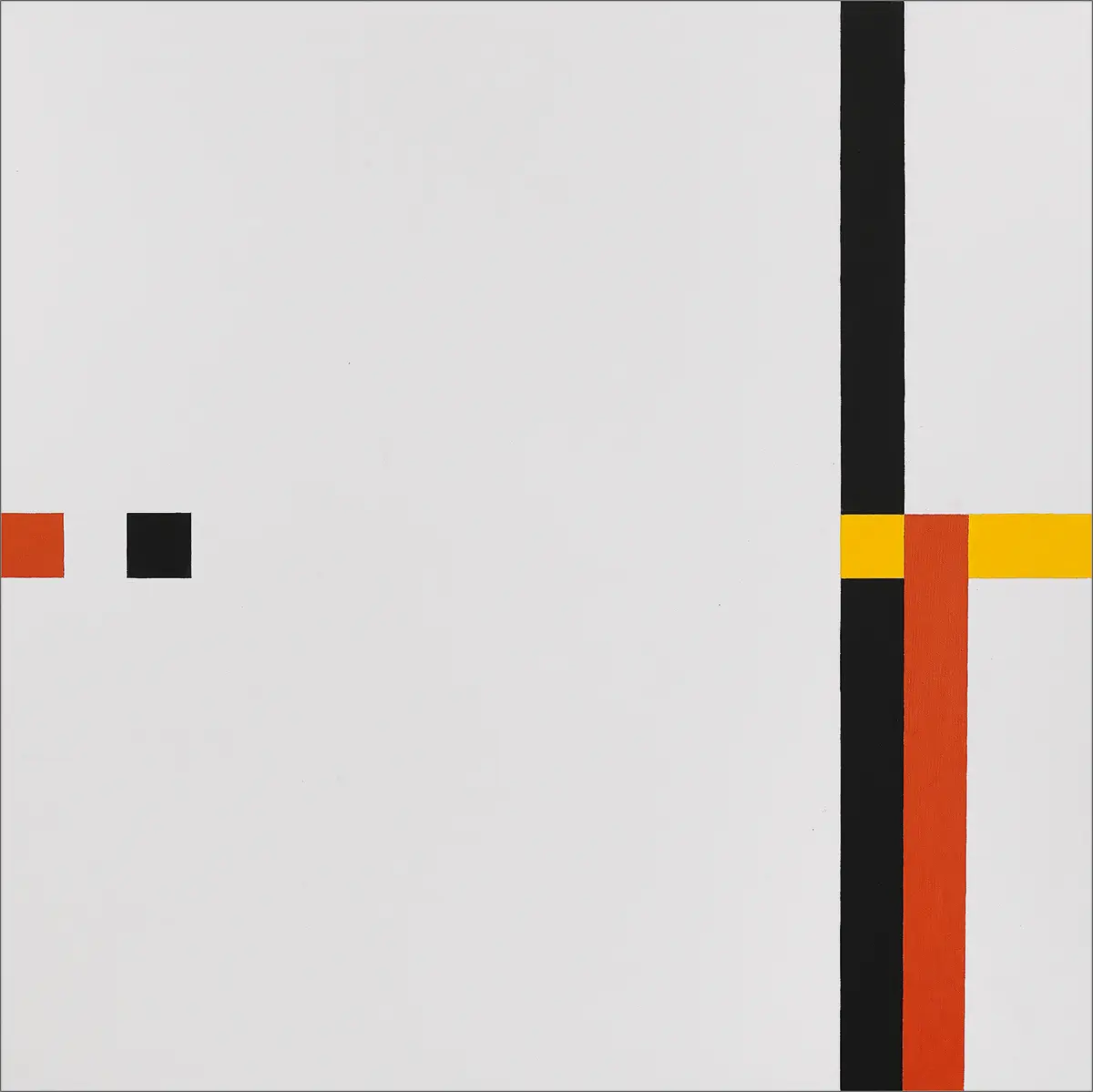
In this exhibition, curated by Paternosto himself, nine of his paintings shared the walls of a small gallery with six works by Picasso, Juan Gris, Piet Mondrian, and Joaquín Torres García from the Thyssen collection. There was indeed a story there, albeit one missing at least some presence of Madi, the group of artists who in Buenos Aires in the 1940s made panting into an object with an unexpected radicalism that is not found even in the work of Torres García, who was moving in the same direction in Montevideo in those same years. Yet it could be said that the gap opened by the absence of Madi works was filled by Paternosto, given his indebtedness to the work that Carmelo Arden Quin, Rhod Rothfuss, or Raúl Lozza created at the time. Paternosto’s paintings are also objects, in the strong sense established by his forebears. To begin with, they are three-dimensional: as Raúl Lozza did most aggressively, to cite a Madi example, the work is no longer a painted surface. Only that in the case of Paternosto, the unhinging of the painting is illusory. From a purely physical standpoint, his works retain the square shape; at the same time, they question it by means of cuts and interruptions of the Cartesian grid (forcefully invoked by the very act of its interruption). If it weren’t for this questioning, Paternosto’s painting would be like Mondrian’s: a plane on which two color lines or bars intersect with none left isolated or loose to impede their articulation into a stable, harmonious whole. In Paternosto’s paintings, on the other hand, there are lines that never reach their supposed destination because they fragment and are interrupted along the way, unable to touch or intersect with others in order to complete the grid to which they virtually belong. These slips, if we can call them that, irreversibly unhinge the square of the rectangle of Paternosto’s paintings, even if they do this without the violence or, in particular, without the raw materiality of the zigzagging shapes we find in the works of Madi artists. In Paternosto, the unhinging is not physical but visual, and it brings back into the work the imaginary dimension that has characterized the art of painting since its origins. We see more than what we see, even in works of art that only intend to be objects.
The above paradox connects Paternosto’s paintings on exhibit at the Thyssen with those at Guillermo de Osma. And, of course, with the paper constructions hanging in the latter’s walls, whose strict orthogonal composition is irredeemably subverted by the shadows that, thanks to space’s lighting, some planes throw upon others. And it is understandable: they all belong to the most recent period in the career of an artist who has gone through many different explorations over the years.
CARLOS JIMÉNEZ