In this exhibition, Carlos Anzola presents works around subject matter he has been exploring for a while, about the accumulation and preservation of memory. His work is situated at the boundary of visual culture, working with objects and images already settled into the collective imagination.
On this occasion, Anzola proposes a double approximation to the concept of transitoriness by establishing paradoxical relationships between the fleeting and the lasting through the selection of functional items and graphic images that reinforces this notion: luggage, photographs, postcards, and intervened artifacts of urban life. Using these supports and techniques, Anzola sets up the installations Valijas (Luggage, 2010-2017); Valet-Parking (2012); Litoral (2014); Álbum (Album, 2014); Rancheras (Ford Rancheros) and Portátil (Portable, 2016); and from 2017, Educación (Education), Turno (Turn), Jabón (Soap), Cadena (Chain), Azafatas (Stewardesses), Boletos (Tickets), Diapositivas (Slides), Bandejas (Trays), and Autobús (Bus).
The exhibition posits a layered narrative, a grid of multiple meanings that engages its subject from a variety of angles: one of them is the idea of a journey, conceived in the troubled Venezuelan context of recent years; another one is the recovery of memory by means of images, a topic that recurs in contemporary art; the communicative reach of the language of advertisement and the graphic arts; collecting as an anthropological activity intended to reconstruct the past and explain the present; the legacy of the object and the graphic element as testimonial sources for the salvaging of personal histories, of micro-histories.
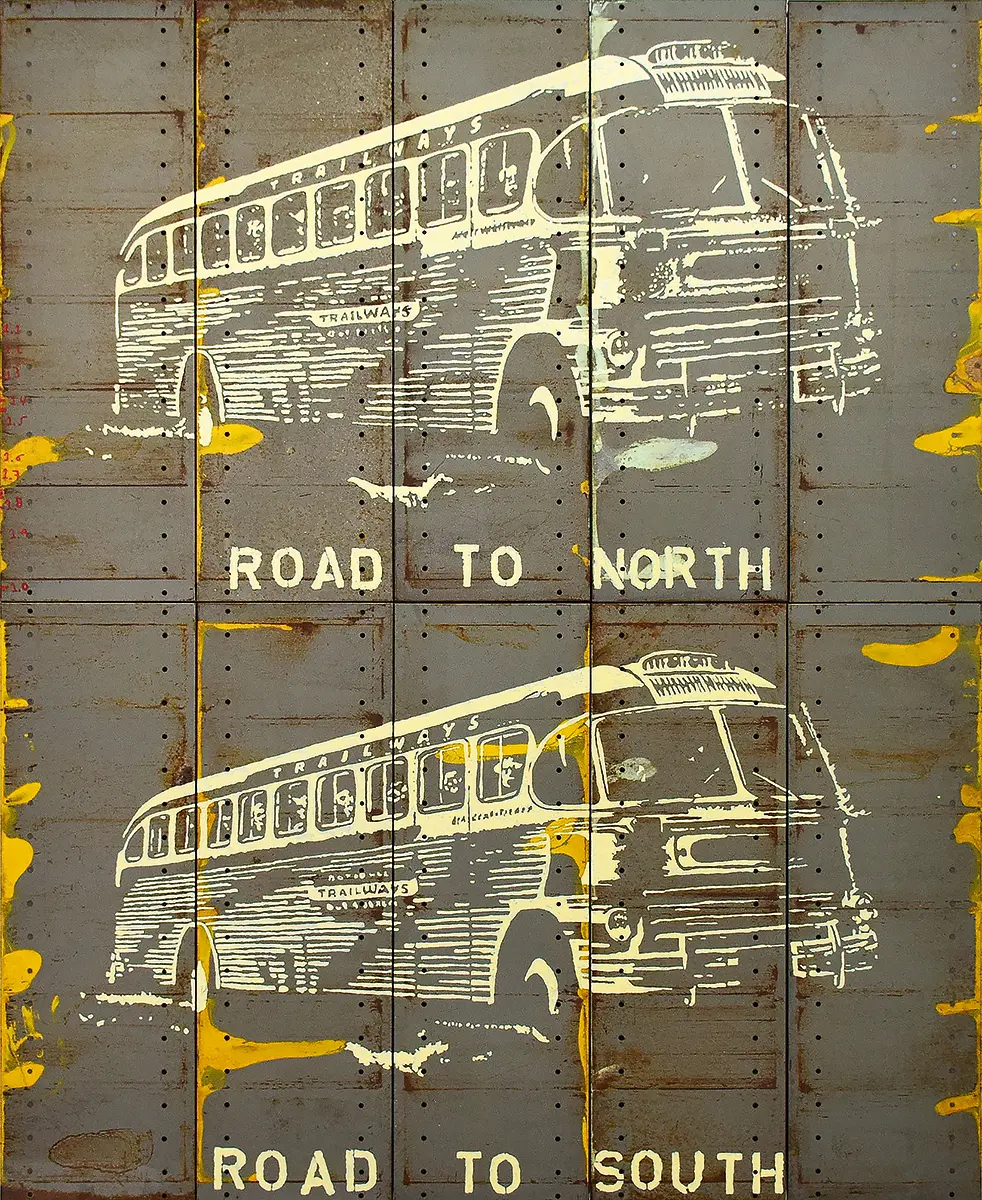
The work that begins the exhibition in Valijas (2010-2017), an installation of a set of travel suitcases—the most eloquent element of the journey—in a variety of designs, sizes, and shapes. The power of this installation is based on the number of suitcases brought into the gallery, which suggest the number of those who set out on a journey. Valet-Parking is an assemblage in ramshackle brass with automobile advertisements printed on its surface, which Anzola altered using graffiti technique. Litoral features a collage of photographs of the coast of La Guaira in two different moments, first as a virginal natural landscape and then with architectural interventions. Álbum is a collage of pages from an album where photographs, annotations, airplane manuals, dictionary covers, postcards, and advertisements have been preserved. Rancheras, from 2016, and Autobús, from 2017, are paintings/billboards that connect image and text: the former depicts a Ford Ranchero, a family vehicle, accompanied by the words (in English), “Left” and “Right”; Autobús, in turn, features a public transport vehicle next to the labels “Road to South” and “Road to North.” Rancheras alludes to the ideological split that takes places as different members of a family move to the left or the right, and Autobús refers to geographical motion and displacement. Portátil presents the transit of families by means of for boxes of typewriters on which the image of trailer homes have been printed. The next set of objects also functions as a discursive device, as they are connected with one another by the same idea: Educación is a diptych with boxes of slides to which two photographs have been attached along with a numbered list, in order of importance, of the values cultivated by primary education in previous decades: “Venezuela, Bolívar, Ruta Libertador, Campo Carabobo, Miranda, Andrés Bello, oil, iron, Natural Resources, National Mausoleum, national symbols, take care of your teeth.” Diapositivas features eight paintings on metal, intervened with images of European landscapes. The representation resembles a black-and-white projection slide of flat, white, whittled figures against dark and somber backgrounds. Boletos presents the journey as associated with pleasure and comfort. It is an assemblage made from tickets, dated 1972, for travel with the airline Viasa, placed on the covers of books colored in green. Meanwhile, Jabón, Cadena, Azafatas and Bandejas are small niches or shelves that focus on the absence of the objects or services mentioned in the titles, replaced by their idol-like image, or function as the trigger for the travel project.
The qualities of the world of objects associated with the serialized production of quick obsolescence, apparently dissociated of all historical context, are reformulated by the artist as he highlights the underside of this facet in the object itself: its anthropological character, its temporal anchoring, its unexpected potential to build connections and its further value as a vestige. Anzola activates memory by means of public narratives in which society recognizes itself and comes together. Recreating a common past, the artist inescapably unlocks the channels that connect personal histories, stoking the remembrances and affections contained in those objects and images. In times of crisis, the exhibition Tránsito (Transit) brings to the fore the diaspora of the Venezuelan people, the motivations behind this displacement, the losses, the absences and substitutions. It emphasizes the social dimensions of the scenes that have so sharply declined and the questioning of the new realities that have been built.
ANNY BELLO