The two long-standing traditions at the center of Arturo Herrera’s work remain in operation here in his first application of them to "pure" painting. With about 20 years of devotion to abstraction and collage techniques and his silence on issues such as figuration, narrative, or the complex relationships such traditions hold to the real world, the viewer is not given much direction. The paint on canvas seems to answer, and while his sense of abstraction is long-standing and personal, it is certainly part of a much wider revival of interest in the modernist language system. In this case, perhaps the “spirit of the time” (zeitgeist) tells us more than the individual intentions of the artist.
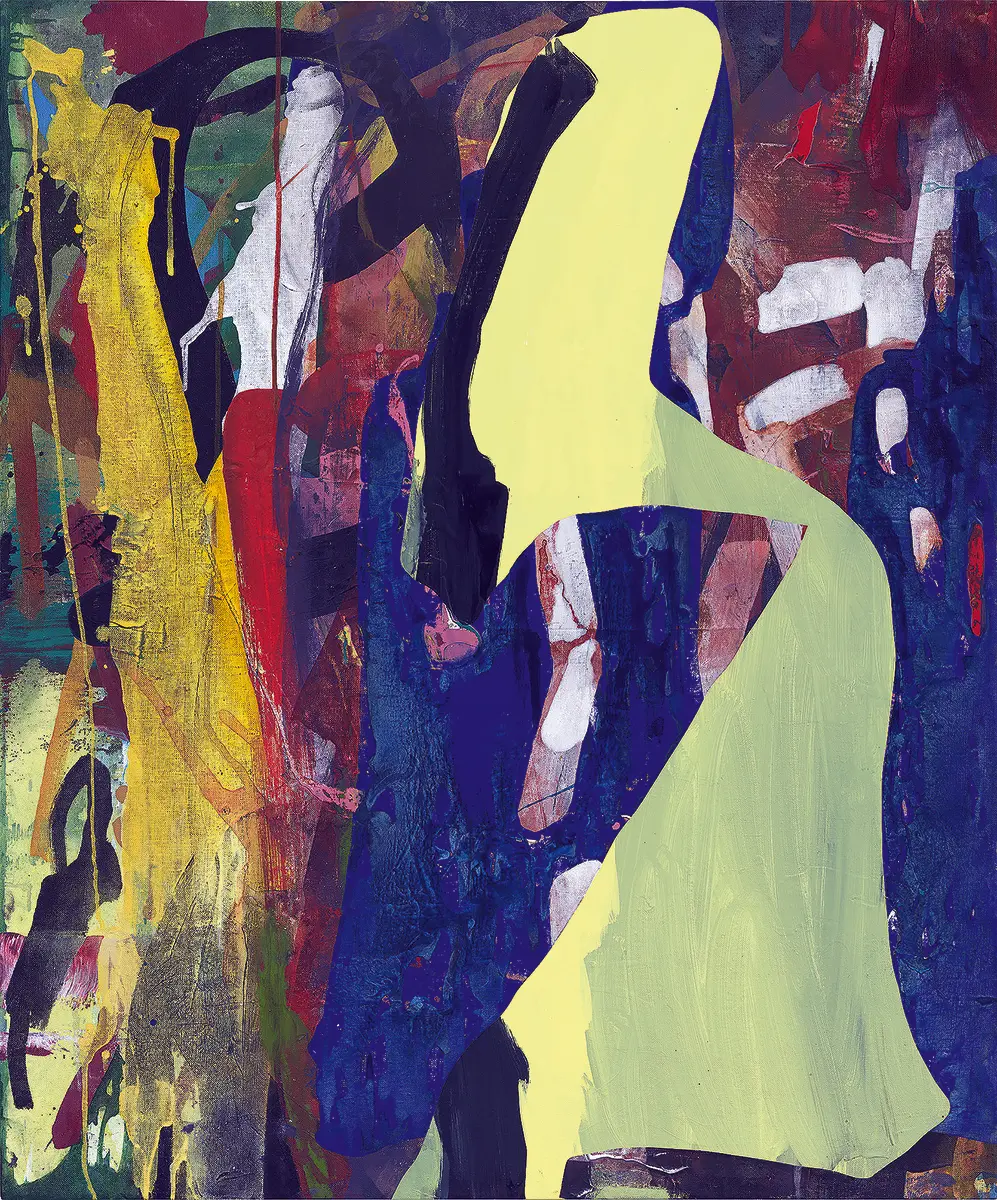
Perhaps you can see and feel Herrera’s personal, emotional and intellectual dialogue through his development of new forms. Indeed, the small to medium-sized canvases can be delightful visual journeys as you follow his complex creations of forms and boundaries that begin, end, disappear and morph; journeys “that lie on the shifting border between legibility and abstraction.” Paint here follows his long-practiced and much loved intuitive logic of collage.
Perhaps, as he also suggests, the viewer can locate an “associative power” in his “snippets” of earlier forms – as he once called them in homage to the collage strategies of resurrection he admires in the classical choreography of George Balanchine – now gathered here in new relationships.
As a self-professed, obsessive listener of music, perhaps we can fall into the rhythms and counterpoints Herrera constructs, or invoke musical correspondences from the colors and lines that the early 20th-Century abstractionists and mid-1960s experimental filmmakers were able to feel.
Aesthetic beauty, by its core definition, renounces any relation to the world in favor of a “disinterested aesthetic,” one that liberates the wanderlust of both minds and, as you move from canvas to canvas, body, as well.
All these are possible, but does anything beautiful or ugly, applied or disinterested, rational or random, really escape its relationship to its moments in the larger picture of history, especially when so many others have developed similar attention to abstract forms? Isn’t there a knowing by seeing and if so, how and of what meaning?
Moving from one to another of the eleven untitled acrylic paintings on canvas, easily losing oneself in the stop-and-go visual adventures, a sense of what we can call “presentness” develops within the experience of the viewer, more so than within the works or through the intentions of the artist. As we look, drift, and look again, we occupy not only a disengaged space common to aesthetic experience but also become aware of our own sense of being; a bit like watching yourself exist in the world, based on the very process of perception.
Modernist art was argued to be superior because there was a sense of “presentness” and “instantaneousness” to it. Obviously, the experience of Herrera’s work is not instantaneous, nor will “modern” - an aesthetic Herrera declares himself devoted to - be reborn. But it has become a renewed source for what has been called the New Sincerity – an anti-ironic attitude first developed in mid-1980s music and now reinvigorated to name an emergent openness to issues that postmodern irony and pastiche had dismissed as no longer viable or attainable. This sincerity, known by several other names, brought insistence on emotional feeling and the importance of vision as a lived experience.
There is an argument to be made that perception is not only a cognitive process – the often heralded phrase that the eye is part of the brain – but also remains as an embodied organ that bears the all too human burden of emotional responses required by the return of a sense of embodied reality that has been a bit destabilized, if only momentarily, by virtuality.
The Surrealists wanted to “see’ with their eyes closed, to see with an inner and sometimes savage eye to fuse mind and animal. Unlike music, which was the experiential model for abstract form in early modern art, the experience of an embodied experience brings a rather refreshing and perhaps renewed sense of self as present to a fuller degree; an affirmation rather than the denial of the body usually associated with the experience of abstraction. No longer an either/or proposition, the physical experience of Herrera’s works, perhaps unrecognized, is the simple yet timely and renewed assertion of arts traditional strength - that we are and need to be in this world as a fusion.
RICHARD LESLIE