Los Angeles audiences had an opportunity, between August 4, 2017, and January 22, 2018, to visit an Anna Maria Maiolino retrospective at the MOCA in Grand Avenue. The show, titled Pacific Standard Time, was part of a program sponsored by the Getty Foundation. This was the large-scale event’s third edition, and it was held in museums not only in Los Angeles but also throughout Southern California. The series of exhibitions had two areas of focus: Latin American artistic production and art created by Latino immigrants in the state. The work of local curators and their international colleagues resulted in seventy exhibitions shining a spotlight on a variety of historical periods and geographic-cultural contexts. Among the curatorships about the period, many included Brazilian artists, periods in the history of Brazilian art, and/or Brazil as a place for dialogs with other Latin American realities The Maiolino exhibition was organized in this context.
Occupying the galleries in the museum devoted to temporary exhibits, the show grabbed our attention with a stark and striking title: Anna Maria Maiolino. Curators Helen Molesworth and Bryan Barcena did not deem it necessary to add a subtitle in order to circumscribe the artist’s oeuvre, as was common in other solo outings seen in the same program. Maiolino’s name—and perhaps an element of self-reflection on the issue of identity on the basis of a proper name—was the starting point for the selection of works. The curators’ option might also be justified by the fact that we are not talking about an unknown name in the context of the international art circuit, but someone with a five-decade career behind her already. One can’t forget, for instance, her celebrated participation in documenta 13, in 2012. Also, not adding a subtitle to the exhibition frees visitors to engage the artist’s images in a much less preconditioned way.
After circulating around the exhibition’s spaces, a second curatorial decision was abundantly clear: the show’s chronological arrangement. Visitors were led along with the MOCA’s pristine architecture in a journey into Anna María Maiolino’s investigation, from her earliest works to the most recent. This type of rather a classical arrangement is not an issue for a retrospective art exhibition, but it is worth noting that any anachronistic connections—which can be very powerful—are left to the viewer’s devices.
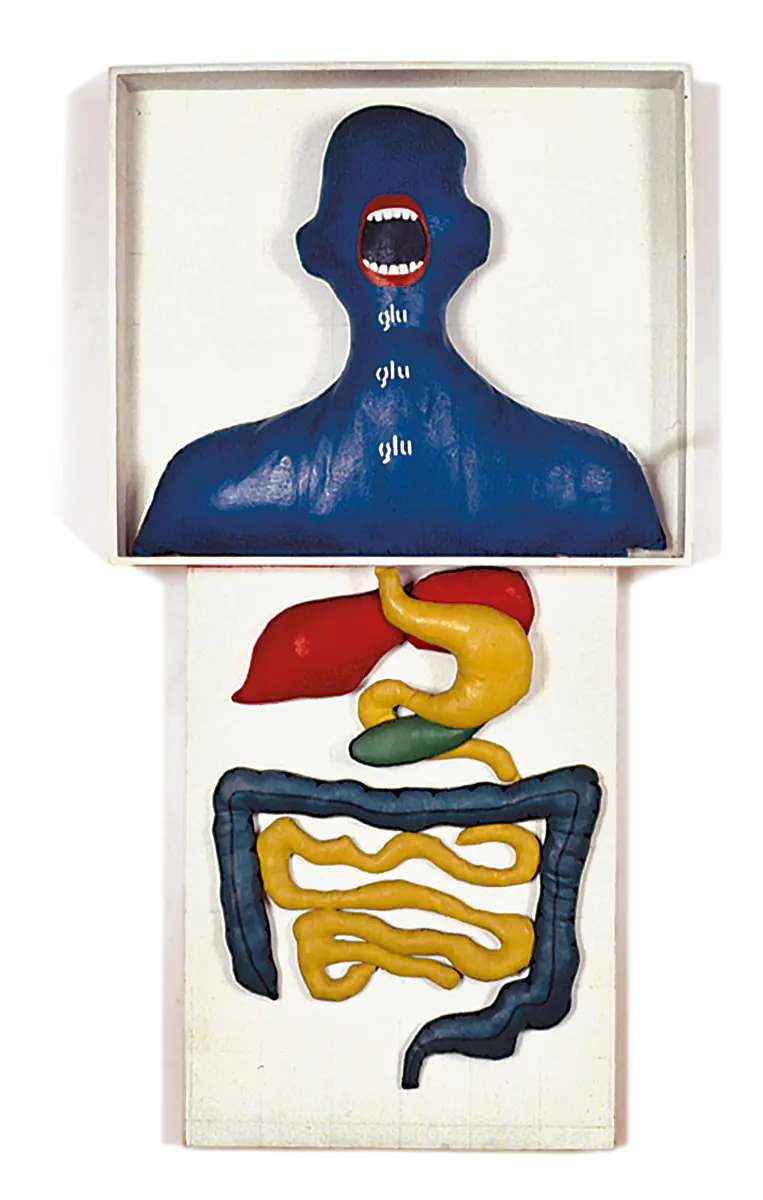
Born in Italy to an Italian father and an Ecuadorian mother, Maiolino moved to Caracas, Venezuela, in 1954. In 1960, at the age of 18, she arrived in Brazil. This biographical information is significant in her case because part of her work of the 1960s and 70s, already in Brazil, deals with her family’s transcontinental passage and multi-cultural milieu. The period of the earliest formalizations of Maiolino’s art is well represented in the exhibition by a number of woodcuts and objects with a strong pictorial component that can already be labeled “classics” in an overview of the history of contemporary art in Brazil. I m talking, for example, about Maiolino’s works about digestive processes, with the onomatopoetic titles of Glu glu (1967), Glu glu glu (1967), and Schhhiiii (1967).
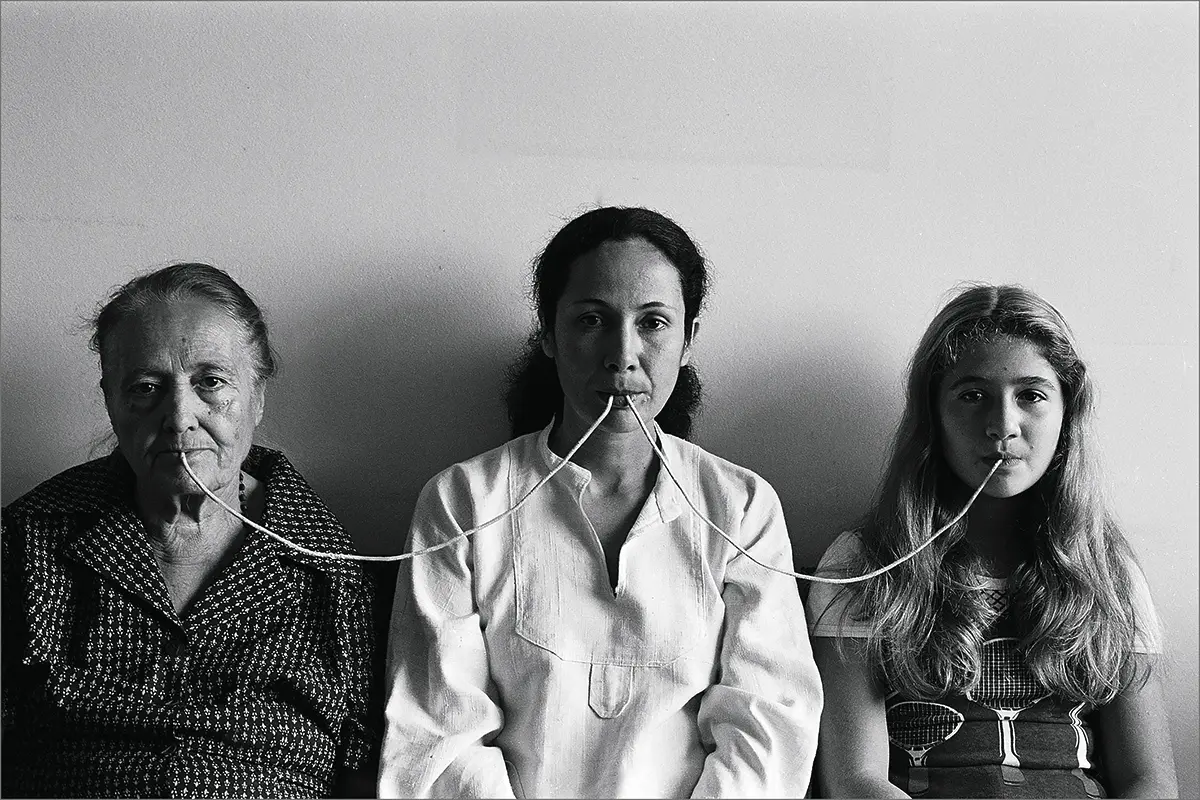
The relationship between image and word—an insistent concern in Maiolino’s early decades as a visual artist—appears as the marker of a dialogic process of cultural cannibalism after Maiolino’s wide-eyed, astonished arrival in Brazil. What did a foreign woman feel in Rio de Janeiro in the early stages of the military dictatorship? How would she dialog with that political and cultural context by means of images? What did it mean to be an artist and a woman in a context so dominated by male presences?
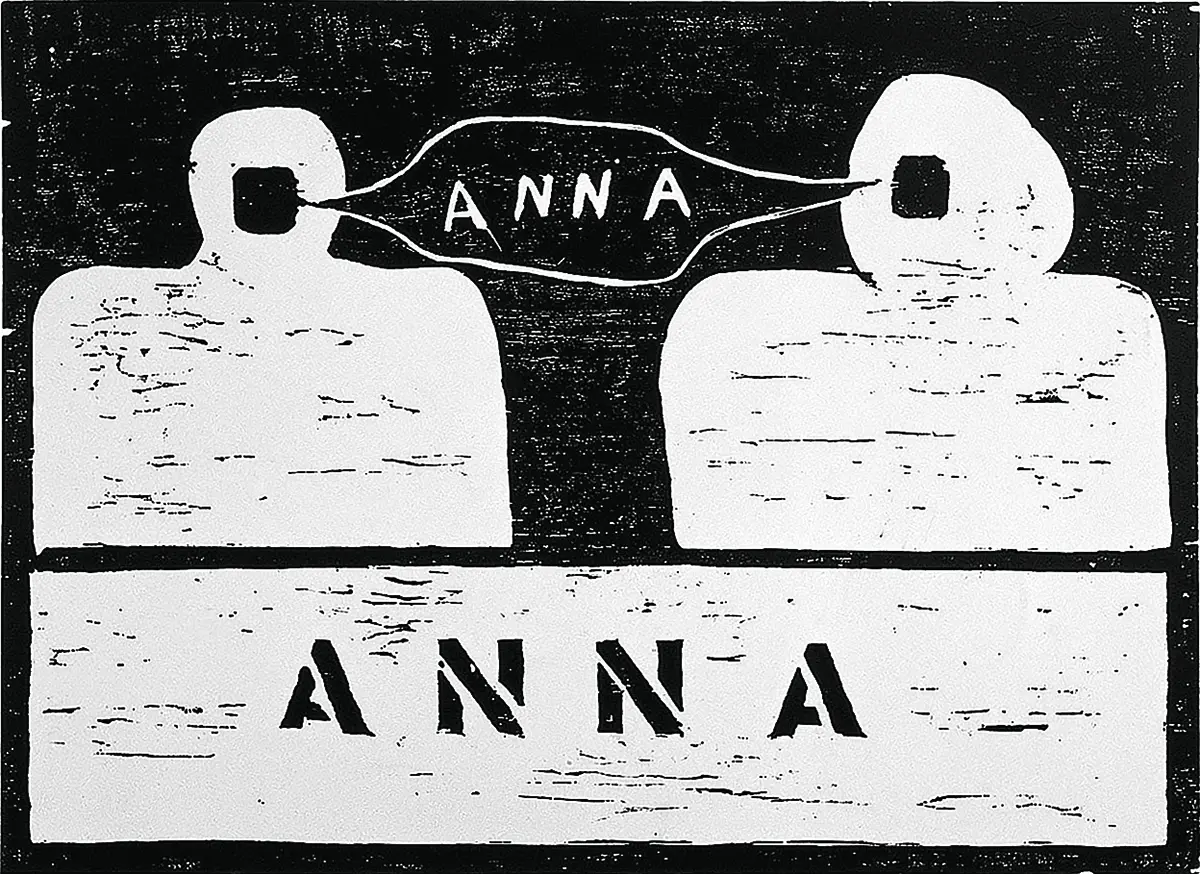
Maiolino seems to have been inclined towards the creation of works with acidic, corrosive contents that were nevertheless—unlike what happened with some of her cohorts—never limited to agitprop exercises. The irruption of the body is always an option for her, as is the use of materials or elements that refer to a domestic environment, as we see, for example, in her use of painted textiles in Glu glu glu, or also in the memory of a clothesline with items hung out to dry, as in La espera (The Wait, 1967). And even beyond that, there is also a meditation about some notions of family and her own place in them. It is not in vain that the woodcut Anna (1967) shows two figures in silhouette, possibly the archetypal father and mother, calling the artist’s name in comic-style speech bubbles. Nevertheless, even though they can be quickly apprehended and understood by our gaze, these human figures are never presented in a realistic style; they are masses of matter that assume their anatomical imperfections and scream more than they talk.
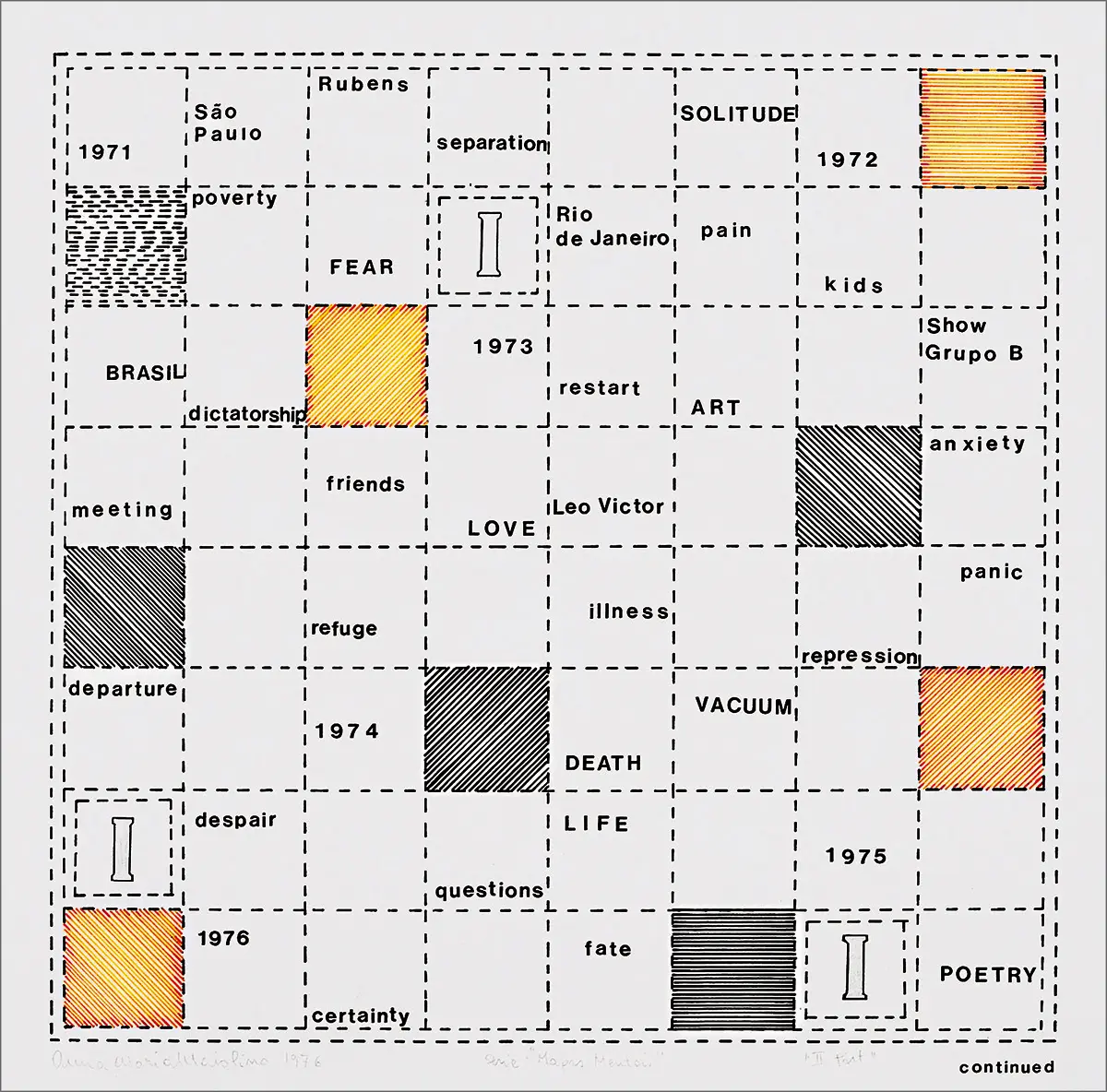
Not far from these works, visitors encountered a later series, dated in the 1970s. Maiolino’s Mapas mentais (Mental Maps) are small-format works in China ink and Letraset, where the artist divides the plane into small squares, resembling a chessboard. Inside the spaces are written words that create a kind of puzzle for the viewer. Therefore us to play with are place names, dates, names of people, and words describing sensations (in Portuguese and English, since the works were created during a stay in the United States) in reference to a whirlwind of experiences that the artist, nearing her thirtieth birthday at the time, had accumulated. The dotted lines in those maps, which bring to mind the lines used to guide actions like cutting or tearing, can be connected to some of the procedures used by the artist later on.
Maiolino’s Desenhos/objetos (Drawings/Objects) and her Projetos construídos (Built Projects), both from the 1970s, deal precisely with those experiments that seem to come from her map’s suggestion of cutting, sewing, and segmentations of planes. Metaphorically, the act of cutting can be a reference to excision and even to oblivion, just as the use of lines can be a way to signal an attempt to bring back something that was lost. In those works, as well as in the first photographs of the series Fotopoemaação, created during the 1970s and ‘80s, viewers are confronted with images that neither give themselves fully to pure formalism nor make explicit an obvious meaning. Between one pole and the other, Maiolino suggests small visual enigmas by means of her ability to create images that are sufficiently forceful as to not provoke in the viewer a desire for immediate comprehension.
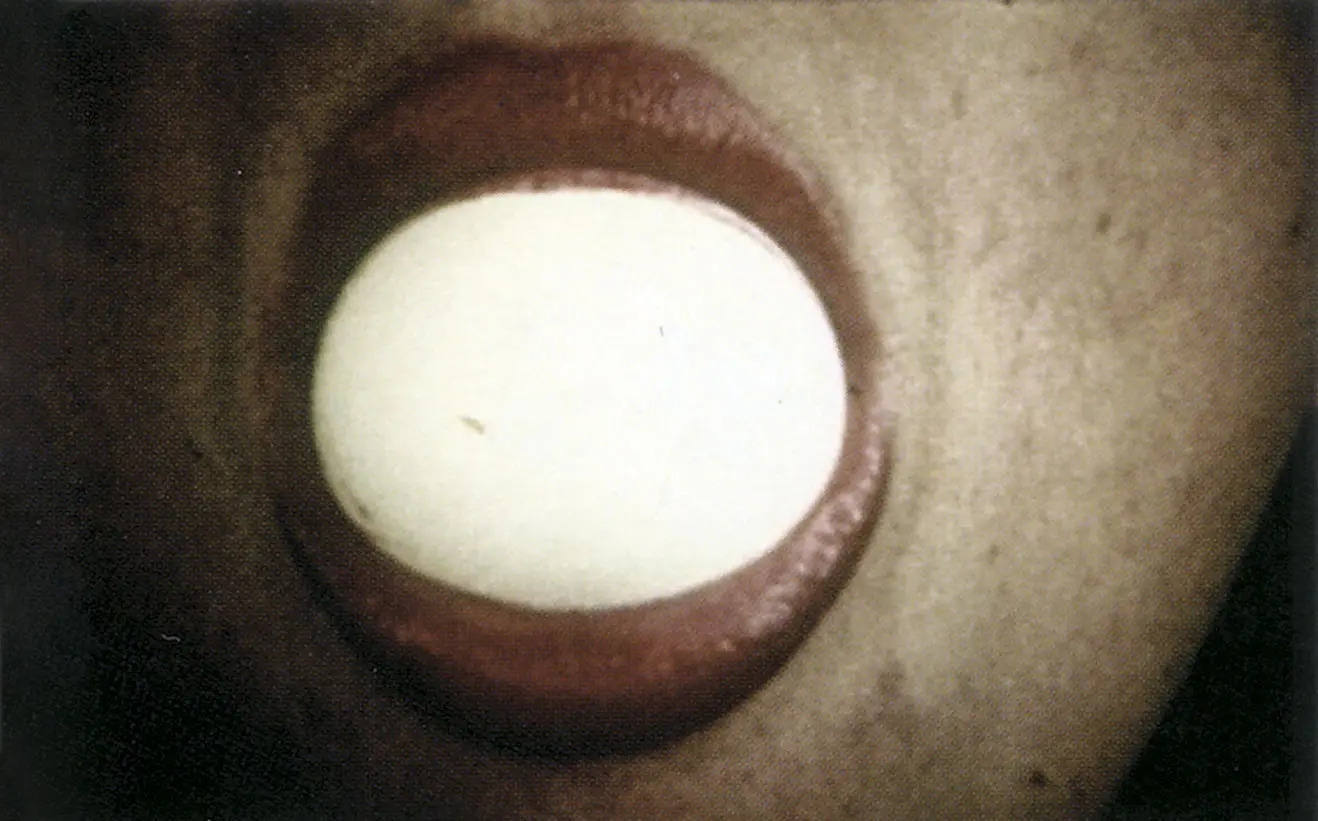
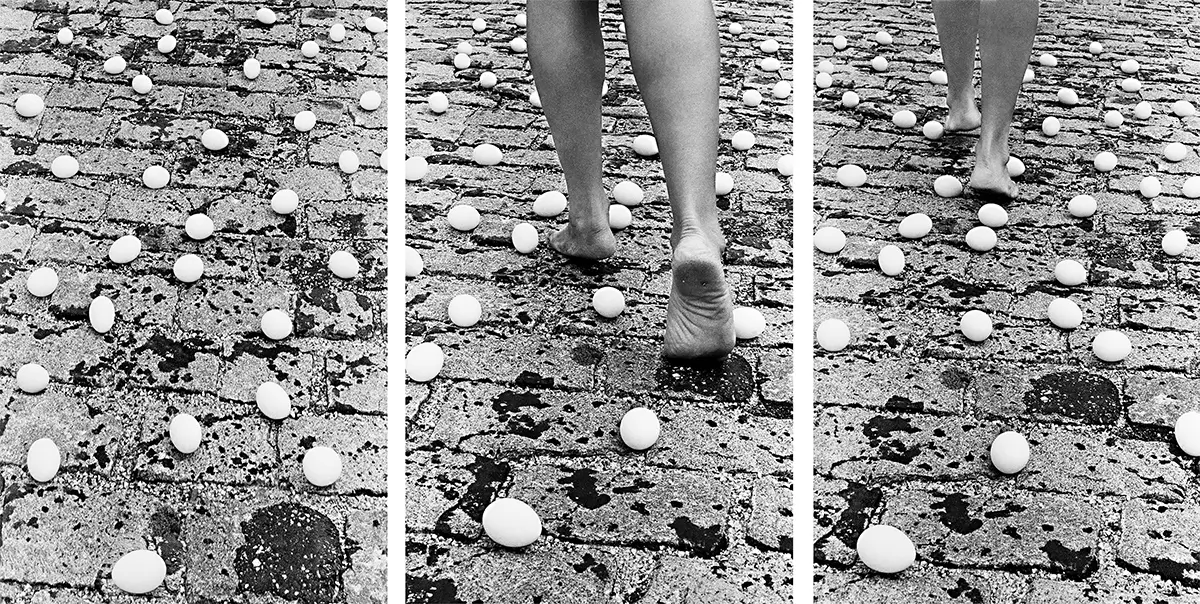
Objects with a significant symbolic charge, like scissors and eggs, accompany the artist in this photographic series, in her experiments with video, and in performances in front of an audience. During the first week of this exhibition’s run, Maiolino and her grandson re-staged a new version of Entrevidas (Betweenlives), a performance first presented in Brazil in 1981 in which the artist walks with her eyes closed between eggs strewn about the floor. The film In/out antropofagia (1973/74) is presented in the same space as the recording of Entrevidas, not coincidentally. In In/out antropofagia, Maioilno’s mouth is filmed at times with an egg, at times with lines. At times, there is an alternation between her mouth made up with lipstick and another one, equally made up but framed by beard and mustache hairs. In and out, male and female, eating each other and eating oneself are all fused into a single object in the image sequence, a good example of Maiolino’s constant experimentation not only with the medium of film but also with video.
It doesn’t seem sensible to attempt, in this limited space, an easily contextual exploration for the above fact, but it is nevertheless interesting to note that after the military dictatorship period in Brazil (1964-1985), Maioilino’s production turned increasingly away from the plane and become more sculptural and artisanal. She was never interested in agitprop, as we said, and we can see her production in sculpture as a continuation of her desire to explore the materiality of primarily organic forms, such as those eggs. Also, the presence of cuts and segmentation is again noticeable in these investigations.
This tendency is already on display in Maioilino’s work in the 1980s, in series of drawings like Aleph (1982) and Piccole note (1986), and later in the sculptures that comprise Nuevos paisajes (New Landscapes, 1989). Since these were not included in the exhibition, in the sequence of works analyzed here the audience encountered the elements mentioned in Maioilino’s production of the 1990s and later. Visitors were presented with a series of exhibition rooms where artisanal methods, human scales, and notions of repetition, seriality, and weight contrasts appear to be of great importance for the artist.
São oito na horizontal (They Are Eight In The Horizontal, 1993), for example, is a plaster sculpture installed at an angle between the floor and the wall, which rises vertically because of its weight yet expands discreetly on the horizontality of the floor. There is a soft and detachable quality to this work and other sculptures by Maiolino that provides a sensation of strangeness in the relationship between their weight and the materials used. On display in the same exhibition area were other works from the same period, all in cement, which provided viewers with an experience that revealed their hollow interior. In Um, nenhum, cem mil (One, None, One Hundred Thousand, 1993), the cement resembled baker’s flour, while the series Sombra do outro (Shadow of Another, 1993) and Uns e outros (Ones and Others) transformed the cement blocks into boxes. The next room featured works in plaster dating from the late 1990s to the early 2000s, as well as some paintings in acrylic, dripped onto paper.
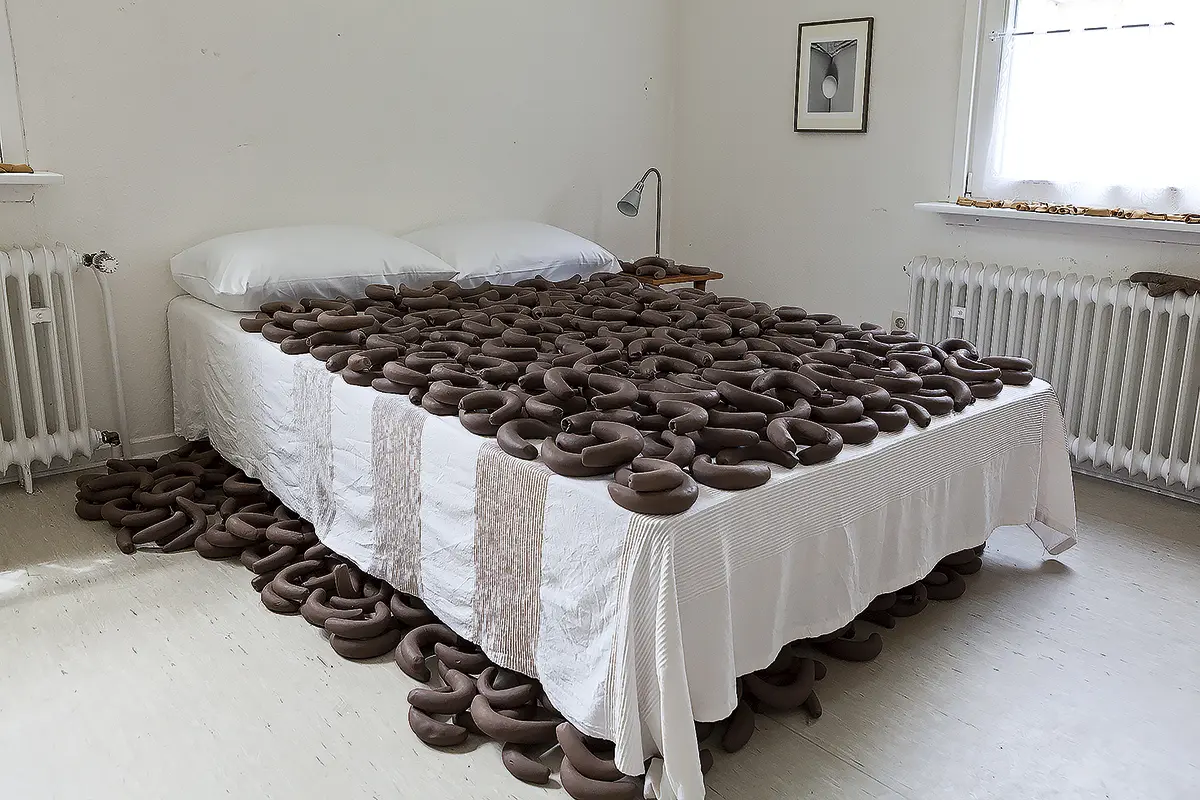
Those were the last two rooms in the exhibition. Before them, connecting Maiolino’s more two-dimensional work with the sculptural elements mentioned, the curators opted (thankfully) for a break in the chronology, in the same section introducing more recent works that resembled what Maiolino presented at documenta in Kassel. It was Estão Sobre a mesa (They Are On The Table), created for the exhibition of the series Terra modelada (Modeled Earth), which in a way caps Maiolino’s journey into those more artisanal investigations. While she began with the coldness and brutalist-like quality of cement, Maiolino quickly moved on to working with plaster, and finally, in a more ephemeral and site-specific way, with clay. Visiting these three final rooms reasserts one aspect of Maiolino’s production that, in light of the exhibition as a whole, can definitely be said to be dominant in her oeuvre: its emphasis on gestures.
Thus, it seems to make sense to connect Maiolino’s manual work in the woodcut Anna, in the exhibition’s first room, with her series in clay, at least in terms of the techniques used and the work’s core concerns. The hand that left its traces in those works is the same that, always at the scale of her own body, sew and tore paper objects, or staged situations with the scissors and the eggs in her photographs, in film, and in the video.
Due to the constant presence—sometimes explicit, sometimes hidden—of the gesture in Ann María Maiolino’s career, for someone who is well versed in her work the exhibition might appear lacking in examples of her forays in the video art genre. Because it is perhaps in those experiments—often without any further expectation—in capturing the banalest actions of everyday life, as well as details and gestures, that the issues mentioned above are present. I am thinking, for instance, of works like Construção/jogo (Construction/Game, 1973), + - = - (1976), Ad Hoc (1982), and + & - (1999).
It is known that all art exhibitions must respect the limits imposed by the available space, the budget, and the production requirements, but I think that including more works where the fragility and precariousness of form or of the register are key would have certainly contributed to breaking through the sterile environment of the museum and the show’s overly clean tone. That was precisely what fascinated us most in Maiolino’s installation at documenta: its ability to appropriate a space that was not initially assigned as an exhibition room. No doubt that the more polished aspect is also part of Maiolino’s art, but it was never a one-way street. There are works that prove it, such as her ephemeral action Estado escatológico (Eschatological State, 1978).
At any rate, and these observations aside, the importance of this exhibition is undeniable, not only for a greater understanding of Maiolino’s unique poetics but also to gain a better knowledge of the arts in Brazil in the last fifty years.
And let there be more monographic exhibitions about Brazilian artists active since the 1960s who continue to interrogate the direction of the visual arts in the contemporary era.
RAPHAEL FONSECA
Professor, art historian and curator of the Museu de Arte Contemporáneo de Niterói, in Brazil.