The first exhibition of works by Anna Bella Geiger (Río de Janeiro, 1933) in Madrid is organized around two poetic-conceptual axes: physical and human geography. The exhibition space is divided into these two poles, which are not, however, opposed or mutually exclusive, but flexible stages of an oscillating gradation. Curator Estrella de Diego brought together almost one hundred works that outline a rather complete mapping of the artist’s trajectory, including her forays into techniques and supports like video, photography, artist’s books, object art, installation, and collage. While physical geography is the realm of (historically male-dominated) scientific representation of space, the curator finds in Geiger’s work with maps a subversion of the order of geopolitical and gender domination. This subversive gesture goes beyond a simplistic or belligerent confrontation: with subtle delicateness not devoid of humor, Geiger questions the most solemn representations of territories and cultures, even blurring them almost in their entirety in order to open up space for a subjective, autobiographical representation.
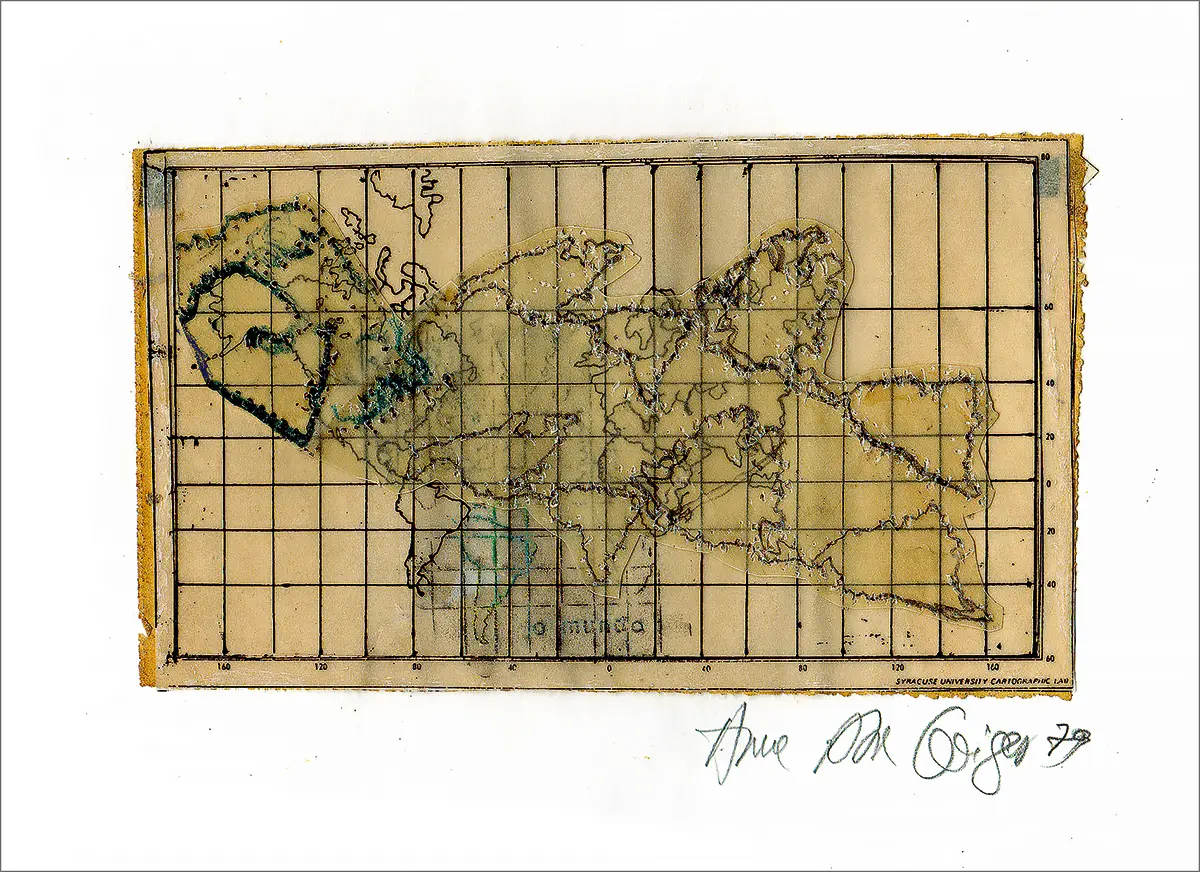
The camouflaged presence of the artist herself as decoration in a living room, a map that is a flower or another map that results from nibbling on a slice of bread are some of Geiger’s poetic-political gestures. In Amuleto. A mulata. A muleta. Am. Latina (Amulet. A Mulatto Woman. A Crutch. Am. Latina, 1977), the artist plays with the words and also with the outline of the Southern Cone, slowly transforming the map into an object imbued with supernatural powers, an afro-descendent woman, and an orthopedic crutch. Each one of these elements refers to notions (magic, sexuality, dependency) that are often connected to Latin America and its peripheral condition. In her emblematic Brasil nativo/Brasil alienígena (Native Brazil/Alien Brazil, 1976-1977), Geiger and a number of female collaborators remade tourist postcards of the country, imitating the gestures of indigenous peoples. Their operation produces a keen-eyed critique of colonial discourses and cultural stereotypes on the basis of a specific aesthetic universe.
In general, the works on exhibit are not grandiloquent; they are, rather, fragile devices of play and poetry. As De Diego emphasizes, many of Geiger’s aesthetic operations are connected to practices in the realm of femaleness, such as embroidery and decoration. This does not make their view of the games of power any less incisive. Parody is one of the most effective resources to that effect, and Geiger uses it often. In Rolo com fauna, flora, e humanos europeus (Roll with Fauna, Flora, and European Humans), Geiger puts on display in an old-style roll the uses, customs, and physical types of inhabitants of Europe. In Corrientes culturais (Cultural Currents, 1975), she makes a drawing of flows and centers of cultural power that resembles the ways in which ocean currents are represented in cartography.
Geiger often also highlights the ironies of art and life by means of such minimal gestures as (in a caustic wink to constructivism) the geometrization of a map of Brazil, a country historically associated with the sensuous sinuosity of organic shapes, or the simple register of a video of herself drawing a map as she listens to a song by Chico Buarque. The song was not fortuitously selected: in order to evade censorship by the military regime that governed Brazil at the time, the poet often deployed in his lyrics cryptic analogies and wordplay that allowed him to exercise social critique on the basis of the most personal emotions, taking the idea of the personal political to uncharted levels with great carioca gusto. In this case, the lyrics are a letter to an absent friend, telling him that things are so bad back home (a coisa aqui tá preta) that people care only about playing soccer, drinking the local firewater known as cachaça, and loafing about under the sun; it is a mischievous feat of poetry summarizing the misfortunes of life in a South American paradise.
There can be no doubt that Anna Bella Geiger’s show in Madrid is a landmark event. But it comes late. Its coincidence in the Spanish capital with Cartografías de lo desconocido, an exhibition of the cartography holdings of Spain’s National Library, is, nevertheless, a felicitous happenstance. Thanks to a creative curatorial proposal, those maps unfold as an exploration of the cracks of the modern mapmaking project: from terra incognita and the representation of the imaginary, to the assertion, found in a sheet in the exhibition room, that a map can serve both to help navigate and to disorient. Ana Bella Geiger’s exhibition has a bilingual English-Spanish catalog featuring essays by the curator and interviews with the artist. It was organized in collaboration with the Centro Andaluz de Arte Contemporáneo (CAAC) and the Museo de la Universidad Nacional de Tres de Febrero (MUNTREF), in Buenos Aires.
DIANA CUÉLLAR LEDESMA