All games are actions created to be “played” under a certain established set of rules. Participants know these rules, and few dare to ignore them. These two premises can be perfectly applied to the art world: playing can be used as an allegory for the world of exhibitions, spectators, and ceremonies. Andrea Canepa (Peru, 1980) relies on such premises to conceive a dance between terms. By exploring the boundaries of rules and showing them in a syncopated manner, Canepa whispers the clues needed to understand an idea of recreation (understood as “creating again” and “entertainment”).
Her latest works are exhibited on the three floors of the Galería Rosa Santos, in Valencia. The project Anschauung consists of a mountain of color prisms and three fabrics with strange symbologies—and even stranger titles like "It Is never literally true that any form is meaningless and says nothing. Every form in the world says something. But Its message often fails to reach us, and even if it does, full understanding is often withheld from us." This affirmation—by Vasily Kandinsky—is a clue for interpreting both the exhibition as a whole as well a slideshow projection containing teaching material shown without any apparent regard for following a pattern. The rules of this game appear to be complex: guided by preconceptions about what a board, its pieces, and logic should be, viewers take long to understand that they are entering a metagame. The piece challenges commandments that, since the 19th century, have been dictating how to fit form and color, supported by the guidelines proposed by Friedrich Fröbel (who patented the idea of the kindergarten with religious undertones), Maria Montessori (who, inspired by Fröbel’s model, developed the Montessori Method centered on intuition and self-education), and Zoltán Pál Dienes (mathematician creator of the logic blocks: the square, triangle, and circle painted with primary colors). The perversion of the basis for childhood education proposed by Canepa not only generates visual material that competes with abstract art and the aesthetic of Neoplasticism and Constructivism, but also atomizes the concepts that children worldwide have been relying on to develop their logical-mathematical, visual-spatial, and bodily-kinesthetic intelligence.
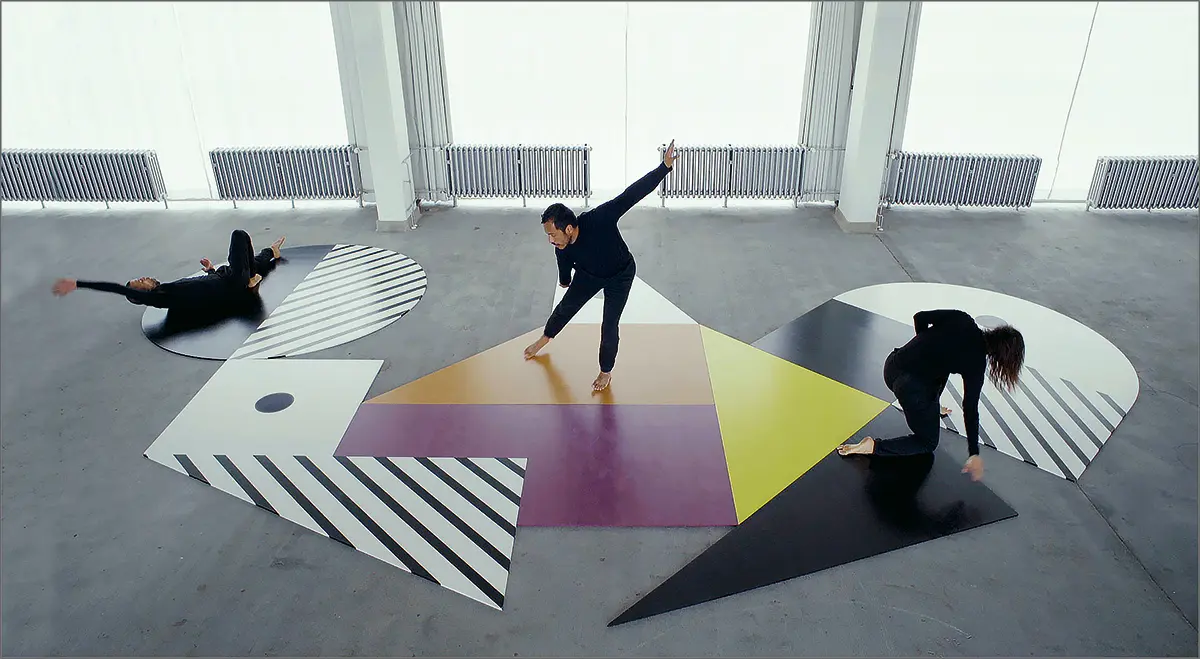
By overcoming the challenge, we gain access to the last floor of the gallery where we can become potential performers. In Until It Lives in the Muscle, Canepa presents a video performance alongside the elements that she used to create it—placed across the floor and walls, the objects invite visitors to imitate the movements performed by the dancers in the audiovisual. In this instance, the “pirated” referent—rendered in black and white—is Rudolf Laban, a dancing teacher who applied his knowledge of architecture to develop a method of precisely choreographed movements that combines equal measures of geometry, dance, and mathematics. Until It Lives in the Muscle proposes a rewrite of Laban’s proposal conveyed through the movements of performers on designed platforms; a sort of contemporary dance version of twister, in which repetition, apparent improvisation, and the codification of movement amount to an unknown symbology that is nonetheless susceptible to being learned just like any other pre-written game.
Al Margen del Juego (Outside of the Game), or the boundaries of the game, is a kindergarten where anyone can have fun but only adults can understand. It is an invitation to reconsider the roots on which we stand and, by extension, it is a door into the universe of “contemporary art” entered through an exit door.
JUAN JOSÉ SANTOS