Ana Tiscornia studied architecture, a discipline that has strongly influenced her artistic language. Born in Uruguay in 1951, Tiscornia has been living in New York City for many years now. In addition to being an artist, she is also a teacher and a curator. Her work has been shown many times on the international stage. In Buenos Aires, she presented the exhibition titled Collateral or Premeditated at the Nora Fisch gallery.
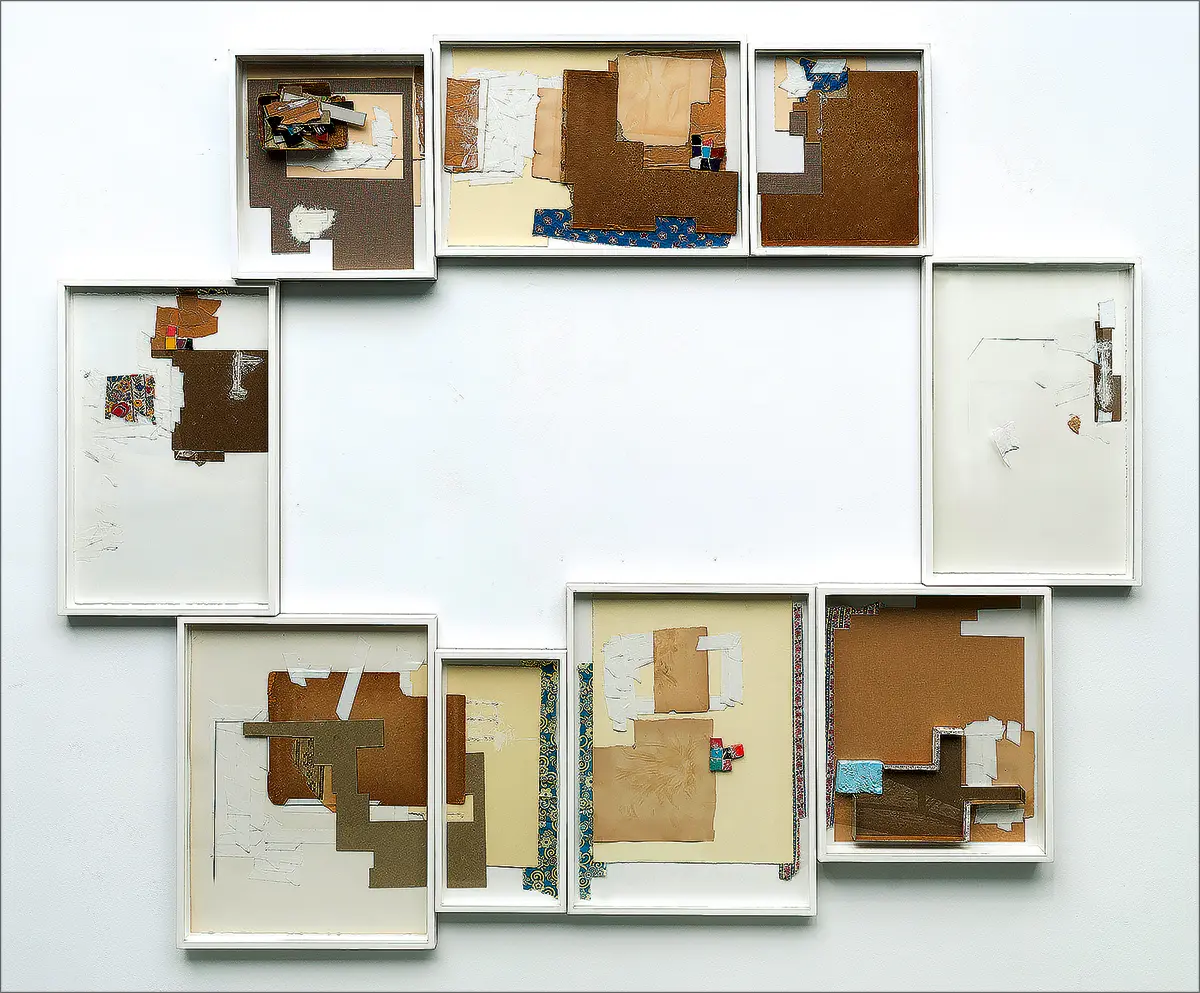
The entirety of Tiscornia’s artistic production in this exhibition seems to stem from a single main plane deconstructed and redistributed through a precisely handcrafted process in search of multiple variables. These variations appear to be responding to a permanent endeavor of recovery and reinstallation, in an attempt to find the right relationship between things established as norms and true necessity.
The plane of the childhood home is perhaps that hypothetical pattern from which lines, the configuration of living spaces, and the fragments of rugs and furniture multiply, along with the stairs, which appear to be in a continuous stage of development. Surely, the plane that gave origin to this first vital space does no longer exists. The distribution and significance of every single inhabited corner live only through the memories of past experiences. Recreations are formalized through remnants of memory in which vestiges are configured according to emotionally-shaped dictates (memory is overtly selective). While many details have been likely distorted by this evocative process, others have been completely forgotten. However, remembering something precisely is not an important issue. No longer traveled, touched, or experienced, space is reconstructed in a singular way, transformed into deep-rooted childhood memory impressions that determine to a great extent the development of a future life.
This individual process can be transferred to other situations that also involve a social approach to the subject of living spaces. While she begins with the childhood home, Tiscornia says that her interest in memory “is not about any particular type of nostalgia, but rather about believing in the importance of history. I am inclined to believe that those wishing to erase history are actually trying to find a way of repeating parts of it, something that is only possible if those parts have already been forgotten.”1 Tiscornia has expanded the focus of her inquiry towards urban spaces originated in poverty, immersed in the repercussions of a clearly unjust social order. Large cities are full of spaces like those, built and maintained with minimal resources, precariously, and almost entirely, organized intuitively and, most importantly, out of necessity.
A teacup handle capriciously emerges from a wall. Further ahead, there is a pile of intertwining, meticulously rendered and fragile-looking, cardboard ladders. In the middle of what at times appears to be the result of chaos, the skills of an architect are shown in Tiscornia’s ability to abstract and resize the space, transforming it into recognizable symbols on a plane. While one can sense the artist’s desire to create spaces that are welcoming and offer shelter, they also inhabited by a sense of austerity and social inequality.
Three works that dominate the entrance to the exhibition appear to be part of an independent installation. Two of them face each other, each displayed on one of the gallery’s opposing lateral walls. Like mirror images of each other, identical elements are repeated in both that while seemingly very different at first sight are actually only different in their compositional layout. A trimmed carpet placed in the center of the exhibition room is stripped of its function. It looks like a labyrinth to be deciphered. The legs of an iconic chair emerge from the floor.
The collateral in not central is not the main event. But it is the effect that carries countless implications with it, a continuous chain of events that range from the most visible to the most subtle or imperceptible. Ana Tiscornia starts with architectural planning in order to become immersed in those collateral effects while pursuing their organizing rhythms, incorporating original mechanics that lead to uncertain and unfinished developments. From the perspective of her personal life, the configured systems move forward towards the truth of history.
NOTE
1. Ana Tiscornia. The State of Things. Contemporary Artists II Series. Museo Gurvich. 2013.
VIVIANA SAAVEDRA