For anyone who knows the work by Brazilian artist Amelia Toledo (São Paulo, 1926–Cotia, 2017), the recent anthological exhibition organized at the Centro Cultural Banco do Brasil (CCBB), in São Paulo, encompassed the life cycle and work of one of Brazil’s most inventive Brazilian creators.
Titled Amelia Toledo: I Remembered that I Forgot, the exhibition paid tribute to a six-decade career of continuous exploration in the visual arts field that had a meaningful impact on the course of contemporary art.
Included in the flows of the exhibition established by the curatorship, the public was exposed to the approaches of a visual mind that favored the exploration of unusual territories.
Distributed across five levels (from the basement to the fourth floor) of the historic building located in downtown São Paulo, the exhibition project consisted of sixty works by an artist who used several lines of inquiry about Brazilian art to create a highly peculiar intervened space.
These inquiries, the result of decades of continuous work, revived an invitation to a public that would once again fall under her spell upon entering into contact with the multilayered sensorial experiences that, through the senses of touch and sight, allowed them exposure to the inventive and vital magical world of Brazilian art.
The exhibition offered six different thematic threads that covered the various aspects of Amelia Toledo’s artistic creation. By the entrance of the space, and under the theme The Encounter, the piece titled Praça das Cores do Escuro (Square of Colors of the Dark, 2017), used a mirrored stainless steel coil along with blocks of pink quartz, blue quartzite, green quartz, and fuchsite, to illuminate the environment and entice the senses of touch and sight.
In the sequence of thematic threads, the public followed a curatorial proposition that, according to curator Marcus de Lontra Costa, addressed Toledo’s “transforming affective art.” In the basement of the cultural center, viewers found the segments Cavern and the aforementioned Encounter, while the other levels contained Passage, Memory, Light, and Destiny.
In the Cavern segment, the 2007 series Singing Dragons, consisting of perforated sound stones on concrete columns, and the 1999-2017 series Impulses, consisting of polished and partially polished stones on concrete columns, divided the basement with the piece Pedra-Luz (Stone-Light, 1999), a large multimedia installation that invited visitors to a completely immersive experience.
The circuit titled Passage consisted of pictorial works by Toledo created with acrylic resin and pigments on jute or with acrylic resin and pigments on the cord.
Additionally, the same environment contained Toledo’s explorations with PVC tubing, water, mineral oil, and colorants. These works dialogued with the 2017 reissue of the 1993 piece titled Caleidoscópio (Kaleidoscope), consisting of mirrored curved stainless steel sheets coated with a blue color that dominated the space.
Under the theme Memory, several mirrored stainless steel modules, acrylic boxes, fossils, and wood boxes filled with sand interacted with the piece titled Poço da Memória. Dedicado a Meu Pai (Well of Memory. Dedicated to My Father, 1973), a fiberglass cylinder plated with polished stainless steel and a cylinder with the inscription Lembrei que esqueci (I remembered that I forgot), central element and emotional key conceived for the itinerary that accompanied the longevity of her many creations.
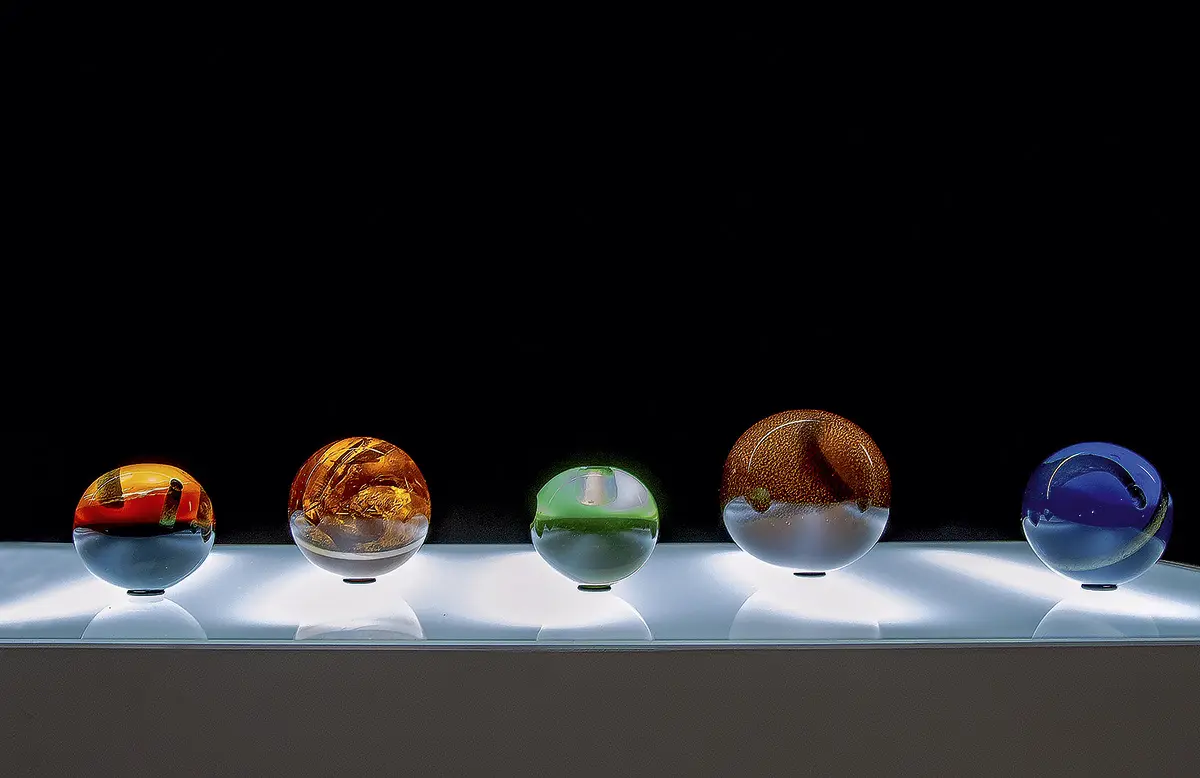
The Memory environment also offered visitors the colorful surprise of the historic work titled Esferas Hápticas (Haptic Spheres, 1969) created with polyester resin and inclusions. These circular forms, luminous balloons, with their blues, greens, and reds were capable of seducing the most distracted of visitors.
In every haptic sphere visitors could experience, almost taste, the sensorial reality that resulted from aesthetic experimentation that during the latter part of the 1960s was intensified by the tireless creator.
The segment titled Light presented a series of two-dimensional works on superimposed tissue paper and metal engravings, as well as the work Penetrável de Terra (Dirt Penetrable, 2014), the central piece of this section. The fascination that is generated in the public—who had to go through a translucent mesh of vertical panels in ochre and other ferrous colors applied with acrylic resin on jute—revived the feeling of a smooth labyrinthine exploration.
Lastly, the theme called Destiny included some of her best-known multiples, like Medusa (1967), created with PVC tubing, water, mineral oil, and colorants. The work was recreated in 2017 for the exhibition; Discos Tácteis (Tactile Discs, 1970), also recreated for the occasion, as well as Bolas Bolhas (Bubble Balls, 1968), the remarkable inflatables created with inflated PVC and bubbling liquid.
Ever aware of her surroundings and able to insightfully intervene in the most diverse materialities, Toledo’s proposals—which contained qualities achieved through the relentless exploration of colors, forms, textures, and atmospheres—left a unique mark in Brazilian art.
The creator of a highly temperamental body of work, unequivocal in the use of materials like stainless steel coils, quartz blocks, and also shells and pebbles, Toledo’s aesthetic vocabulary proposes, concurrently with the Neo-Concrete art explorations established in Brazil during the latter part of the 1960s, the need for an unbound body ready for life.
In her works, and even in her interviews, Amelia Toledo revealed an affinity towards environments fueled by an interest in a very peculiar type of constructivism reinvented by the creative powers of authors who were inspired by live sensorial experiences.
In fact, Amelia Toledo’s work was loved by the public, even her proposals far removed from the spaces consecrated to contemporary art. Her entire body of work, which always excited visitors from the most diverse backgrounds, was committed to the experiential project of a sensitive dialogue that her public recognized as a space of freedom.
CLAUDIA FAZZOLARI