Animal Cartography by Peruvian artist Alberto Borea (Lima, 1979) is a sort of critical mapping of the recent history of Peru. Several episodes in the history of the Western South American country, like the political violence of the 1980s and 1990s, the prevailing political corruption, the weak justice system, and its inability to uphold the rule of law, among others, form the traumatic itinerary surveyed in this exhibition.
The ground zero of this history appears in Arqueologías (Archaeologies), four large canvases depicting superimposed aerial views of various terrorist attack locations, including those of the Tarata bombing in the Miraflores district, in Lima, and of the Universidad San Cristóbal de Huamanga, in the Andean region of Ayacucho. The black and white palette and grainy quality of these images of urban areas are reminiscent of the newspaper photographs from the 1980s that crudely depicted the violence. In addition, perforations in these canvases reveal other underlying canvases that offer similar images, suggesting a city in a state of emergency as well as an archaeological excavation. That the canvases bear the marks of bullet holes suggests a type of archaeology more aligned with forensic anthropology.
This strange archaeology entails an exploration of the meaning of history and confronting wounds from the past that are still open because of an unjust justice system. The video titled Cosas que no entiendo ni quiero entender (Things I Do Not Understand or Want to Understand) evokes the dark web of justice by counterpoising two spaces that confront one another: the Sheraton Hotel and the Palace of Justice in Lima. The camera surveys a hotel room whose window offers a view of the building that houses the Supreme Court of Peru; drawing a bridge that connects a private space (associated with luxury) to public power and inviting viewers to wonder about all the judicial decisions that may have been agreed upon behind closed doors.
The correlative justice is the law—and its empire. In Orden, tecnología, Trabajo (Order, Technology, Work), a series of police batons intersect one another in a fused manner. The grid that they form is reminiscent of a ruler and, by extension, of jail (the punitive side of the law), of a hierarchical structure (intrinsic to the police institution), and of an urbanistic web (suggestive of a connection between the city, order, and repression) that, as result of its configuration and diagonal arrangement, is also reminiscent of the grids created by Theo van Doesburg.
By using the batons, Borea cancels the possibility of their order. And through its title, he suggests that dishonesty has checked the king: order, technology, and work echo the slogan of Alberto Fujimori’s 1990 presidential campaign: “honesty, technology, work.” Needless to say that Fujimori was sentenced to 25 years in jail for corruption, among other crimes.
And it is precisely corruption that is at the center of Sapito, a piece that recreates the Peruvian board game “Sapito” (small frog) that consists of throwing coins to the mouth of a metallic frog. In Borea’s version, the amphibian has been replaced with the head of a person whose features are a combination of Peruvian presidents from recent decades (whether dead, incarcerated, pardoned, on the run from the law, investigated, or under suspicion of having broken the law). In this manner, Borea creates a corrupt frog-president (in Peruvian slang, “frog” means astute) waiting for a coin to be thrown at him.
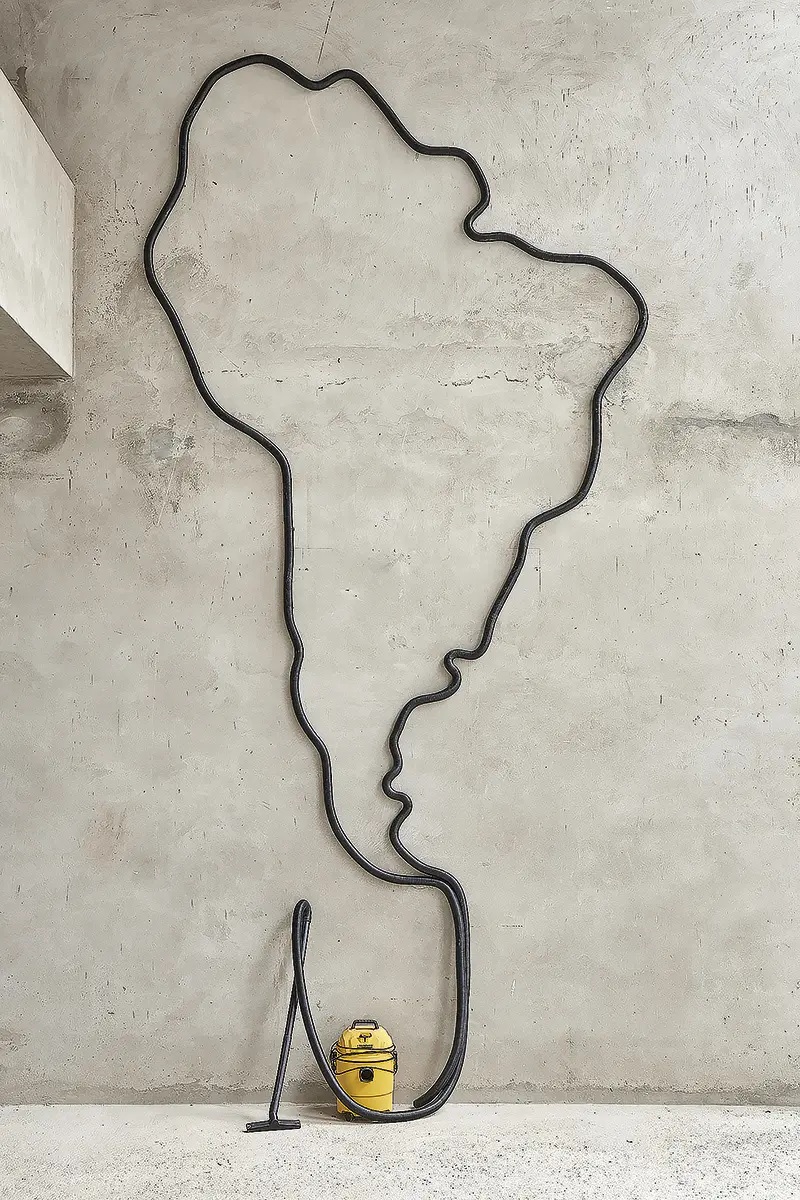
Aspiradora (Vacuum Cleaner) proposes a critical take on the problems of the continent. A very long industrial vacuum cleaner on the gallery wall draws the outline of South America. The vacuum cleaner points to the idea of cleanliness and, thus, of dirtiness (corruption, crime, violence, etc.), while also referring us to the job of cleaning. This is a South America shaped by cheap labor and poor working conditions. But cleanliness is also a metaphor and alludes to the aseptic nature of history (and its historians).
But the memory that emerges from history in a continuous process of purification is inherently confusing. As if it were from within a discotheque, blinking blue and red lights—typical of a police car—emerge from the interior of an old and dilapidated refrigerator whose doors cannot be properly closed. Consequently, in the piece titled Memoria (Memory), allusions to a garbage disposal unit (the junk appliance), a raid (the police lights), and nightlife (the flashing lights of the discotheque) converge into a confusing combination of entertainment, crisis, and insecurity.
The combination of order and entertainment also appears in Poesía (Poetry), a police helmet with a large multicolored visor similar to those used by the electronic music duo Daft Punk. The idea of authority is once again called into question.
Perhaps what Alberto Borea is proposing with this exhibition is, above everything else, the cartography of the affections and memories of a generation marked by suspicion, searching to understand the reason behind the scars that shape its identity.
MAX HERNÁNDEZ CALVO