During the months of September and October, Venezuelan-born-Miami-based artist Tony Vázquez-Figueroa presented Crudo / Archivo at the Espacio Rozas-Botrán zone 14, in Guatemala City. The title of the exhibition, curated by Carol Damian, refers to two concepts that are important to the artist: crudo (raw oil), which alludes to the oil he uses as a medium and is closely linked to Venezuela’s economy and the “archive” which refers to the historical reality his country experiences and the perception that people have of it.
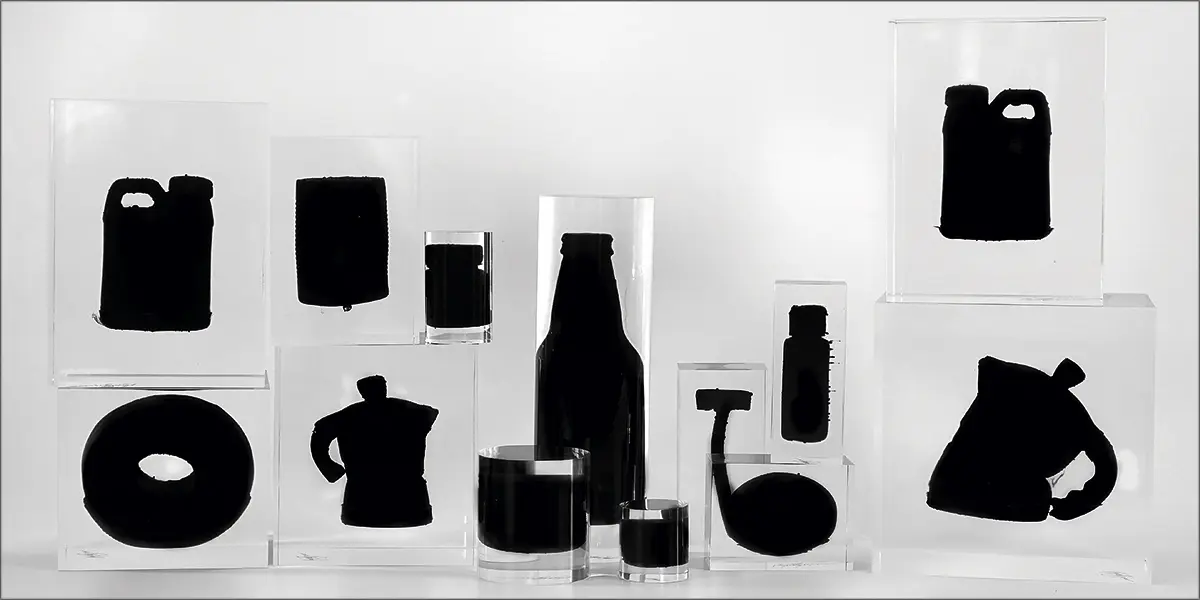
In 2014, as a response to the shortage of mass consumer products experienced in his country of birth, he began to sculpt the missing objects with bitumen, a black organic substance composed of hydrocarbons that are considered the heaviest crude and the most vicious material on the planet. The items, which included a coffee machine, a roll of toilet paper, and a milk carton, allowed him to create a kind of symbolic shop. The Inventory series became a sort of “file” that includes works he has produced over the past four years.
The idea of the exhibition came up when he was awarded the prize at the Rozas-Botrán Biennial, Awards & Auction (Miami, 2015) for his work In the Land (2015). This piece and a selection of drawings included in the exhibition Crudo / Archivo are inspired by printed advertisements. Between 1992 and 1997, Vázquez-Figueroa worked as creative director in his own advertising agency in Caracas. Once he settled in the United States, he began to collect and to reproduce in his works advertisements featuring Venezuela but made outside of the country, between the decades of the ‘30s and ‘70s. Initially, he transcribed the ads in pencil (In the Land / Señoritas, 2014) and later he copied them using filtered amber-colored crude using a pen he invented for this purpose (In the Land / Magic, 2014). As he read the messages in different ads, he realized that the information printed in them was not correct or was manipulated. In later works, he chose to extract the text from the ads and placed them next to the image (In the Land / Magic, 2014).
Annoyed because the ads spoke of Venezuela’s wealth when in reality the country has been experiencing an extreme economic crisis, he decided to develop the series Inventory, mentioned above. The objects made in bitumen, documented photographically in Inventory (2016), melt over time and end up being puddles of oil. In a way, the disintegration of the sculptures symbolizes Venezuela’s reality. Through his work, the artist wonders how such a rich country could have arrived at the current situation and he believes that if resources had been well-managed things today would have been very different.
In addition to the objects, he produced two series of photographs titled Inventory / in Nigredo (2016) and Inventory / In Concreto (2016). The first one was inspired by the refinery’s aesthetics and the industrial landscapes he recalls from trips made in his youth. The second shows everyday objects, such as a coffee maker and cans of food, made with concrete. Unlike bitumen, concrete immortalizes products that in the past were very much part of people’s daily life but now, with the crisis, they have been relegated to memories.
That same idea inspired the work Inventory / In Memoriam (2016-2017), made of common objects such as bottles and plastic containers made of bitumen and encapsulated in resin. This process gives greater durability to the pieces and allows their “memory” to be frozen in time. In some cases, the artist lets the objects melt a little before placing them on the resin. According to him, the objects are humanized as they melt and they symbolize, somehow, the exhaustion of Venezuela’s political opposition.
The series Black Mirror / Portraits (2017) was inspired by the Biennial’s winning piece which included a small box full of bitumen perforated so that the oil dripped as it melted. That led him to experiment by placing the bitumen between two acrylics creating a black mirror. According to the artist, just as oil distorts the perception of things, the black mirror distorts not only the person’s reflection but also the way he or she sees the world. He later transitioned into a new type of work, placing a huge drop between two acrylic sheets. The result was a more intimate mirror that looked like the samples that are placed under a microscope.
The exhibition ends with the series Spills (2017), which presents color spots compressed between several acrylic layers. Inspired by the colored satellite photographs documenting major oil spills, the series marks his return to color, which generates him great satisfaction because it reminds him of his student days in which he worked with paint and collage. The exhibition Crudo / Archivo allows us to see for the first time in the same space the different facets of Vázquez-Figueroa’s work and highlights not only the impeccable quality of the pieces but also their important historical and conceptual value.
FRANCINE BIRBRAGHER-ROZENCWAIG