Costa Rican artist Priscilla Monge (San José, 1968) presents the exhibition titled Fragments from a Loving Discourse at the Galería Luis Adelantado in Mexico City. Inspired by the title of one of the most celebrated books by Roland Barthes, the exhibition was originally scheduled to open near the date of the earthquake that, on October 19, 2017, destroyed several neighborhoods in Mexico City. The inauguration was postponed out of respect for the tragedy and the victims.
In this manner, in its latent contextual (in)visibility, the established condition invoked by Monge in this group of works is overwhelming and touches the neuralgic points of themes that, on the one hand, turned Mexico City into a brutal reminder of the absolute vulnerability of existence and, on the other, led to the actuality of displaying a profound vital resistance as well as our deepest fears—suddenly turned into evidence that lacked a discourse about the imminent awareness of a fragmented forever.
In the gallery’s grand nave, a very large white canvas floats ethereally cutting the space into two. A large Sábana (Bed Sheet, 2017) has been “delicately” perforated in several points—Monge sews sections from several “nuptial sheets” that featured a hole strategically placed for the wedding night so the groom’s penis could penetrate the vagina without touching other parts of the skin. Here, the work formally and symbolically questions and resignifies that very heavy cultural and religious veil while exploring the depths of being exposed. It also reaffirms the self-recognition of domination—prowling the darkness of the unconscious that “dresses” sexuality as something unblemished, but deems it murky when it strays from what is expected and longs to touch the unspeakable.
Four large Polaroid photographs measuring 170 × 150 cm, intervened with oil and coal, are consumed before our eyes immersed in the dark densities of the coal: fires under increasingly darker blacks that cry out for the destruction of the visible/invisible. The images offer passages of a looting scene through the calligraphically written titles—a recurrent distinguishing characteristic in Monge’s artist’s work—located in the white bottom area. Between the observed and the read, the illegible and the visible, the provoked gaze reaches beyond the continuous narrative order, ignoring the pre-established directive, jumping from one image to another with a subtle and increasingly cardiac rhythm that incites in and between every “fragment” a narrative offered from within the ashes. It is like an exploration of the clues documented by Monge in the image and strokes from other layers of the present; superimpositions of passages, time, sensations, and meaning.
It is almost possible to unravel a coarse and disjointed narrative from the tragedies exposed by a desolate intimacy, whether by exploiting its conventional dimensions or those confined in the vignettes of other seven Polaroids (65 × 50 cm) intervened in the same manner with phrases and titles like: El Fuego Abrazó Toda la Casa (The Fire Engulfed the Entire House), Todo Era tan Lindo que le Dio Miedo el Infierno (Everything was so Beautiful that He Got Scared of Hell), El Fuego la Dejó Completamente Limpia (The fire Left Her Completely Clean), Orinó Sobre las Brasas (He Urinated Over the Embers), No Tuvo Miedo al Infierno (He Was Not Afraid of Hell), and Tan Frio que Quemaba (So Cold It Burned); all from 2017.
A constant tension between visual abilities and intensities and the narrative potential of writing shakes the walk through the exhibition. What unfolds between words and images to a nearly breaking point? What amorous and sordid texture, exposed interiority, saturation devoid of gravity, is placed among the works to gestate in actuality an embrace-ablaze (namely, that which unites and consumes at once [pace Barthes]), an embrace of that which is rejected: A magnetized repulsion/attraction force between the poles of language in between which Monge’s work is dismantled?
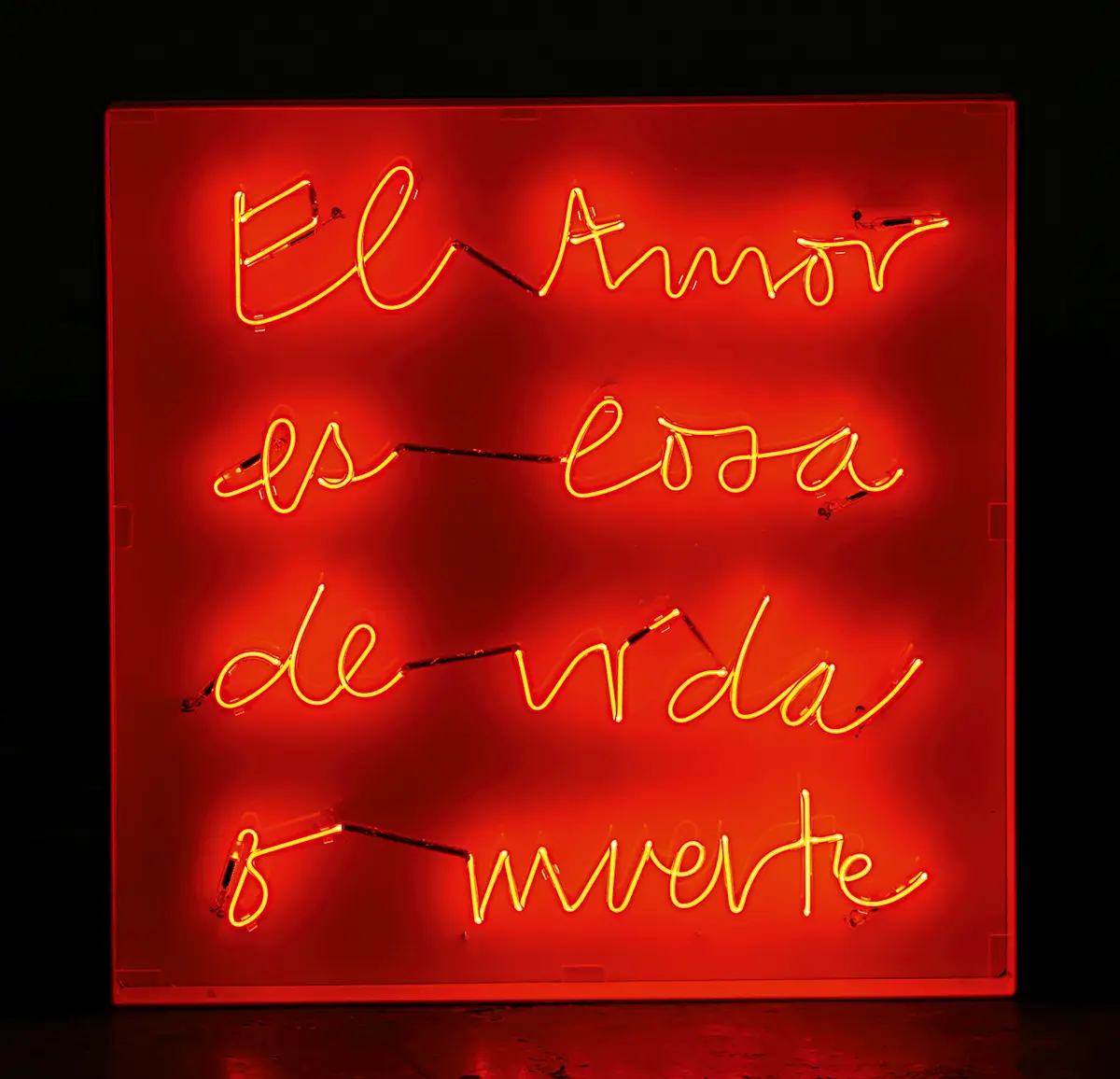
The Costa Rican artist constructs the omen of a past that attempts with the last remaining shred of certainty to tell (itself) in order to inhabit, to remain in the present. In a darkened room three pieces “written” with red neon tubes (80 × 80 cm) are germinally reminiscent of the Blackboard series by Monge, repeating the white chalk writing in between them, like the condensed remnant of a school disciplinary action: No Debo Sentir Dolor (I Must Not Feel Pain,1995). Now, the crude, uninhibited and silky red of the phrases brightly glows from “duty” to the motto: “Love is a matter of life and death;” and one of the three phrases, the diagonal one, ignores structurally formal horizontality as an attempt to assign itself reality from “another” direction: Este es un Lugar Poético (This is a Poetic Place, 2017).
Also worthy of mention among the other works that complete the infringed and extremely pertinent thematic opacity of the exhibition is the piece titled Instrumento de Medición (Measuring Instrument, 2015). It consists of seven marble circles, each measuring 30 × 30 cm and framed with flimsy wood embroidery hoops made seven clocks. Revealing a conceptual counterpoint—not only in opposition to the marble, a historically resistant and revered material—are the graphic incisions—now numbers—a mark/hour per circle that establishes its symbolic coldness as the materialization of the forensic “body clock” that measures the outline of the vagina in rape investigations (following the formal/temporal parameters of a conventional watch) to discern the instances of forced penetration and the time gone by since the act was perpetrated. It is a confrontation that elicits a new approach to violence/gender by unfolding the spectrum of Priscilla Monge’s creative continuity.
Fragmented, wanting in love, we eagerly seek duration.
MARCELA QUIROZ