Paul Amundarain, a Venezuelan artist living in Miami, presented his latest solo exhibition, Símbolos rotos (Broken Symbols), at Cerquone Projects, a new space devoted to showing emerging contemporary art. In this exhibition, curated by Walter Cerquone, the artist was able to consolidate a language where the formal treatment of the image, seen as a sequence of fragments, shed the abstract connotations or earlier works and focused instead on a critical reflection about the interruption of the modernizing, progressive process that characterized Venezuela in decades past.
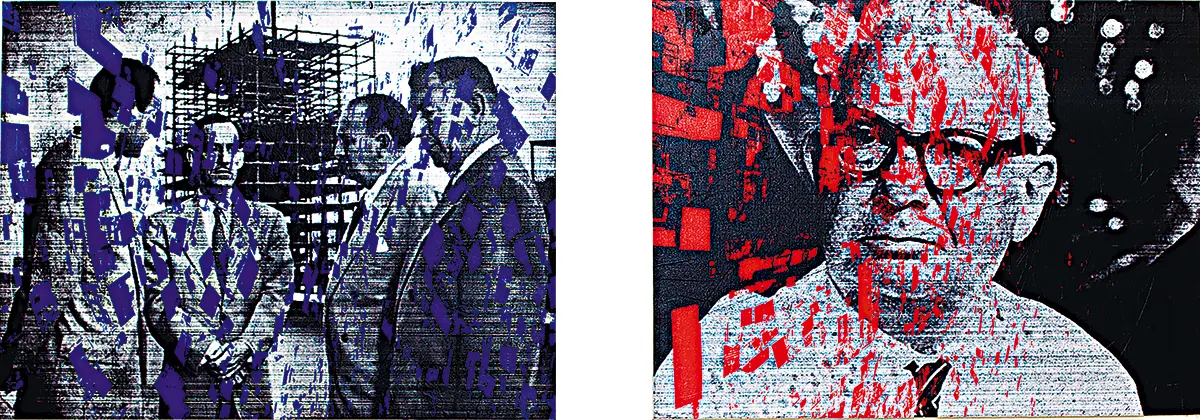
Amundarain’s works in this exhibition can be subjected to different readings. Nevertheless, none of them casts aside a recognition of the course of history, in this specific case, of the city of Caracas. This is due to the fact that all the referents on display belong to the Venezuelan capital: buildings monuments, avenues, urban-scale artworks, etc., seen in black and white period photographs intervened by the artist. Amundarain also intervened images of the protagonists of the period: Marcos Pérez Jiménez, Venezuelan dictator between 1948 and 1958; architect Carlos Raúl Villanueva, the forger of the Modern Caracas we see today; and others.
This modernization process, which in truth began in the late 1930s and early 1940s, reached its moment of splendor during the Perez Jiménez regime, in the 1950s. The monuments and architectural constructions represented in this exhibition became, over time, symbols of modernity: the Simón Bolívar center and the Towers of Silence (projected and built-in 1948), as well as Los Próceres (inaugurated in 1956) and the University City (projected by Carlos Raúl Villanueva between 1945 and 1954). Libertador Avenue (begun in 1957 and finished in 1965), the Parque Central architectural group (an example of the “brutalist” style), and the Teresa Carreño Theater—the last two built between the 1970s and 1980s—all emerged later, during the democratic era. Alongside these emblematic buildings and sites, Amundarain emphasizes the presence of Venezuelan kinetic art in Caracas’s urban space, for its national and international transcendence. Jesús Soto, Carlos Cruz-Diez, and Juvenal Ravelo are present in the city’s environment with important urban works.
All these referents appear in the video Símbolos rotos, which opened the exhibition. Both the start and the end of the video show panoramic vistas of Caracas. Then, the images register details and “narrate” a car trip to those various sites that identify the city. But we only see them on the cracked rearview mirror. The entire exhibition is posited from the same perspective. We see it in the series Sueños de modernidad (Dreams of Modernity) and in Broken Painting. By means of such fragmented visions, we see, through a series of architectural details, the geometric-abstract aspect of the city—abstractions that to a degree reconnect these recent works with the artists' earlier production. Now, these shapes are charged with meaning, from the moment that the rupture of the modernization process by the unfortunate situation of the country today is subjected to critique. The cracked image on the mirror, then, denotes in a direct way the fragility of these symbols of identity. These are indeed broken symbols. The images in the video, on the other hand, speed up, and slow down, and acquire greater dramatic power by their association with a music concert heard during the entire journey.
The broken fragments in the mirror are explicitly represented in the paintings featured in the exhibition. They are the pictorial motif in themselves. The series Broken Painting brings these fragments further to the fore with their representation at a larger scale and its play of positive/negative images. Meanwhile, the use of color, especially in the photographs, has a clearly ironic intent: the gilded lines or markings in the triptych Sueños de modernidad “CSB” (Dreams of Modernity “CSB”) allude, perhaps nostalgically, to the golden era of modernization. In Sueños de modernidad “Juegos políticos”, (Dreams of Modernity “Political Games”), the printed pink-colored tracings of the popular game known as "La vieja" (The Old Woman) question its historical import, due to the unduly mistreatment of its figure from the high spheres of power. The game remains unfinished. In this way, Amundarain highlights the fracture of its powerful symbolic significance.
In the eighteen works that comprise the exhibition Símbolos rotos, Paul Amundarain demonstrates conceptual density in the treatment of such a complex issue as the Venezuelan context, seen through its history and its legacy. Similarly, his versatility in the use of different media (painting, printmaking, photography, video, as well as the sculpture for he is known) was in ample evidence. As Gabriel Guevara notes in the exhibition text, Amundarain seeks in this way “to present symbols as demystified by the situation of complete social, political, and economic dislocation in a country that was an example of progress, security, and intellectual and artistic reach, a point of reference for Latin America and the world.”
SUSANA BENKO