Working with objects to bestow upon them dimensions that are not theirs is something applicable, for instance, to the contemplation, presence, and sensation elicited by a “scene.” São Paulo-based Argentinean artist Pablo Accinelli (Buenos Aires, 1983) proposes in the exhibition titled Faraway at The Goma Gallery, in Madrid, a different perspective about constructed objects. Suggested by the title itself—which alludes to the distance required for observation—upon entering the gallery space we observe several devices that immerse us into another dimension.
Based on the readymade concept—widely developed in contemporary art—Accinelli nonetheless succeeds in not falling for themes pertaining to the reutilization of industrial objects. Instead, he offers a clean and refined proposal that is even mysterious: the white cube of the gallery displays very simple artifacts that nonetheless acquire their own presence and temporality. The piece that gives the title its name, Lontano (Faraway) is made with wood photographic paper, and locks. In a very subtle manner, we are shown a reference to time unfolding within the work of art, which is not easily accessible. The theoretical reference that inevitably emerges is that Michael Fried and his book titled Art and Objecthood (1967), in which the New York art critic fiercely criticized minimalism for introducing stage values in the visual arts, namely: contemplation, duration, and theatricality.
According to this, a transition occurs in which the materiality of the work itself is replaced by the situation constructed around it. And something similar happens in the exhibition by Accinelli at The Goma gallery. The displayed industrial objects remit us to a working environment. They have been divested of their entire original meaning. For instance, the piece Duración Interna (Internal Duration, 2015) consists of a standing corrugated cardboard cylinder with a rake wrapped inside it. This piece challenges viewers to walk around it, observe it, and enter into contact with it through the curiosity that it elicits and the sensation of impenetrability that it conveys. On the other hand, the contrast between manual and industrial processes, between rural and urban contexts, also inhabits the pieces.
This is the first solo show by the Argentinean artist at The Goma gallery. Pablo Accinelli lives in São Paulo and is one of the names that have stood out in the emerging art coming from Argentina.
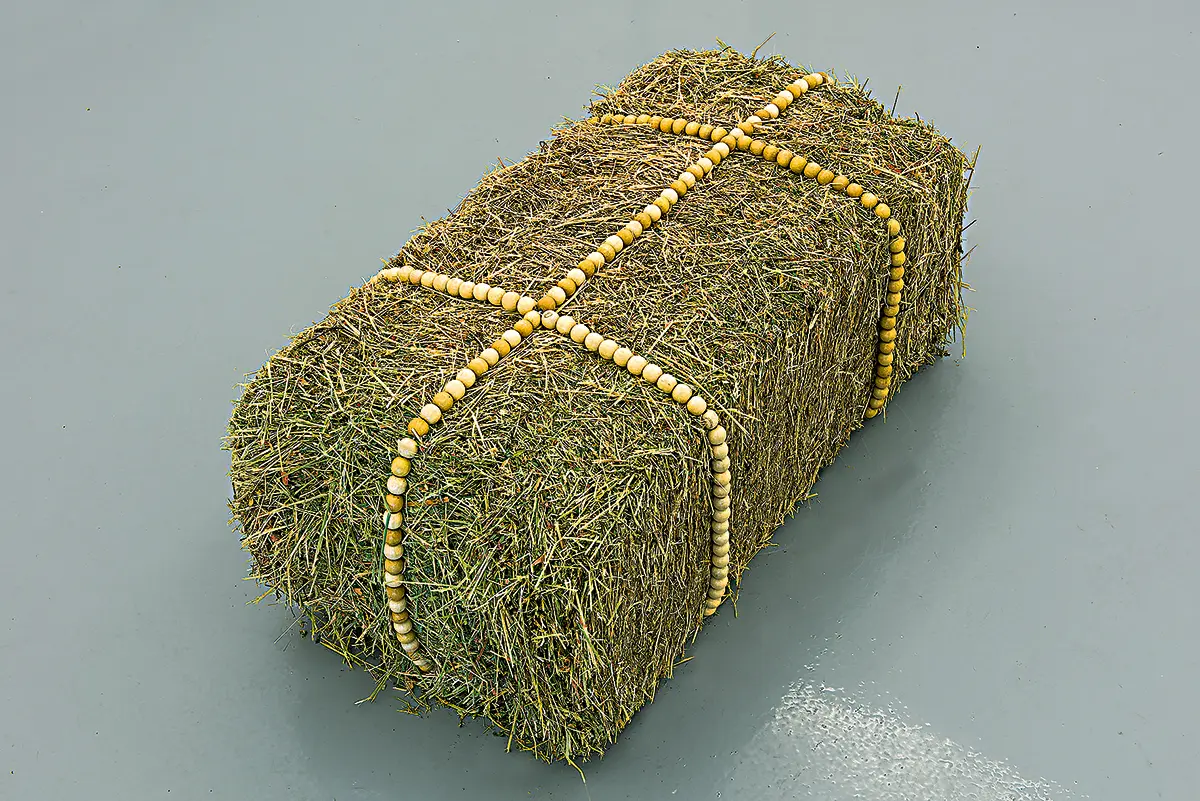
His work reflects on objects as generators of different forms and different contexts. In this sense, another piece that stands out in the exhibition at The Goma Gallery is Duración Interna (Internal Duration, 2017), a hay bale tied with a string of wood beads. Although here we are obviously far from minimalism, there are nonetheless certain echoes of it in the work-viewer relationship: the aforementioned theatricality, the non-representational nature of the piece, or the indisputability of the object’s presence. On the other hand, one of the most original aspects of Accinelli’s proposal is the subtlety in the use of materials, some industrial and others natural like the hay—the gallery is impregnated with their perfume. While some may perceive a few similarities between Accinelli’s work and Dan Flavin’s innocuous neons, they are actually very different or let’s say rather that they belong to different dimensions.
Another tool that Accinelli uses in his work is repetition. One of the installations in the exhibition is fashioned with wood and screw eyes. They are cylindrical structures mounted on the wall one on top of another. Their insistence is rather mysterious. Once again, the work with materials is delicate, subtle, and minimal, requiring a different type of listening from viewers. This work also conveys the concept of suspension and a floating sensation: the same that exists throughout the gallery. A wooden figure hangs on the wall near a corner. It is a sort of deconstructed sphere that outlines a sinuous silhouette. Once again, wood is the material used.
There is another installation that almost goes unnoticed. It consists of a vertical row of 20 cm tiles mounted on the wall. More than two meters high, the row has a geometric drawing made with vinyl printed on each tile. Here, Pablo Accinelli plays with observation and asks us to maintain a distance. A line in San Diego Serenade, a song by Tom Waits, goes like this: “Never saw my hometown, until I stayed away too long.” Perhaps we must observe things from afar so we can truly see them up close. And Accinelli somehow asks us precisely that, to look at them from Faraway in order to see them better.
ANA FOLGUERA