In March of 2015, Ecuadorian artist Oscar Santillán (Guayaquil, 1980) removed the highest tip of the Scafell Pike, England’s highest mountain, to use it as a central element in the piece titled El Intruso (The Intruder) for his exhibition at the Copperfield Gallery in London. The gesture—the piece—had already been done by Santillán in the Netherlands, by exhibiting a bunch of dirt from Vaalserberg, the highest hill in that country, which had its height reduced as a result of the action. The Dutch did not take it to heart, and the presentation even involved an action in which children walked over the dirt brought from Vaalserberg. On the other hand, the reaction in England was much more violent. As reported at the time by newspapers, the English were outraged and demanded that the small rock that once crowned the mountain was returned to its original place. This and other pieces by Santillán, like Estrella Perdida (Lost Star, 2013), which featured a copy of Alexander Von Humboldt’s book Cosmos, but without any of the ink that formed the text—which Santillán extracted using a chemical process—are good examples of this artist’s intention; one that is comparable to the minor art (literature) term that Gilles Deleuze and Felix Guattari gave to the subversive nature of Franz Kafka’s work. But in Santillán’s case, the intention is taken to the realm of geography (with all that that implies) in order to document but also to disrupt, in the original sense of the world, modern assumptions about colonialism so these can be timely returned, like a deferred debt to be cashed in a world that continues to move through perks and attributions.
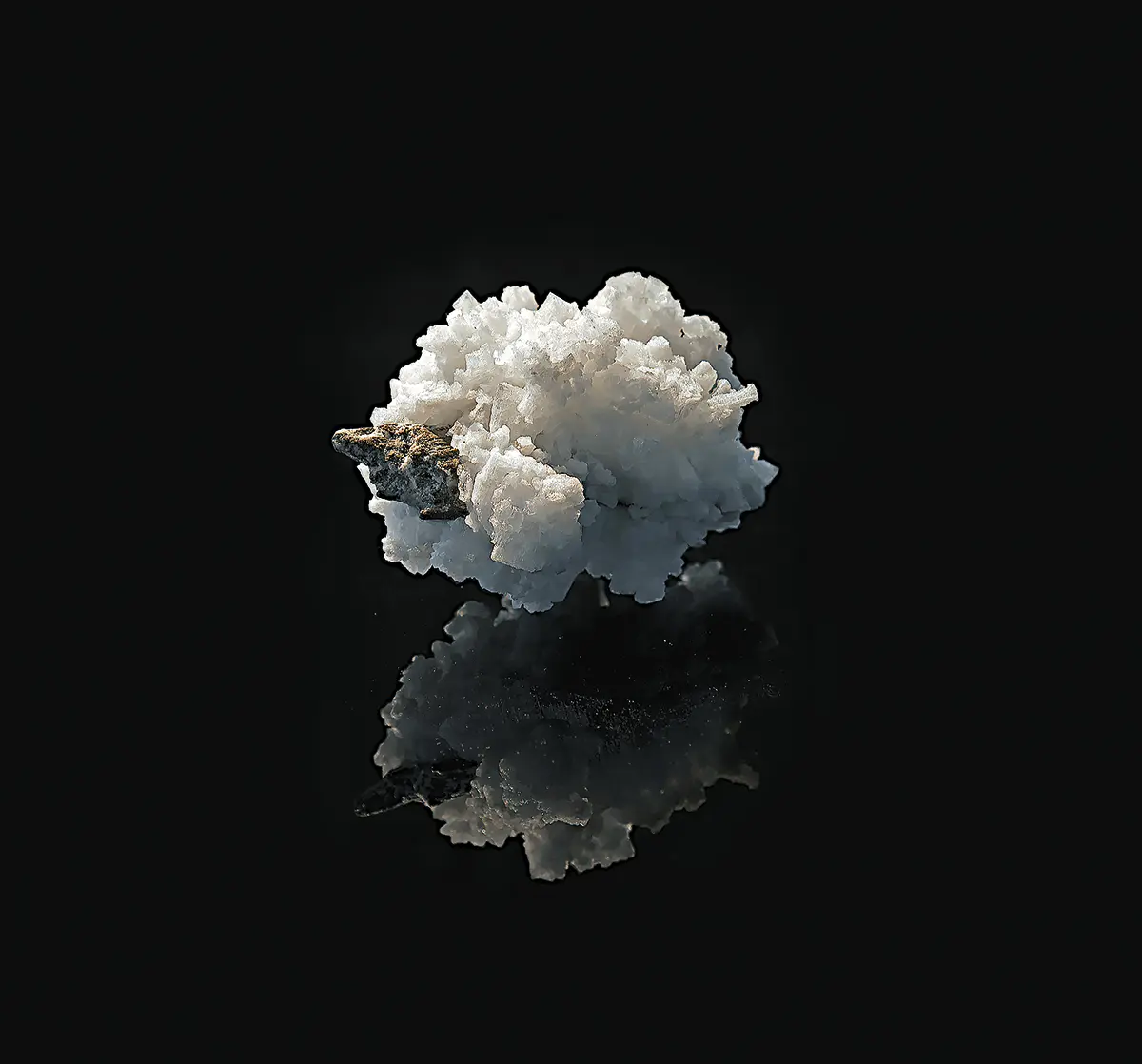
The show offers some of his emblematic video artworks—celebrated in publications like Frieze—in addition to new pieces created specifically for the exhibition. Curator Amanda de la Garza describes it as a “disrupted survey of the landscape that inhabits the geography of the American Continent,” based on a process that generates narratives that are, paradoxically, extensions or continuations of other narratives. The binomial defines the Western spirit and its materialities. For Baneque, one of the emblematic pieces (included in the exhibition), Santillán begins, as told by curator Eelco Van Der Lingen, with a first map used by Columbus after arriving at La Española (Today Haiti and the Dominican Republic) where the natives spoke of an island where he could find all the gold he was looking for. Columbus searched for the island to no avail. In this map, Santillán discovered a small perforation—equivalent to a hole in the Atlantic that could very well be the point that Columbus was looking for. It was precisely at that point that he extracted the necessary water to create an island: a conglomerate of crystals obtained through an evaporation process.
In a direct reference to the novel by Stanislav Lem that inspired the movie by Andrei Tarkovsky, Santillán described to Emily Steer his installation Solaris, commissioned by the MUAC, as “the notion of the landscape as an observing subject rather than a passive object to be looked at: the possibility of a self-conscious landscape capable of reflecting upon itself.” It consists of three lenses created by melting sand from the Atacama Desert (the driest place on the planet that, because of its privileged location, is home to several astronomical observatories) and turning it into the glass which was used to create three photographic series of the desert. The photographs are projected onto screens in the exhibition space. So what viewers observe is that which the desert has been able to see of itself through lenses created with its sand.
The installation Vaciado (Cast) presents a video and a wood box. The video shows five participants removing an invisible limb from a woman with an amputated leg. She instructs them where to find the limb based on the sensations of her phantom leg. The found limb is then placed in the wood box that is in front of us. The imaginary content—the sensation of the missing limb—acquires weight as we witness the careful development of the action. A missing element, which in other circumstances could be deemed nonexistent, suddenly becomes real. We can feel it inside the box like an apparition; we can see it inside the box. It is the phantom leg but also its cast.
In Epílogo (Epilogue, 2015), Santillán draws from Friedrich Nietzsche’s purchase of a Hansen Writing Ball, the early typewriter created by Danish inventor Rasmus Malling-Hansen—Nietzsche was barely able to use it because it was damaged during its delivery. Santillán appropriates a piece of paper typed by the German philosopher for an installation of fourteen slides, a series of ink prints, and a video that captures a fortune teller entering into contact with Nietzsche to ask him how he danced (about his dancing technique, to be more literal).
The exhibition ends with the piece Enciclopedia Quemada (Burned Encyclopedia, 2017), a series of burned clay plaques with images and texts—halfway between newspaper of incredible events and those codices printed five hundred years ago—that summarize the reach, limitations, devastations, movements, achievements, and consequences of a general and globalizing culture that emerged through scientific and technological development (playing with science fiction and media culture). Here, like in his other works, Oscar Santillán is trying to lay out a map that offers physical evidence of a fleeting territory that is nonetheless always there, beyond reality.
RICARDO POHLENZ