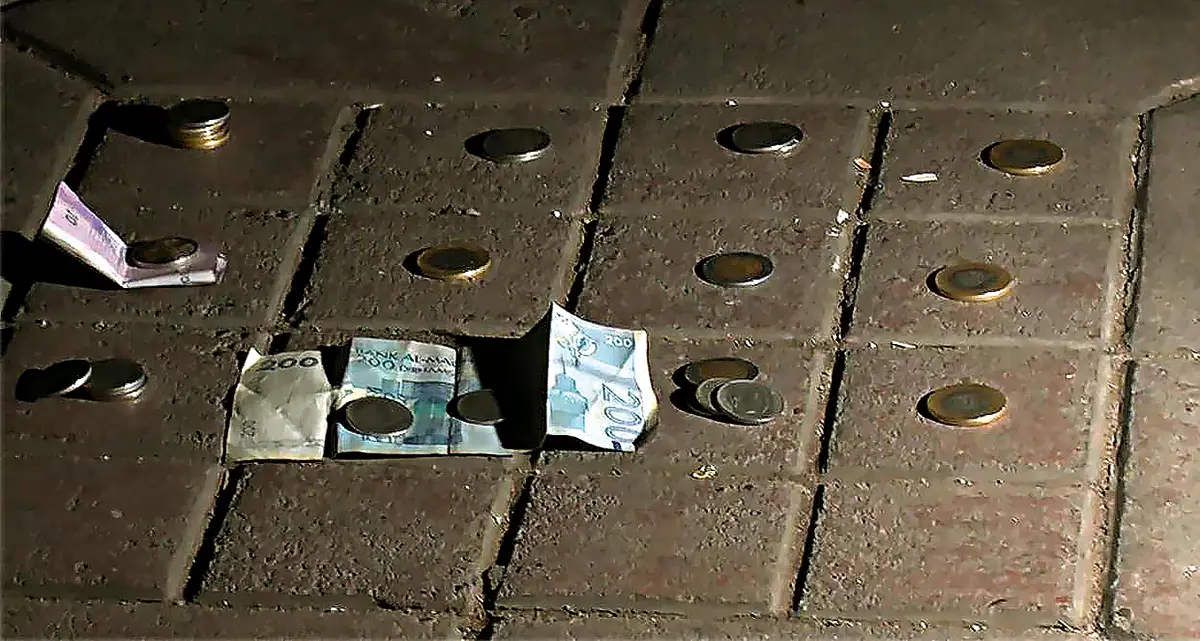
Resounding Structures is the title of the exhibition that London-based Colombian artist Oscar Murillo (Valle del Cauca, 1986) presented in September at the Jeu de Paume gallery in Paris. Prominent among the works shown is Untitled, a video that marks a departure from Murillo’s earlier videographic production. Created this year, the 53-minute long video was produced during an artistic residency in Morocco and is part of an exhibition centered on a concert of traditional Moroccan music performed by Berber musicians before a crowd of locals and tourists. The theme is therefore very different from the topics covered by this prominent Colombian artist in earlier videos that focus on reclaiming and cherishing places from his childhood through the distance imposed by life and his experience as a London-based international artist; videos like, for instance, Ramón, How Was Trade Today? Enjoy the Food but You’re Not Welcome at This Table, one of the other videos included in the exhibition, it follows a poor street lottery seller during his daily walk through a neighborhood in the city of Palmira, in Colombia. But the thematic difference does not nullify the unity in style with which both documentaries have been created: direct, raw, and, to a certain extent, in line with the principles of Dogme 95, the famous Danish filmmaking movement started in 1995 in which directors trust above all the environment sounds and the incorruptible visual power of the images that they are capturing. The editing is also very measured, so much so that it could be said that it is limited to contrasting long and medium shots with the often unnoticed close-ups that offer details within the scene—like the shoes worn by the characters, or the facial reactions of spectators.
This shared stylistic approach also demonstrates the extent to which ethics and aesthetics are combined in Oscar Murillo’s oeuvre. The rawness in his videos is also very much a part of his paintings, which are usually black—like anarchist flags or banners darkened by grief—and often sewn together in the same manner in which the very poor mend their worn and faded clothes. In fact, one could even venture to call Murillo’s entire body of work Arte Povera if it weren’t for the fact that the term is unavoidably associated with the Italian current of the 1960s and 1970s of the same name, an artistic movement that compensated the relatively limited choice of materials used with compositional and formal refinements that brought art back to the sublime sphere of beauty.
Oscar Murillo does fall for those aestheticisms. Instead, his works compellingly convey his intention of vindicating the world of those living on the fringes of society; lives that are as precarious as the second hand and discarded materials used to build their homes and the furniture in them; lives in which survival often depends on scavenging and where the enjoyment of aesthetic pleasures is out of the question.
It was actually hard to look into one of those shanty dwellings and pry into those lives so grittily evoked in the paintings by Murillo that were part of his grand installation created for the 2016 Marrakech Biennale in Morocco, which was organized under the challenging motto of “Not New Now.” It represented the direct precedent of Murillo’s wish to complete an artistic residency in a singularly complex country that would also possess an exceptionally rich musical culture.
It is the very richness that fascinated US writer Paul Bowles, who did extraordinary work for the recovery and conservation of that musical tradition. But while Bowles relied on ethnological and archival methods to achieve those particular goals, Oscar Murillo has instead focused on recovering, not so much the art of the developing world, but rather its abundant creativity and distinct active imagination not yet absorbed by hegemonic Western cultural models—the hypertrophy of authorship included.
In 2013, Murillo spearheaded the collaborative project titled Frequencies. It consisted of offering children from around the world between the ages of 10 and 14 a canvas placed on a desk that they could use to express their hopes, fantasies, and interests through painting, drawing, marks, and sketches. These canvases were also featured in this exhibition at the Jeu de Paume alongside the videos, installations, and paintings that were also part of it.
CARLOS JIMÉNEZ