The 1980s is known as the comeback decade for painting, as opposed to the artistic production of earlier years committed to strong political undertones and when the preferred mediums were those that purposely avoided anything directly connected to the traditional vocabulary or art—like Xerox copies, mail art, stamps, stickers, and everyday materials. But no revival is an exact replica of the original because the context in which it is produced is not the same either. It was, rather, about a return to the essence of painting, the idea of composition, the construction of lines, forms, and fields of color, but without the utilization of the same physical and conceptual tools that characterized the fine arts consecrated and loved by the system. During that time, Brazilian artist Nuno Ramos (São Paulo, 1960) was beginning his artistic career, having completed a degree in philosophy from the Philosophy Department of the Universidade de São Paulo. Already associated with the Casa 7 group back then, Ramos’ painting would materialize almost violently. His energetic gestures and use of his body as an instrument for his work were so essential and explosive that a large surface was required to contain them. To some extent, his paintings paid tribute to Jackson Pollock’s action painting, in canvases showed a restlessness that transformed his studio environment into a witness of the process involved in rendering the work. The splashed and excess painting were everywhere, very much in the excessive and exaggerated style of the period, something that, on the other hand, could also be attributed to our chaotic ways (desbunde) in Brazil.
Ramos’s paintings never settled for two-dimensionality. While strictly presented as paintings, even in his early works the heavily applied paint created reliefs as the impetus of the gesture plowed through the support. Very soon his paintings began to incorporate external materials vehemently projected outwards into space, sometimes even covering several meters.
To state the obvious, it is only natural for returns to come back, even if they are not exactly the same as before. Although Ramos stopped creating wall reliefs during the 1990s and instead devoted himself to the creation of monumental installations and interventions, he now returns precisely to those reliefs or rather renovated versions of them. Having presented in 2012 the exhibition titled Death Globe of All Things alongside Eduardo Chimachauska at the Anita Schwartz Galeria de Arte, this latest exhibition titled Scream and Landscape is actually his first solo show at the gallery and the first time he exhibits his Vaseline and oil paintings in a solo exhibition in Rio de Janeiro.
These current and never before shown works are very large too, but this time they appear calmer, better organized even, as if reaching a level of personal maturity has also led Ramos to a cooling of the impetuous gesture. The millenary encaustic technique—involving the incorporation of colored pigments into heated beeswax—continues to be part of a creative process that in addition relies on the utilization of weaves and plastics. In sum, these reliefs incorporate the traditional accumulation of materials but this time around with fewer elements. The works now appear to show a greater preoccupation for composition. They are no longer as fun of the all-over style, focusing more instead on the different areas of the surface. I would even venture to say that they remit to mockups or cartographic images, even to landscapes. The colors are also typical of 21st-century art, of the pop universe of fluorescent and brilliant inks, much in the same aesthetic vein of the Japanese mangas and animes.
In any case, the works allude to gardens or to the countryside and are a drastic departure from what Ramos used to produce in previous decades with a more urban palette—heavy on ochres, blacks, and greys—that reflected the industrial production and pollution found in major urban areas. About his work, Ramos said: “I am thinking about what I should do with painting, this substance that has always been a part of me and that I am now reclaiming, mixing in that swamp, in what is to be true and ancient matter:”
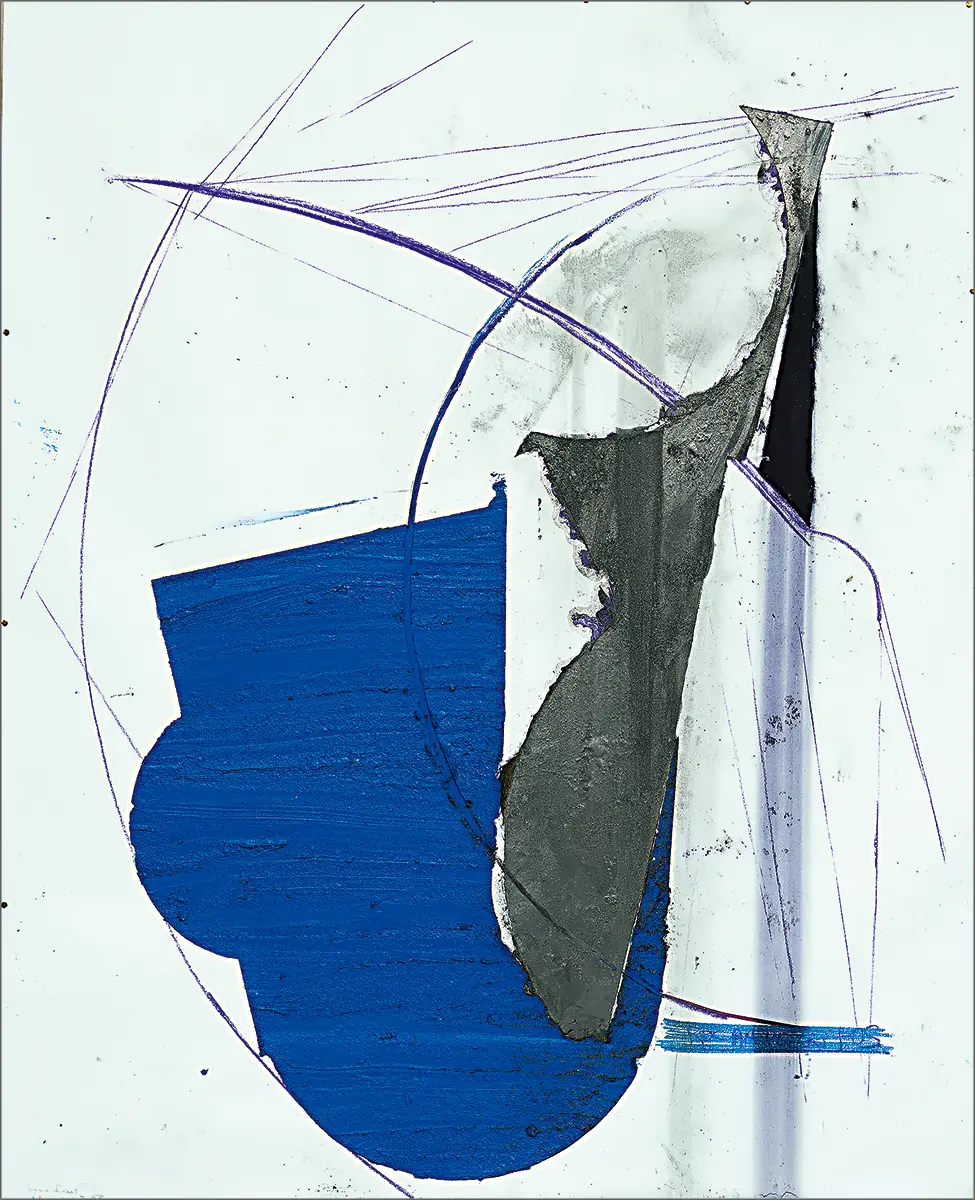
Also from 2017, the series Rock of Screams is displayed on the second floor of the gallery. It consists of large drawings, created with graphite, pastel, and charcoal on paper, inspired by the poem by Italian modernist poet Giuseppe Ungaretti titled "Tutto ho perduto" (Everything I Lost) from his book of poems Da quella stella all’altra (From that Star to the Other):
La vita non mi è più,
Arrestata in fondo alla gola,
Che una roccia di gridi.
[Life stuck in my throat
Is no more to me
Than a Rock of Screams]
Nuno Ramos’s relationship with literature continues to be close. Words are always part of his work, whether materially, like in past installations such as Alborada (Dawn), exhibited at the Centro Cultural Banco do Brasil in 2014, or indirectly as a slogan. In his current drawings, the figures are organized on the plane in a dance between the fluidity of the lines rendered with graphite and the heavier materiality of the pastels, which are practically used like paint. Here the relationships are much more subdued than in his reliefs, even allowing for the whiteness of the paper to participate in the compositional interaction. According to Ramos himself, the process with the drawings is much faster and spontaneous, and therefore, very different from the long periods of time required in the completion of his paintings. To him, this new phase, less political than in recent years, has been madly cheerful. And adds: “Everybody knows that happiness is the best type of vengeance.”
SYLVIA WERNECK