It was a nice surprise for me to enter the gallery and find myself in the middle of another space. In this case in the middle of the main hall of the Museo de la Universidad Nacional de Bogotá: granite floors, cement columns, surprising level shifts, and its characteristic wooden accents in the columns and the edges of the level gradients, which make this museum rather atypical, with strange trajectories conceived for people to stop, to “sit down” in the middle of the exhibition space, and perhaps to reflect on what they are seeing. I experienced all of these sensations in the gallery because Nicolás Consuegra rebuilt the museum’s main hall, “transporting” it at a 1:1 scale.
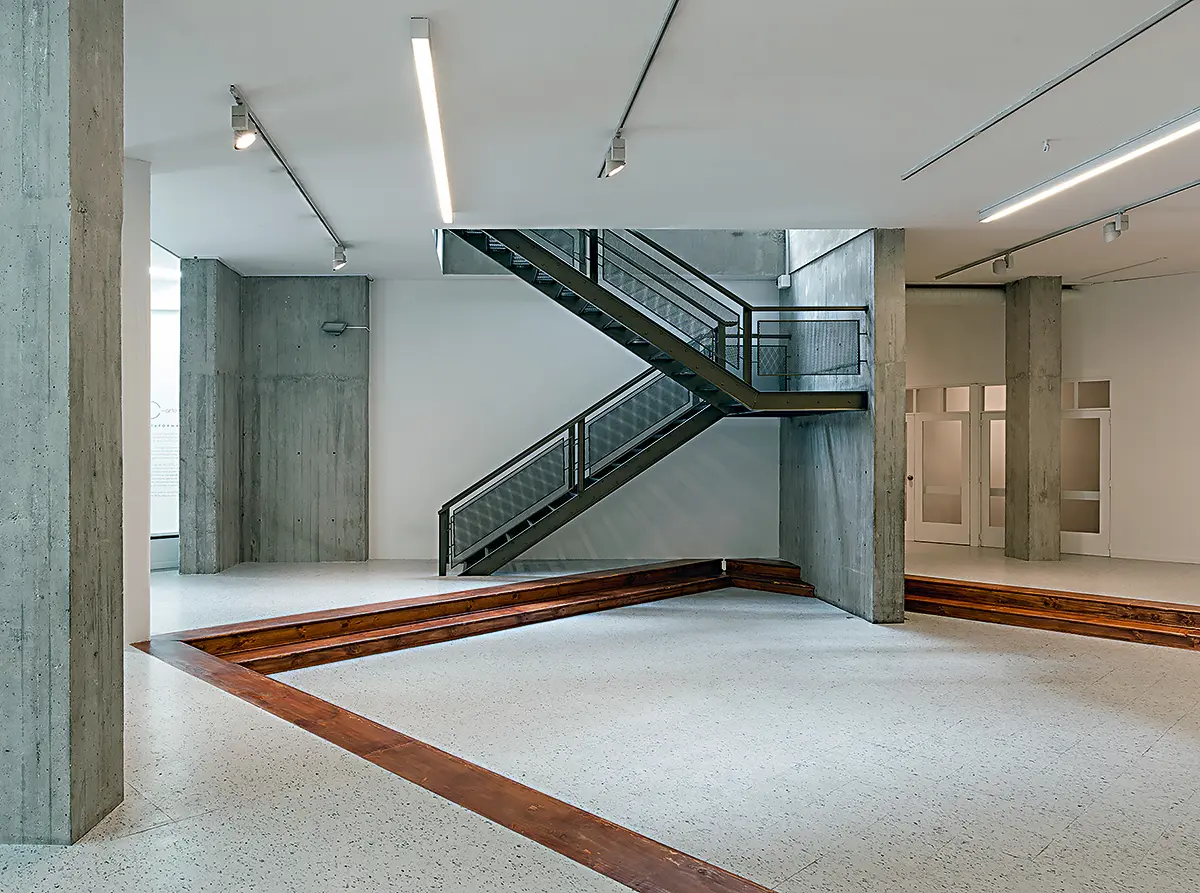
The Museo de Arte of Universidad Nacional was built inside the university’s Bogotá campus at Calle 45 and Carrera 30, in order to foster coexistence between the members of the university community and to propose art as an indispensable activity in student life. It opened in 1973 and was designed by architects Alberto Estrada and Elsa Mahecha. In my view, this museum is a subtle critique of the white cube’s uniformity and neatness, proposing, as I said, a unique trajectory, from the main hall; greets visitors with a large gradient and a number of small, wood-topped walls that invite sitting. This museum proposes a shift in the idea of an exhibition visit, the public’s standard experience in a museum, towards the notion of slowing down, taking a seat, and “living” or “thinking” what is being seen for a moment or two. All of this, complemented by the presence of the materials, cement, and wood, makes it possible to understand this museum in light of its willingness to reflect on the concept of place. A concept that, unlike that of space, invites us to consider boundaries and physical dimensions and raises questions about inhabitability, stopping, remembering, lived experiences, the time invested in living.
In a review of Lo que la maqueta puede hacer (What the Model Can Do), an exhibition at the Museo de Arte Contemporáno de Siegen in the 1990s, Pedro Hernández tells us that several answers were posited there to the implied question: building a model in order to understand the world by miniaturizing it; the model as an intermediate state between concept and execution; as a manifestation of power, since historically models were used for sponsors to pose in front of their investments. In the end, Hernández quotes Catalan artist Domènech: “a model is always the proposal of a future, a promise, a wish, a representation in the scale of an idea that will become a tangible, real, inhabitable space”; this is to say, Hernández adds, a model is the idea of something still to come, something that has not yet taken place.
Given all this, Consuegra’s exhibition was not only a surprise for me but also a provocation. First, because while a model is an assemblage, at a reduced scale, of possible space, Consuegra’s 1:1 scale underscored his intention to “launch” himself towards execution; it expressed a kind of despair with art’s habit of remaining at the level of intentions, of possibilities, as well as the artist’s decision to occupy the experience of doing: hauling cement, installing the flooring, building columns, a neo-Bauhaus reflection where the master of form and the master of doing pretended to be one. Consuegra decided to launch himself also into the construction of the main hall of a museum connected to his deepest affection.
Already in an earlier exhibition, Consuegra has built an architectural model of the interior of a Bogota house of 1940, using a photograph as his starting point. Here, at a 1:1 scale, the intention was more decisive and posted the urgency of thinking about what takes or has taken place in that specific museum.
For this exhibition, Consuegra conducted several interviews with various individuals, which he published on the Web. The roster included former directors of the museum like Germán Rubiano Caballero, William López, and Santiago Rueda, as well as its current Director, María Belén Sáez de Ibarra. I would have liked for these interviews to be present in the exhibition in some way, even if only in the gallery’s top-floor office-archive, to help visitors understand the urgency of thinking about the museum and so that the debate about the place, about what takes or doesn’t take place in the museum, found an echo. I believe that the Museo de Arte de la Universidad Nacional has decided, now and under the last administration, to stimulate and finance the work of artists “enshrined” in the international scene and among critics, turning its back on student proposals. A naïve and uninformed position, to be honest. When one is in touch with the classroom, one knows that students’ vital experimentation with ideas and materials needs and demands a place to be exhibited and tried out; a place such as a museum, which, according to this public university’s statutes, belongs to them. The vital experimentation proposed by students in film and the visual arts, for example, has in recent years filtered into international exhibitions, without the current administration noticing. Naïve and uninformed, also, because the history of the museum is dotted with exhibitions by then-unknown, young artists, highly critical of the art scene and the culture of their era, who today are indispensable in any account of the country. At any rate: the simulacrum of a museum, the simulacrum of an experience, the simulacrum of history, an entire reflection to be made.
NATALIA GUTIÉRREZ