Galer(it), the recently inaugurated annex of the Baró Galeria, presents a selection of large canvases signed by Mônica Nador + JAMAC: Jardim Miriam Arte Clube. Banners or canvases placed between beams enfold the pavilion-container. The first impression is one of being before an expanded field and productions that are completed through dialog. According to Nador, the images over our heads contain drawings by the carvers featured in the 2012 Gwangju Biennale in South Korea. She adds that the exercise questioned identity images in Brazil that were translated by Koreans into maps, ounces, and figures that allude to sports, the carnival, and indigenous people. Of a baroque style, in my opinion, it is a procession of decorative patterns created by children but orchestrated by Nador’s virtuosity.
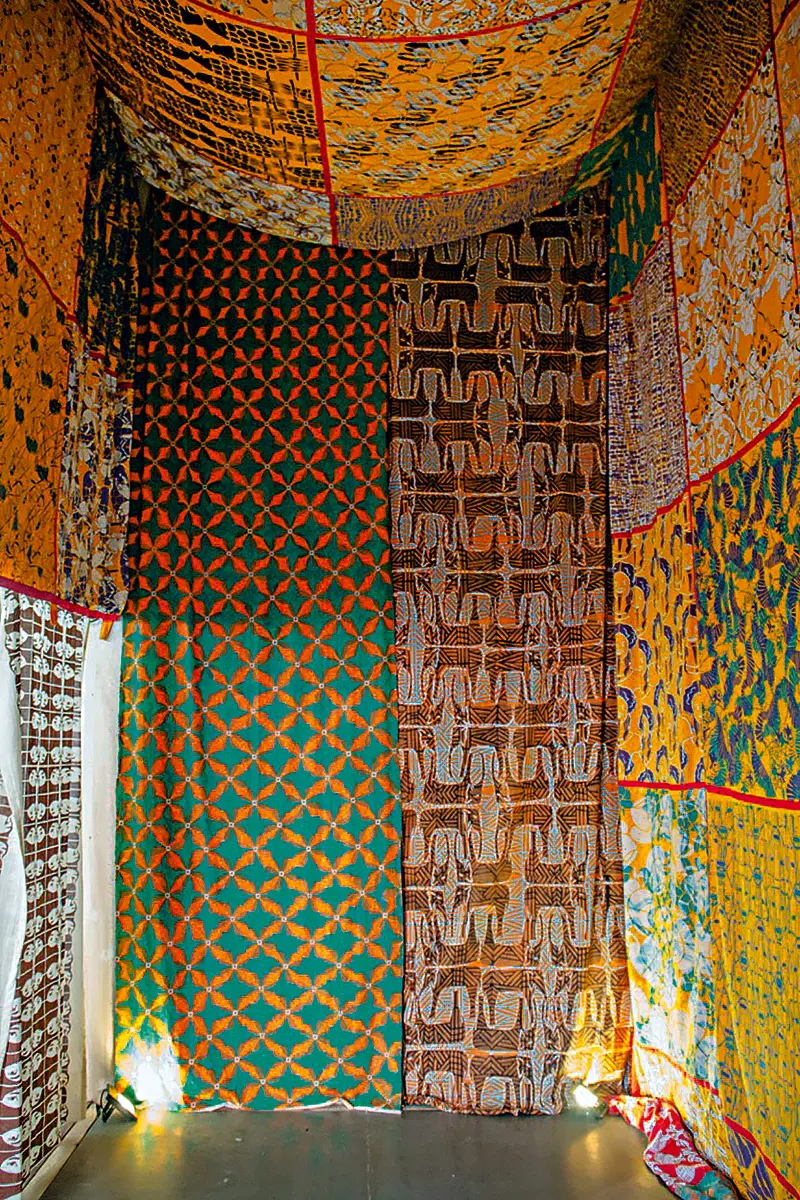
Further inquiries lead me to discover other images with tribal symbols drawn by a young person from the Miriam neighborhood who is actually a motorcycle painter. Next to this canvas, there is one about the Subcomandante Marcos (of Mexico’s Zapatista Army of National Liberation) also created within the project. Paul Virilio called certain immaterial forms that traveled in time and space “cliché images,” which are identifiable, for instance, in the language of stencil graffiti, in the anonymous voice of mass media, or in our own memory. Nador consciously or unconsciously searches for these images. To do so, she looks for the dose of identity circulating in the universe of her “paintings of shared authorship,” a concept that reappears here but was introduced years ago at the Pavilion of Brazilian Cultures in the already mentioned biennial. She has been able to deliver a synthesis of the desires and aspirations of the Subject, with capital S. In sum, all the works share something in common: the participation of ‘N’ pairs of hands, numbers, and statistical data in the background that offer not only stories but ethically-minded ones.
But, what is JAMAC exactly? Already acclaimed by the museum circuit and the art critics, Nador chooses to leave those spaces behind and begin a nomadic journey of no return. She exhibits Paredes Pintadas (Painted Walls, 1994) in Manaus, Vila Rhodia, and São José dos Campos. In that project, she sought to discover new patterns like the hand-painted roses in doilies created by a woman to make ends meet—one of the very few artistic activities that she found in that district. This type of drawing is repeated with the help of a stencil that is applied to the walls of the shanty town’s precarious homes. By resignifying painting through folk art and the application of a concept that she appropriately called “hillbilly constructivism,” she later was once again able to conquer spaces of legitimization like the Havana Biennial (2000). Following her first insight, Nador travels to Cariri, in the Brazilian northeast. She even travels abroad, to the Asentamiento Modovio Rojas, the residency of the inSite program, in the tumultuous border between Mexico (Tijuana) and the United States (San Diego). When, in 2003, she founds the JAMAC platform, she began to systematically multiply those interferences.
Initially conceived to house serigraphy and stencil workshops, the platform was equipped with an atelier, a library, and a philosophical café. Concurrently, through its educational mission, it has become a place in which to debate ideas and even train the local neighbors through conferences imparted by renowned economists and sociologists centered on art and the sociopolitical reality. Even after the dissolution of the initial collective, the platform continues its activism under Nador’s directorship. The project operates with proceeds either from cash prizes that Nador has won, like the one granted by the Banco Do Brasil, which she used to kick-start the project; or proceeds obtained from a variety of services rendered in 2008 to the Companhia de Desenvolvimento Habitacional Urbano in São Paulo (CDHU), used to expand its activities to several districts within the Greater São Paulo area.
In sum, JAMAC is a network that expands a truly “utilitarian” type of art whose origin stemmed from Nador’s educational development. Its operating motto for creating the works conceived on-site, like the painted walls of poor people’s homes, would be inspired by her visits to favelas and restoration projects while an architecture student, way before she became an artist. A relational aesthetic was in the works. Nador herself has affirmed before that the entire process began when she became aware—during the graduate courses that she took with Regina Silveira—of the predicted and paradoxical end of painting within the international mainstream. If something so seemingly untouchable and sacred could disappear, then why not take things to more definitive consequences? She and other artists of her generation, like Senise, Milhazes, and Leonilson, took such a colossal leap—to use an expression used at the time—that it once and for all closed the chapter on painting from Altamira to Pollock. In this manner, once she was immersed in this feeling of irony, in this sort of “all or nothing” sentiment that dominated painting during the 1980s, and already in works like Campos (Fields, 1983), Nador proposed black paintings in anarchic formats rendered with mechanical brushstrokes fearlessly rendered in industrial-like fashion.
Since then, as it usually occurs across conceptual art, but particularly in painting, she risked the loss of materiality through the praxis of reproducibility or kitsch, but gained nonetheless another niche: that of painting in survival mode. This is the context in which Nador created works like Paintings for Flying, For Eating, so they could literally serve a purpose. All following the motto of “pure beauty,” which for over a decade Nador applied to develop a great number of artworks rooted in abstraction and inspired by Arab culture. Just before she began to focus on the walls and embroidered fabrics, the series of abstract lattices titled Ad Reinhardt (1995) is repeated in a series of engravings, created in 1994 with the support of the Mid-America Arts Alliance, which achieved such degree of synthesis that they already suggested the direction that she would eventually follow.
Given what we have so far discussed here, the body of work created by Mônica Nador only increases the significance of the canvases exhibited at the new space of the Baró Galeria. The result is one of the most compelling examples in Brazil of the resilience of art, even if at first glance these works could be regarded as mere canvases rendered with effusive contrasts and in tune with popular contexts.
XENIA BERGMAN