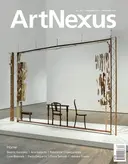
Matilde Marín (Buenos Aires, 1948) presented at Espacio de Arte Fundación OSDE her inspiring anthology titled Matilde Marín. Archeologist of Herself curated by Adriana Almada. According to the curator, “An anthological exhibition is organized around the invisible veil of memory. […] It is the staging of a long journey: the select episodes of a voyage. It is an exquisite rodeo delayed by stops and detours. It is the personal outline of a horizon: a written account […] Matilde Marín directs her gaze back to the road already traveled. More than a journey, it is an expanded space that unfolds in all directions.”
Traveling was and continues to be the central theme in the life and work of Matilde Marín. During her travels, she has been able to further her studies and research, establish long-lasting friendships, forget her sorrows, marvel at beautiful landscapes, learn about different worldviews, push the boundaries of different disciplines, search for and capture a great part of the images included in this exhibition; discover who she is and regard herself as an artist-witness.
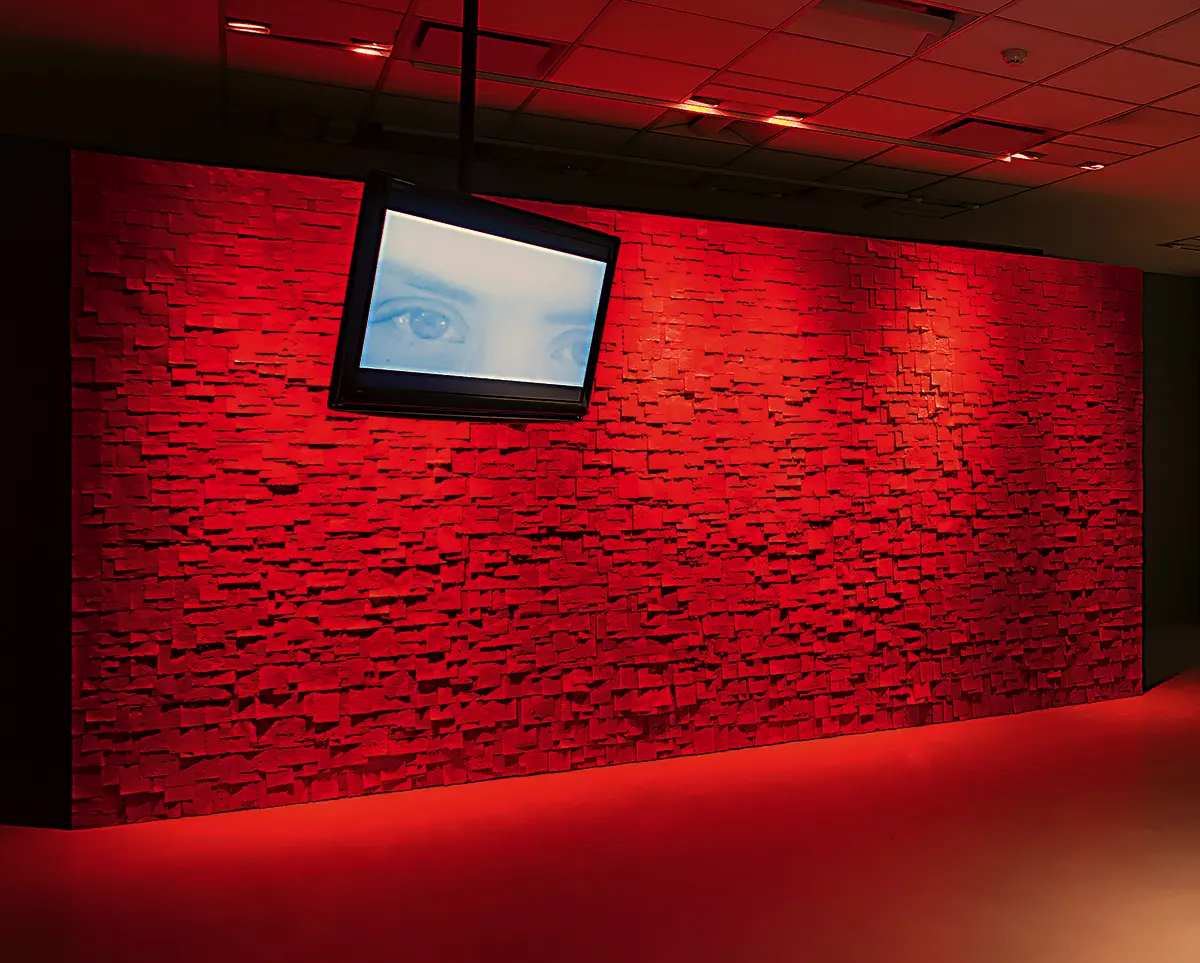
Created with more than 5,000 handmade papers, the all red work titled El Manto de Próspero (Prospero’s Cloak), was the magnificent work chosen by many visitors as the background of countless selfies. Did visitors select this piece because they felt under the spell of its compelling visual presence or because they already knew about the magical powers and the knowledge that its bearer, Prospero the ousted and exiled Duke of Milan, was capable of summoning? Prospero’s magical cloak references William Shakespeare’s late play The Tempest. Some critics have seen this play as the English playwright’s swan song that summarizes his views on art, philosophy, and family ties. Prospero lives on a remote island accompanied by his daughter Miranda, a few books, and several spirits. With the help of Ariel (a spirit of the air) and by casting a spell, Prospero summons to the island several persons from his past (like his brother) that are responsible for his precarious situation. But in the end, he is able to forgive them all.
This installation not only became the central point of attraction of the exhibition, but its conceptual development also condensed several of the preoccupations and aspects that are part of Marín’s biography. Travels and displacements, losses and reencounters, adventures in more than seventy works—engraving, artist’s books, photo-performance, installation, photography, and video—in ten series from different periods and disciplines; from the 1990s to today.
Seen from a certain perspective, and as result of the mounting designed by artist Osías Yanov, El Manto de Próspero even overlapped with the video titled Travesía (Voyage), which showed silent eyes questioning the observer; black and white expressions of persons (children and adults) displaced by war, famine, and inequality.
The exhibition is not organized chronologically but rather, as Almada explains, through “a diagram of radiant points.” It involves well-known series by Marín that includes photo-performances like Juegos de Manos (String Games), which mimics an old game that consists of manipulating strings that converge, tangle, and separate, and Bricolage Contemporáneo (Contemporary Bricolage) (the collection). Movements multiply, vary, collect different elements, but always with the same pair of hands; Marín’s hands explore the space and take over the strings and elements that are essential for survival. When open, the hands appear to convey generosity, honesty, and expressiveness that goes beyond the game being played.
The photographs in the series titled Pharus Project capture the incredible architectures of powerful century-old lighthouses. Threatened by the advent of GPS, these powerful navigational guides, whose concentrated beams of light are accentuated by Marín, equally persist in the landscape, literature, and the collective imaginary. The videos recorded in the southernmost part of the South, Atlántico Sur (South Atlantic) and No Demasiado Lejos (Not Too Far), are connected to those incursions into beautiful sceneries and extreme landscapes around the world.
The series The Imaginary Journey of Kazimir Malevich and When I Catch Sight of the Blue Smoke of Ithaca are, on the one hand, a collection of architectural structures and details captured in different countries and, on the other, a series of clouds of smoke that attest to war conflicts and fires out of control. The former is clearly a thoughtful tribute to the creator of Black Square (1915), the Russian artist immersed in philosophical, spiritual, and cosmic inquiries who contributed to furthering the development of abstraction. The framing and montage are equally important in the photographs and videos of smoke clouds, all of them are images appropriated from newspapers and news broadcasts that cover different types of calamities.
The observer who stood in front of Itinerario (Itinerary) surely pondered about the fleeting nature of life, and perhaps also dared to wonder about the place in which the shots were taken. The forty photographs displayed—taken between 1993 and 2001—form a single work and are presented in the form of a large wall that reflects the artist’s shadow in several points across the planet. This piece won the 2002 Biennial of Cuenca in Ecuador.
Winner of several awards, the work by Matilde Marín is part of private and museum collections like those at MALBA-Fundación Costantini in Buenos Aires, the Bronx Museum of the Arts in New York, and the Centro de Arte Reina Sofía in Madrid. Marín is a full member of the Academia Nacional de Bellas Artes in Argentina.
VICTORIA VERLICHAK