This exhibition, curated by Alberto del Castillo, Alfonso Morales, and Laura González, presents the work of Marco Antonio Cruz (Puebla, 1957), a photographer who has also practiced drawing, painting, and graphic art, and whose career began in photojournalism but expanded into a variety of visual explorations that ranged from the news to capturing images of everyday life.
A leftist activist and at some point a member of the Mexican Communist Party (PCM), Cruz was a contributor or founder of several publications and news organizations in Mexico, such as the daily La Jornada and the Imagenlatina news agency (the latter, active between 1986 and 2003, under the decisive sponsorship of the renowned newsman Miguel Ángel Granados Chapa and with Pedro Valtierra and Fabrizio León among its initial contributors, served as an important formative space for young photojournalists). He remains to this day on the roster of the weekly Proceso as Photography Department editor and coordinator.
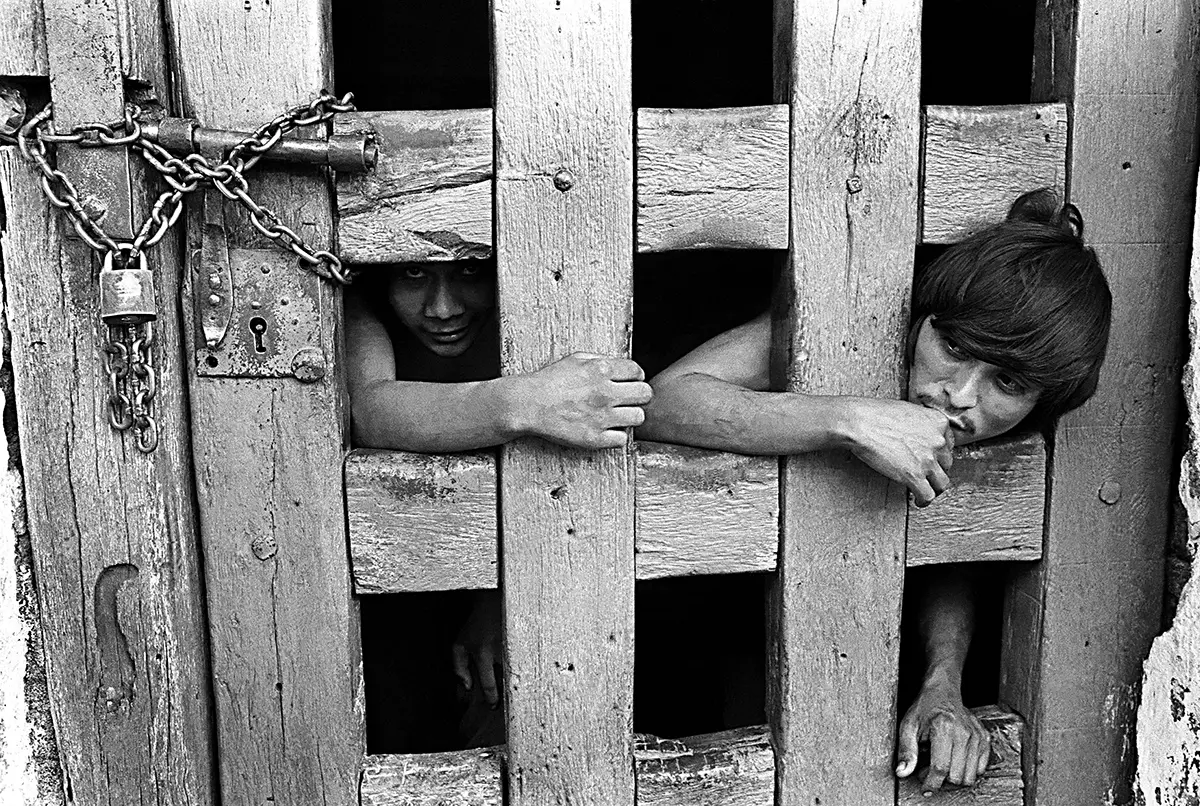
The exhibition curators emphasize and review how Marco Antonio Cruz is part of a generation of Mexican photojournalists who, in the final quarter of the Twentieth Century, defended the relevance of their practice both as a historical witness and as expressive creation, exhibiting series, photo-essays, and visual roundups on different subjects in dialog with the press materials where the work was published.
For the section covering Cruz’s formative years, the exhibition revisits his passage through the Benemérita Universidad Autónoma de Puebla in the 1970s; the Escuela de Diseño y Artesanías in Mexico City; his stints as assistant to such figures as “Hersúa” (of great importance in the establishment of alternative artistic practices in Mexico); and the emblematic photo journalists Héctor García, his wife María, and Nacho López, who exerted a decisive influence on his work.
Two further sections are devoted to Cruz’s political activism and his work on the issue of the disappeared. After the PCM became the Unified Socialist Party of Mexico (PSUM) and relaunched the journals Oposición and Así es, Marco Antonio Cruz was an active contributor of cartoons and photographic coverage. On the subject of the disappeared, the photographer’s work focused on denouncing the kidnapping, illegal detention, torture, and disappearance of members of opposition groups as a State policy in 1970s Mexico, documenting the activities of the Eureka! Committee (led by Rosario Ibarra de Piedra) as well as the National Front Against Repression and its public actions.
In the 1970s and 80s, Marco Antonio Cruz produced unsettling portraits of the main leaders of Mexico’s governing Institutional Revolutionary Party (PRI), revealing in their gestures the weight of their factual power. During the following two decades, he covered efforts towards political change in Mexico, as well as the government’s anti-crime policies.
In the next section, titled Tierra y Libertad (Land and Freedom), the exhibition reflects on the rural-peasant-indigenous aspect of Marco Antonio Cruz’s production: workers and the precariousness of their situation across the country, and the areas where the Zapatista National Liberation Army operates (an insurrection that first emerged in 1994 in the state of Chiapas), are a distinct axis in Cruz’s oeuvre where journalism becomes a channel for the sensible experience.
Another line of exploration is Mexico City and the Urban Space, based on the role played by this acropolis (the title of yet another section of the show) has played in Cruz’s life since the 1970s, and as part of his exercise of street photography, learned from Héctor García and Nacho López, to provide a visual chronicle of demographic processes, urban sprawl, the sequels of the 1985 earthquake, and routine, everyday rituals and practices: electrical installations, pulquerías, Holy Week celebrations, and yellow journalism.
The exhibition ends with the sections Vislumbres (Glimpses) and Penumbra, around one of Cruz’s most celebrated projects: Habitar la oscuridad (Inhabiting Darkness), about people suffering from blindness, their contexts, activities, and practices. Also explored here are Cruz’s recent explorations combining video art and photography; his works using pinhole techniques; and his night photography in the city. In both of these sections, we are presented with the evidence in Marco Antonio Cruz’s work of the gestation of photography as an exploratory expressive process, triggered by the documentary situation: framing, shutter speed, the capture of action, dialogs between the handling of light by the camera and the light conditions for a given shot, all qualities of a craft turned into political sensibility to signal a variety of social issues in Mexico: the physical limitations imposed by poverty on large sectors of the population, in a context of scarcity of resources and services; subjects suffering discrimination in contrast with the hegemonic classes; mobility, transitability, recreational uses of the public space, and other subjects.
EUGENIA MACÍAS