Contact with the latest work by Brazilian artist Márcia Xavier (Belo Horizonte, 1967), presented at Casa Triângulo, opened layers of interpretation about spaces of domesticity and the relationships established between memory and affections.
Titled Domestic Geology, the exhibition by Xavier was understood as an invitation to discover a strategy of hers to establish a thoughtful coexistence with a key piece in the composition of her exploratory approach: her parents’ wedding album.
The exhibition layout was proposed in three zones of interaction constituted in an integrated fashion by a photographic series of large dimensions, a composition with three photograms displayed on lightboxes, and an installation created with two overhead projectors.
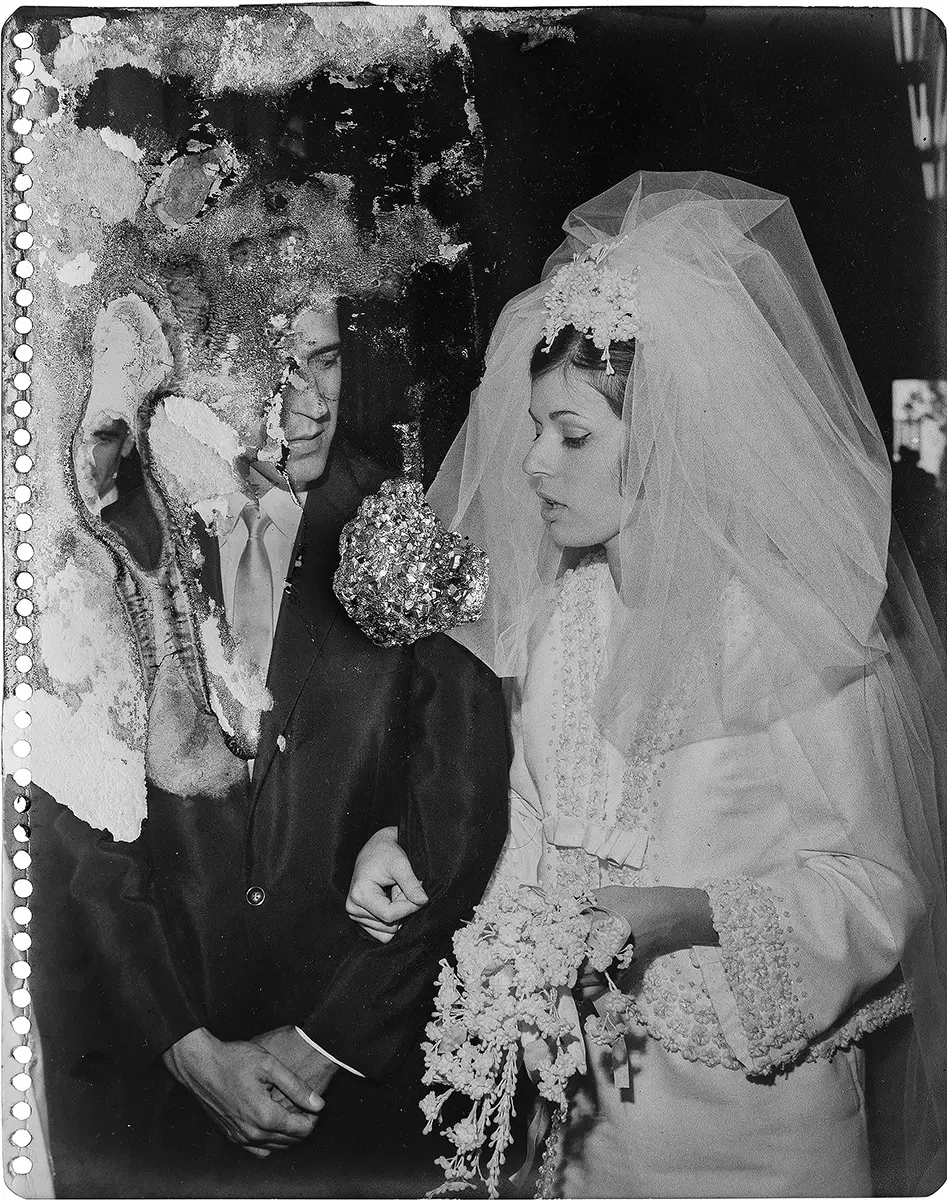
The series Domestic Geology, which gives the exhibition its name, along with the seven large black and white images, bring the wedding environments, now rephotographed by Xavier, into a new dimension. In this manner, the material associated with the wedding album scenes was intervened by the artists through the manipulation of several types of minerals placed over the scenes.
The minerals in question—stone, marble, pyrite, and magnesite, among others—disrupted the scenes by introducing a complexity never programmed into the original record.
It should be mentioned that the central role of the photographs was partially increased by the invasion of mold and stains caused to the images by the action of time and the disturbing incorporation of an intrusive agent: humidity. With the superimposition of the new element, whether a fragmented mineral or even a rough stone, every image acquired new contours.
The memories reinvented by Xavier acquired other lives when rephotographed from above, an approach devised to create a sort of phantasmagoria of the wedding.
In the other two zones of the exhibition space, the photograms and the installation established relationships with the landscape of the show. There, it was the artist’s own body placed almost in shadows in its entire amplitude across the illuminated photograms, as well as the projected image of a cavern with the superimpositions of hands and Saint Agnes’s clothing—the result of images captured inside Sant’Agnese in Agone, the 17th-century Baroque church in Rome: the whole exhaling the untouchable.
Márcia Xavier has stood out in the Brazilian contemporary art scene because of her relentless search for optical dislocations and original photographs in aesthetic dialogue with the images of other people’s scenes. She is the creator of a series of explorations that stood out during her participation in the Sixth Havana Biennial and in the 3rd Mercosul Biennial.
The 2017 enlarged photograph titled Mármol (Geología Doméstica) [Marble (Domestic Geology)] on cotton paper, captured the attention because of the casual action of the stain that one day impregnated the image, consuming the face of Xavier’s father—portrayed in a very frequent scene in wedding albums—and as result of her decision to strengthen the obstruction by inserting a marble stone over the father’s face.
In fact, the image of the couple consumed by the mark of time and the artist’s own intervention dislocated the center of attention towards the lonely bride’s gaze that now dominates the scene.
This geology or domestic-mineral origin recreated by Xavier to make sense of the expectations of affection displayed in the wedding album, gave new dimensions to the classic poses at the altar, by the church’s entrance, or at the moment when the couple receives the communion wafer.
Another image from the same photographic series, Pirita (Geología Doméstica) [Pyrite (Domestic Geology)], opened a slice into the most usual history in the photographic records of marriage. In the recreated scene, the couple appeared to be surprised by the presence, among others, of pyrite, a mineral known as “fool’s gold” because of a glowing appearance that deceives those not initiated in geology.
In this manner, the maneuverings by Márcia Xavier became evident through her careful selection of minerals for each intervention, rationing its qualities and exploring every possible statute.
It is evident that her decision to work with her parents’ wedding album—in its dimension as a document that one day accommodated the possibility of a destabilizing intromission (the humidity that destroys any scene)—regulated another intimacy now recovered to disorient the photographic record read as a regulation mechanism for the behavior of affections.
The domesticity proposed by marriage—that connection between parts embodied in the classic album with images of the altar—confirmation of the formality of a coexistence presented as a preordained path for life—found in Xavier’s interpretation a detour of expectations in which every image touched by mold established a new version of the facts.
In this manner, included among the strategies developed by Márcia Xavier to consider the group of works in the exhibition, there was the historic point of debate about the social places assigned to women. The place for matrimony, constructed based on the bride’s wedding dress present in the photographic series, was resolved by the mold that, prone to contaminating anything, served to compose the iconography.
The exhibition Domestic Geology revealed meaningful connections to the public through three illuminated universes: the photographic series, the photograms of the humane figure captured for posterity, and an installation projected through thin layers and itineraries created to resolve the experiences of lives that memory and affections disrupted decades ago.
CLAUDIA FAZZOLARI