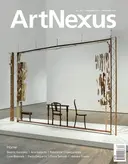
Manuel Calderón’s exhibition La caja vacía (The Empty Box) was on display in the second level of Bogotá’s El Museo Gallery. On this occasion, Calderón, known up to now mostly for his drawings, presented both graphic images and objectual works that in general worked as optical devices. The images and the objects in La caja vacía suggested models in the scale of a material reality previously projected graphically, like cities are as they begin to be planned on a drawing table. As a whole, Calderón’s works functioned as the mental equivalents of the ideas that precede the configuration of a space, and, for that reason, all came in a reduced scale. This made them appear as condensed spaces, be it in two or three dimensions.
The artist mentions the fact that the insertion of subjects in the visuality of the world helps them understand that there is a screen structured like a reticle anteceding and supporting the visual appearance of all the things in the world. In the discourses that deal with visual experience, it is often said that visuality is the cross between the social aspects of the visual and the visual aspects of the social. Along those lines, such techniques as geometral perspective—central to Western art in the Modern age—are part of that visuality, which functions as a screen that only lets us see in a certain way.
From the point of view of the La caja vacía, it is important to pay attention to the meaning of a visual emblem like the reticle. In the modern artistic context, the reticle seems to have shifted from being tacit to being omnipresent, given that before the Twentieth century it was used to support the enlargement of images, to structure their proportions, to transfer reality to artistic representation, and even to shape geometral perspective. However, starting with the art of the historical Avant-Garde, the reticle has become a recurring presence in the work of many artists and has remained visible, decade after decade, into the Twenty-First Century. For that reason, many theorists have referred to the reticle as a degree zero of the artistic image.
The image of the reticle was present in Manuel Calderón’s graphic works, but it was articulated to morphological matrices related to geometric patterns loaded with cultural references. It is in this way that they could be understood as self-referential structures in the field of geometry, as well as fragments of architectural surfaces, such as wall hangings of flooring. Thus, the abstract element of an initial reading was shifted as it became possible to make a referential approach. In that sense, they function as a cultural geometry, which is the term used by Jeffrey Deitch to refer to abstract images able to articulate themselves to referential interpretations, for instance in the case of a flag that represents a nation. In some of these images, however, those abstract patterns make a direct reference to architectural spaces, as will happen with their objectual counterparts.
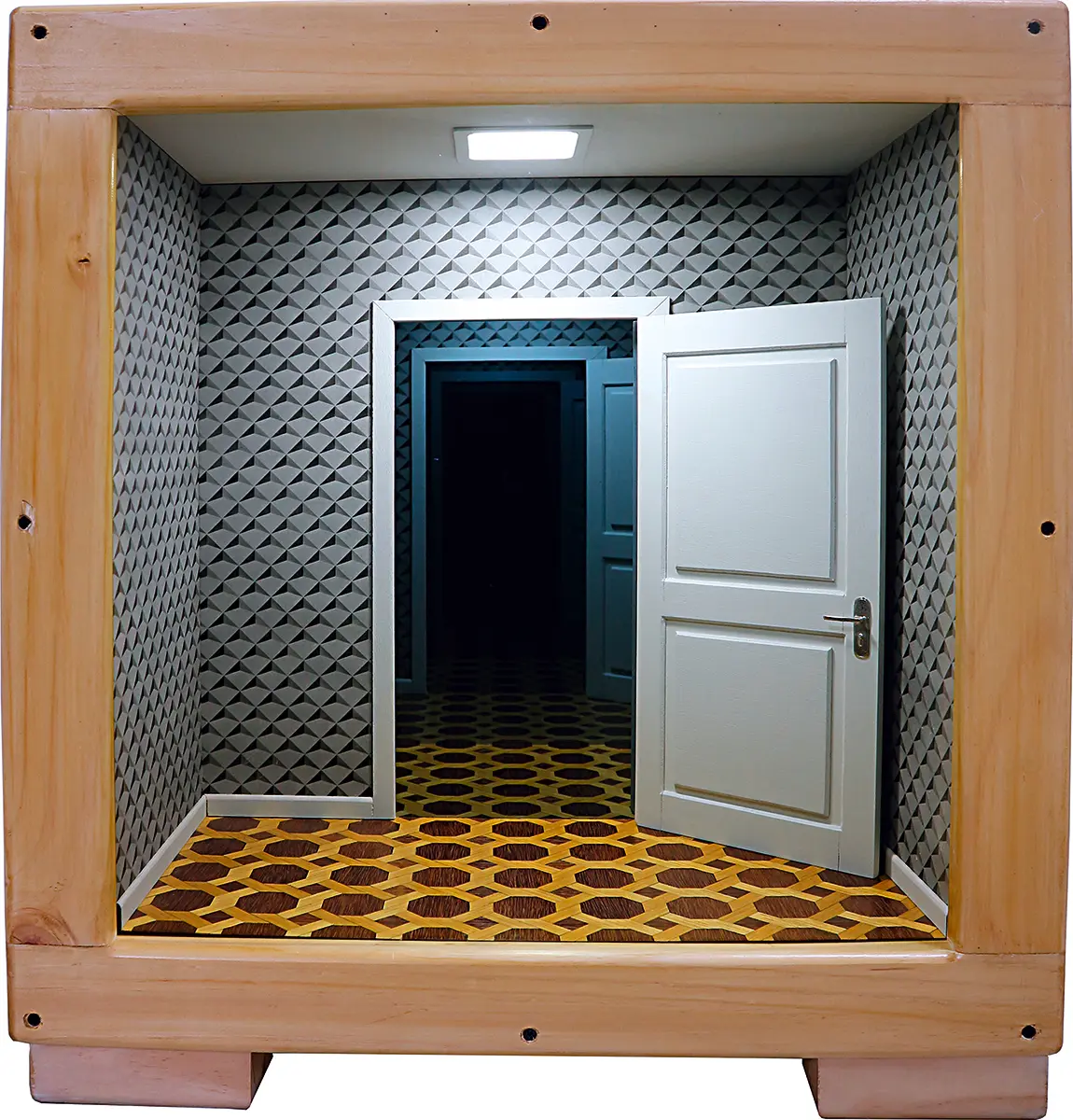
In the majority of the features of the object in La caja vacía, the outside is a wooden crate of the kind used to ship works of art as they travel, only in the case the front is made of glass so that we can see what happens inside. In these works, that interior space is an illusionistic structure that seems entirely shaped by the human eye. In all cases, we perceive an architectural space in reduced scale, the walls and floors of which display geometric formal patterns similar to those that inform Calderón’s graphic works.
All the objectual works in this project resemble the optical devices that came to shape modern visuality, such as the magic lantern, the camera obscura, or the perspective box, among others, which bring to mind the tools that science and technology have contributed to the transfer of the visual experience of the world into artistic images, in the manner of the uses of the reticle mentioned above.
The selection of works in La caja vacía was based on an appropriation of all the gimmicks and contraptions that the arts have deployed in order for images and objects to reconstruct our visual experience of the world, and for the viewers’ bodies and eyes to recreate the very visuality that connects them to that world.
JAIME CERÓN