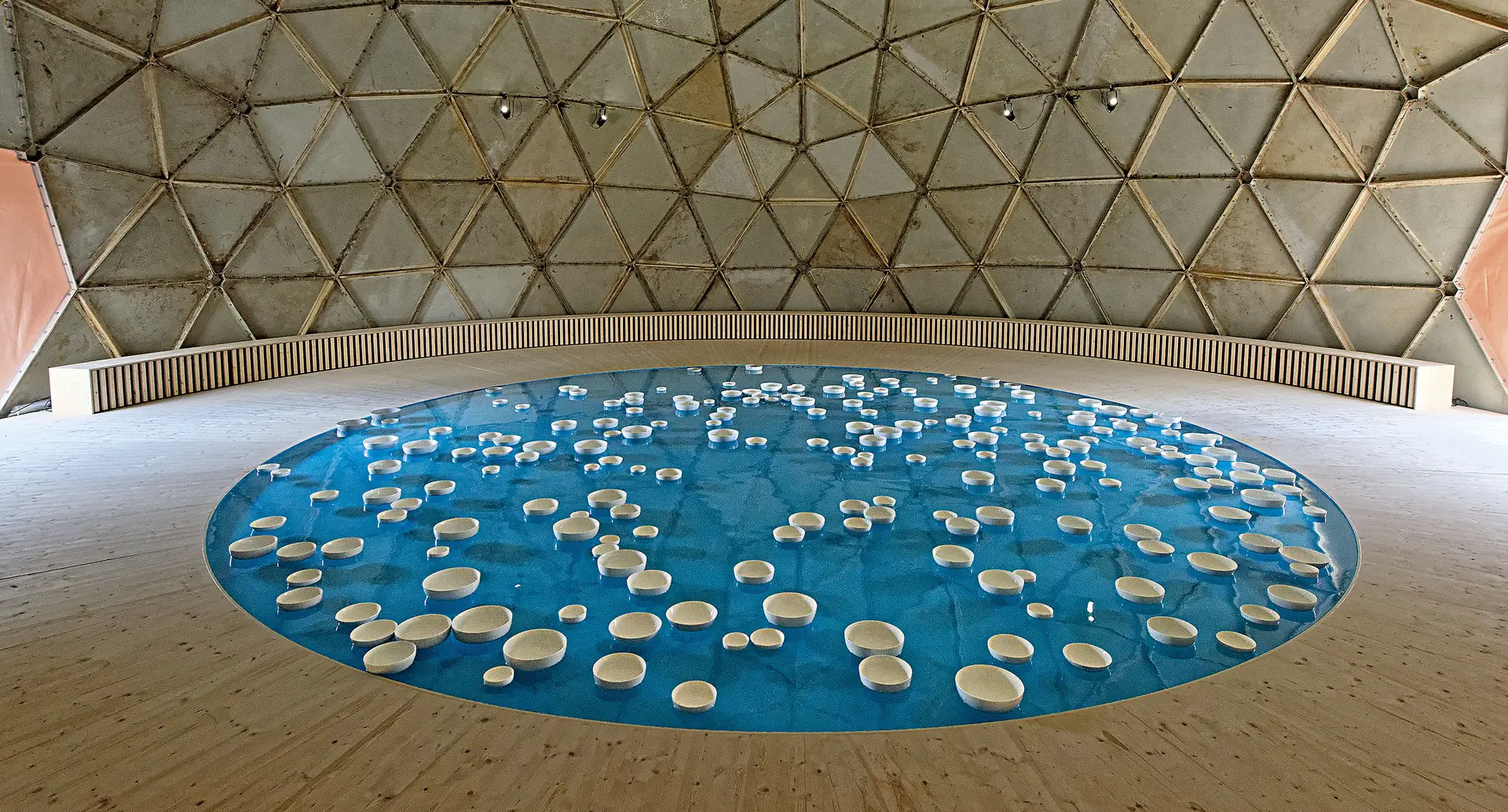
Featuring a selection of nearly ninety artists, eleven of them from Latin America1, under the general title of Floating Worlds, the 14th Lyon Biennale was on display in three different locations: the Musée d’Art Contemporain, La Sucrière (an old 1930s warehouse), and Richard Buckminster Fuller’s geodesic dome2 rebuilt for the occasion at the center of town, with an installation by French artist Céleste Boursier-Mougenot. The theme chosen by curator Emma Lavigne, Director of the Centre Pompidou-Metz, makes reference to the Edo era in Japan, which saw the flourishing of the kind of print known as ukiyo-e (floating worlds), but also imbued with the “archipelagic” idea developed by Édouard Glissant, a poet of the “relational” and the “rhizomatic identity,” creator of the concept of the “tout-monde.” The circulation and intertwining of flows, the dissolution of forms and the instability of the present time, the poetics of the evanescent, dominant conceptual and aesthetic axis of the Biennale’s project, echo a world in permanent transformation, where modernity is the object of ceaseless interrogation.

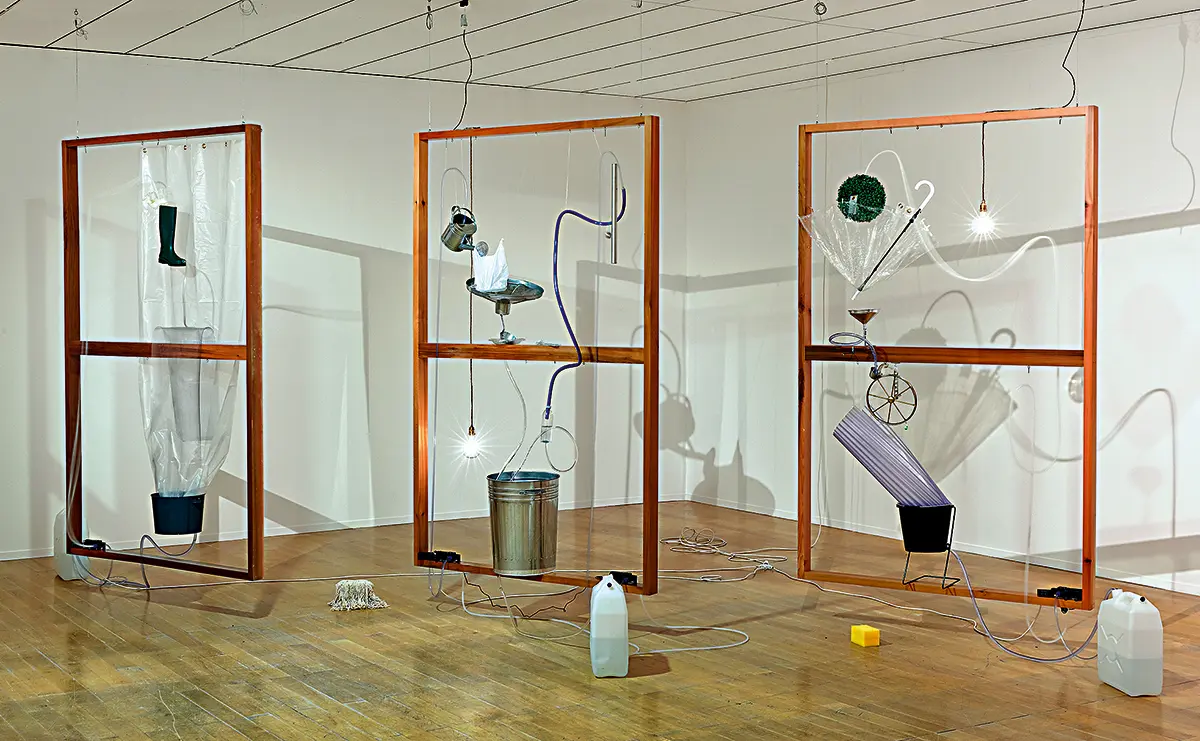
One of the most successful characteristics of this Biennale, designed as an experimental “mobile landscape,” at once sensorial and nomadic, is the connivance between the works, since, for the first time since the event’s inception in 1991, a number of emblematic figures of Modern art are set to dialog with their contemporary counterparts, especially Alexander Calder, Jean Arp, Lucio Fontana, and Ernesto Neto, or Japan’s Yuko Mohri (Tokyo, 1980) with her variations on Marcel Duchamp’s Large Glass. A coherence both aesthetic and poetic suffuses the well-paced museography of the Musée d’Art Contemporain, confirming, with the impeccable selection of artists and works, the maturity of a project intended from the start to “widen our perception and conception of the world.”
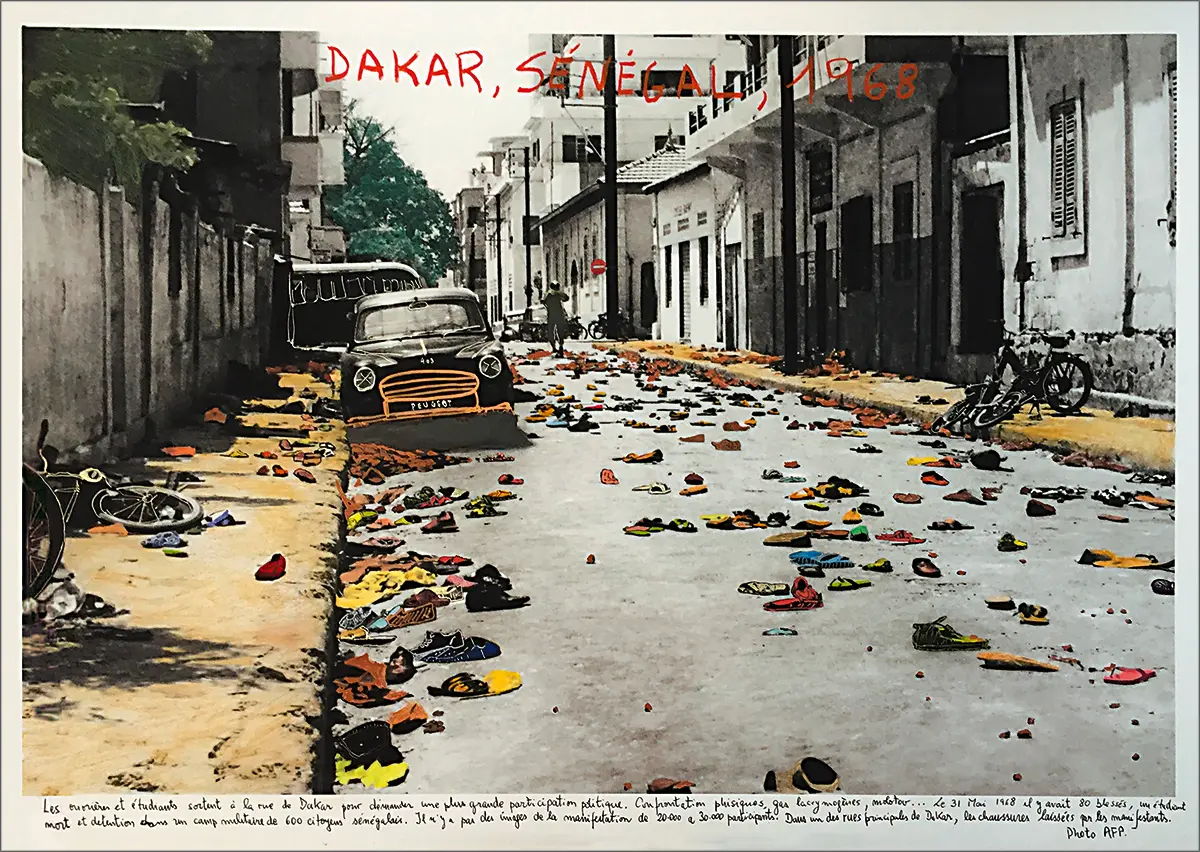
Several installations bring into play elements like air (Hans Haacke, 1936) or water (Doug Aitken, 1968); noise and sound—drawings and collages with notations, a kind of virtually sonorous “calligraphies” by German artist Jorinde Voigt (1977), created for interpretation by musicians—or the installation by David Tudor (1926-1996), which connects the improbable coexistence of the sounds of a primary forest with everyday objects; nature coexists with political issues, as in Melik Ohanian’s video (Lyon, 1969), projected on four screens, which depicts a “marginal territory,” the realm of the homeless and the vagrant, filmed on a floating roof in New York, or the posters from 1968 intervened (drawing and painting) by Argentinean artist Marcelo Brodsky (1954). Some of the works display absurdist and surrealist elements—such as Fantômes Avant le petit-déjeuner (Ghosts Before Breakfast), a 1927 film by Hans Richter (1888-1976)—or elements of the extravagant, like the video Let’s make cows fly, by Japanese artist Shimabuku (1969).
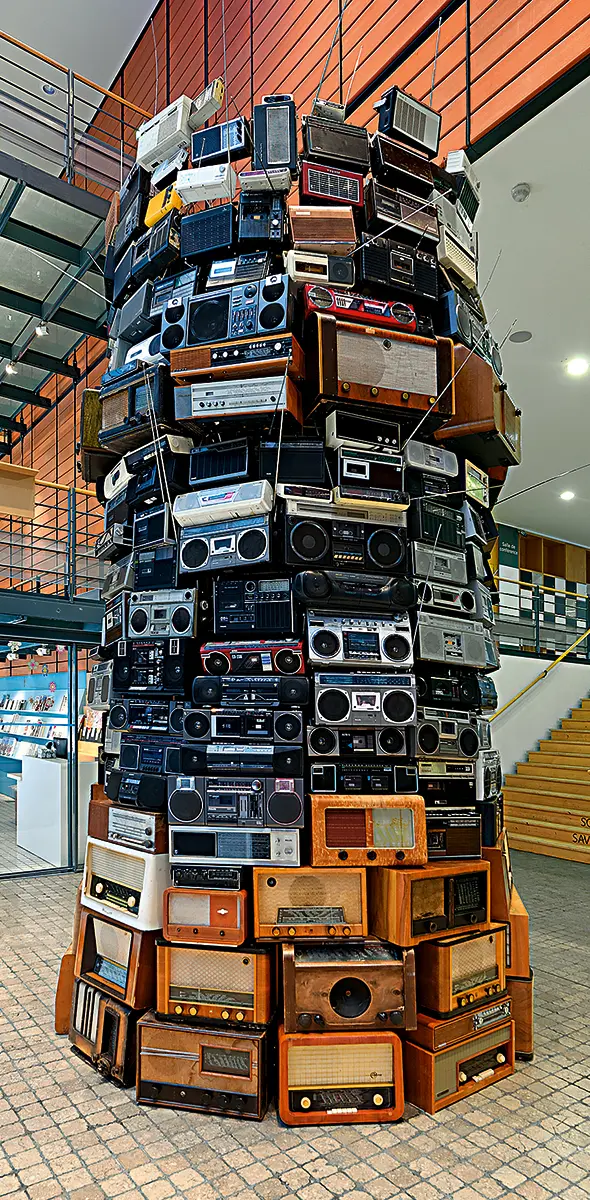
Some of the works, groups, and installations in the sizable Latin American selection are particularly noteworthy. At the Musée d’Art Contemporain (MAC), the sampling of Brazilian art is forceful. At the entrance to the museum, visitors are visually and auditorily confronted by Babel, a 2001 installation by Cildo Meireles (1948), a kind of modern totem comprised of a vertical pile of radios in different sizes and formats, which the artist has dubbed a “tower of incomprehension” and where percussive sounds repeat in an unbearable cacophony.
Lygia Pape (1927-2004) is represented by three works: Divisor (1969), Luar do sertao (1995, a vast expanse of popcorn under a black light), and especially New house (2000), where a dominant white monochrome is unable to make us forget the horrors of destruction. Featuring fragments of plaster constructions, some suspended, some on the ground, and clouds of white dust, the elements encased in a glass cube appear as lifeless, timeless chaos.
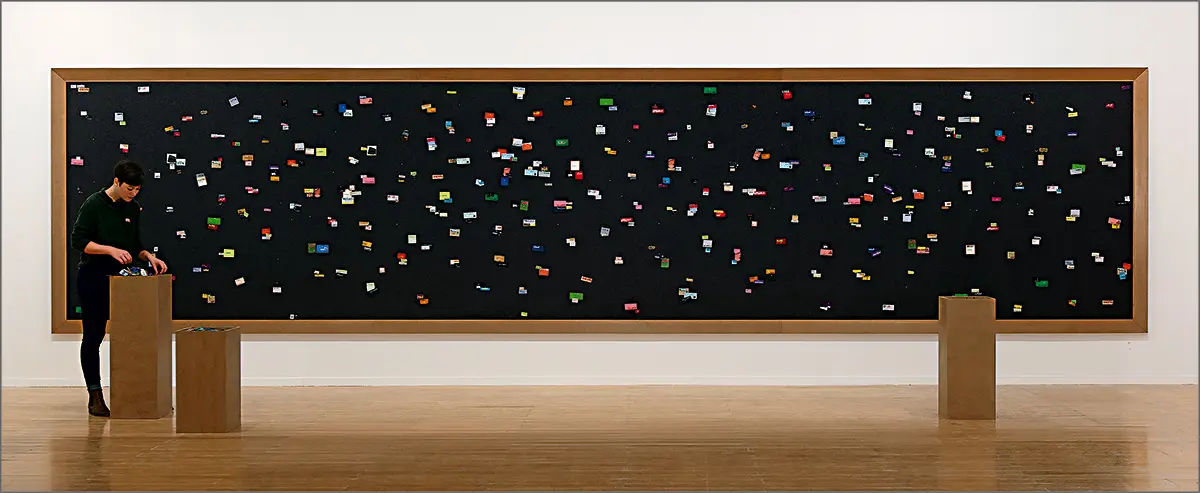
Bataille, an interactive work created specifically for the Biennale by Rivane Neuenschwander (1967), invites visitors to pick up small fabric labels with inscriptions that refer to freedom, resistance, utopianism, and justice, and pin them on a mural surface or on their own clothes, thus becoming “the messengers of a committed poetry.”
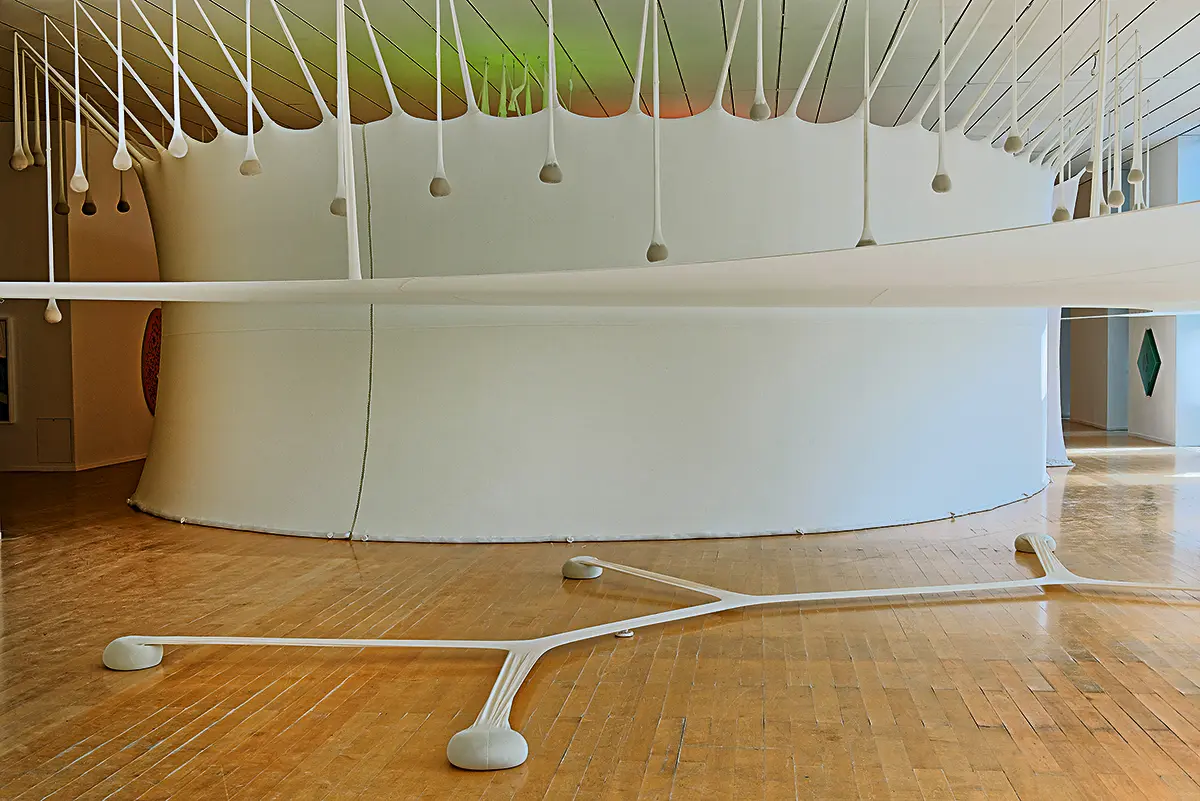
One of the Biennale’s greatest successes is an installation by Ernesto Neto (1964), set to dialog with Arp’s white sculptures, a black and white mobile by Calder, and Lucio Fontana’s pierced fabric titled Concetto spaziale (1950), With four works from 2007—Two Columns for One Bubble Light; Three Stops for an Animal Architecture under Gravity; Minimal Surface of a Body Evolution on a Field, and Stand up, Speaker up, see up—Neto invites viewers to wander around under a white polyamide sky and to traverse the transparent spatial labyrinth created by her shapes, between organicity and tension, emptiness and fullness, immaculate purity and positive energy. An experience in active meditation. Ícaro Zorbar (Bogotá, 1977) submerges viewers in sound-filled darkness, faintly lit by small bulbs high up in the ceiling, in an installation of rather enigmatic meaning. For his part, Fernando Ortega (México, 1971), who filmed a flute soloist playing Kazuo Fukushima’s Requiem in a rather bare space, provides a sober and poetic experience of emptiness and music in the midst of a solitude inhabited by sound.
At La Sucrière, the ample spaces of which allow for the unfolding of projects with greater spatial ambition, four artists ask us to share the sensations and meaning of four different experiences. Marcelo Brodsky, already mentioned, presents a group of twenty-one photographs taken in 1968 in different locations around the world, during the rallies and riots of that year, at a time when civil rights were being trampled on. Brodsky recovers the photographs and intervenes on them with words or paint, attempting, to a degree, to update them.
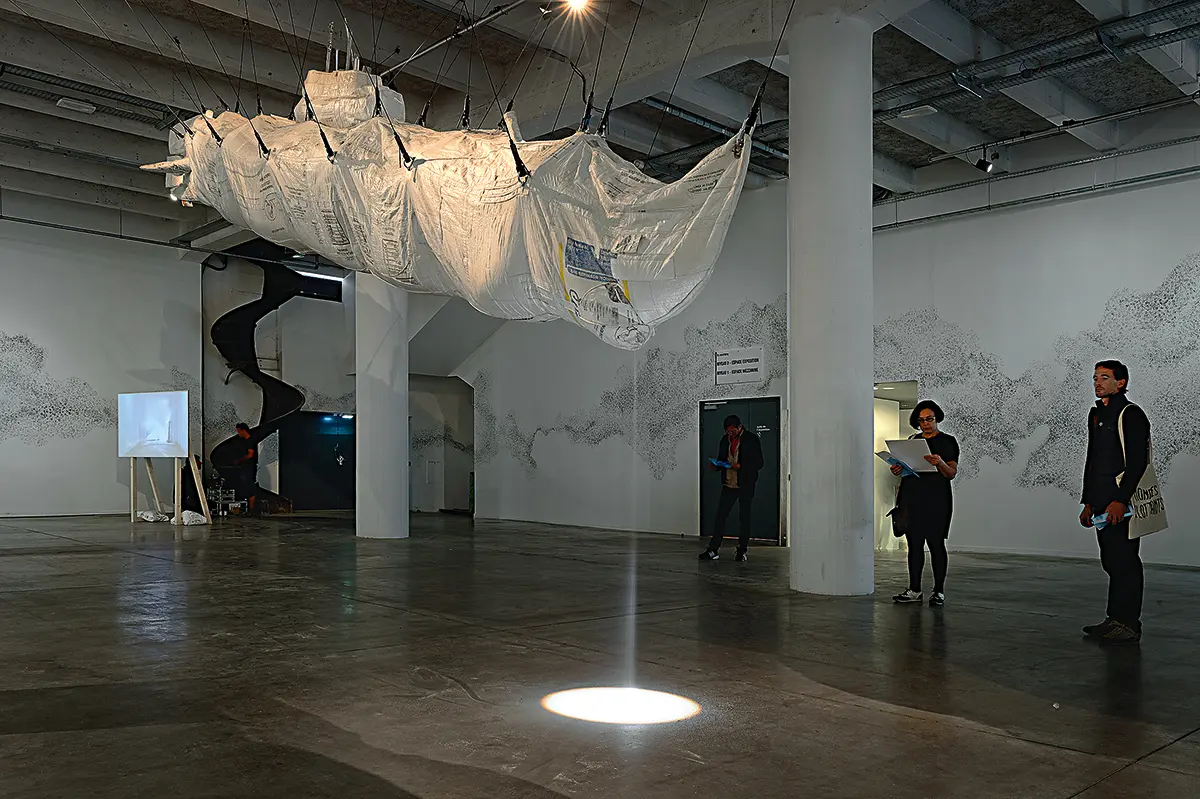
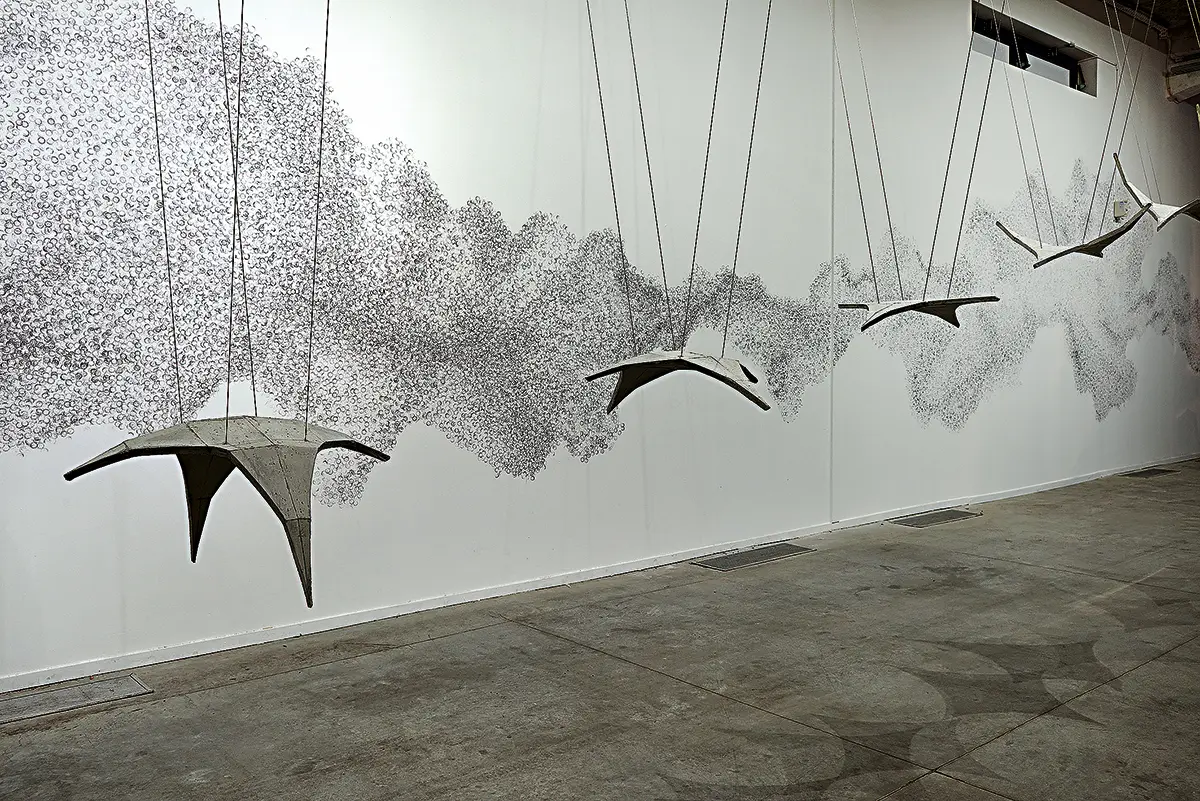
Mexican artist Damián Ortega (1967) hung an outsize shape that resembled a large whale, representing a cocaine-filled submarine found outside the coast of Ecuador. In the artist’s transposition, we see salt-filled bags with a hole through which the contents spill slowly. The title of Ortega’s work, Hollow/Stuffed: market law (2012), is inspired by T. S. Eliot’s five-part poem The Hollow Man, which in turn refers to Kurtz, the ivory-trafficking “imposter filled with emptiness” of Joseph Conrad’s novel Heart of Darkness. An indirect connection to Mexico’s drug trafficking mafias is not entirely absent from Ortega’s work. Not far from this “submarine” is a suspension by another Mexican artist, Héctor Zamora (1974), who also uses detoured everyday objects, in this case, basic architectural elements. Comprised of reinforced concrete shells, the installation evokes the flight of a bird that obeyed opposing mathematical laws. Equilibrium and levity mold, with their sense of gravity and transparency, the improbable flight of this stone “migrants.”
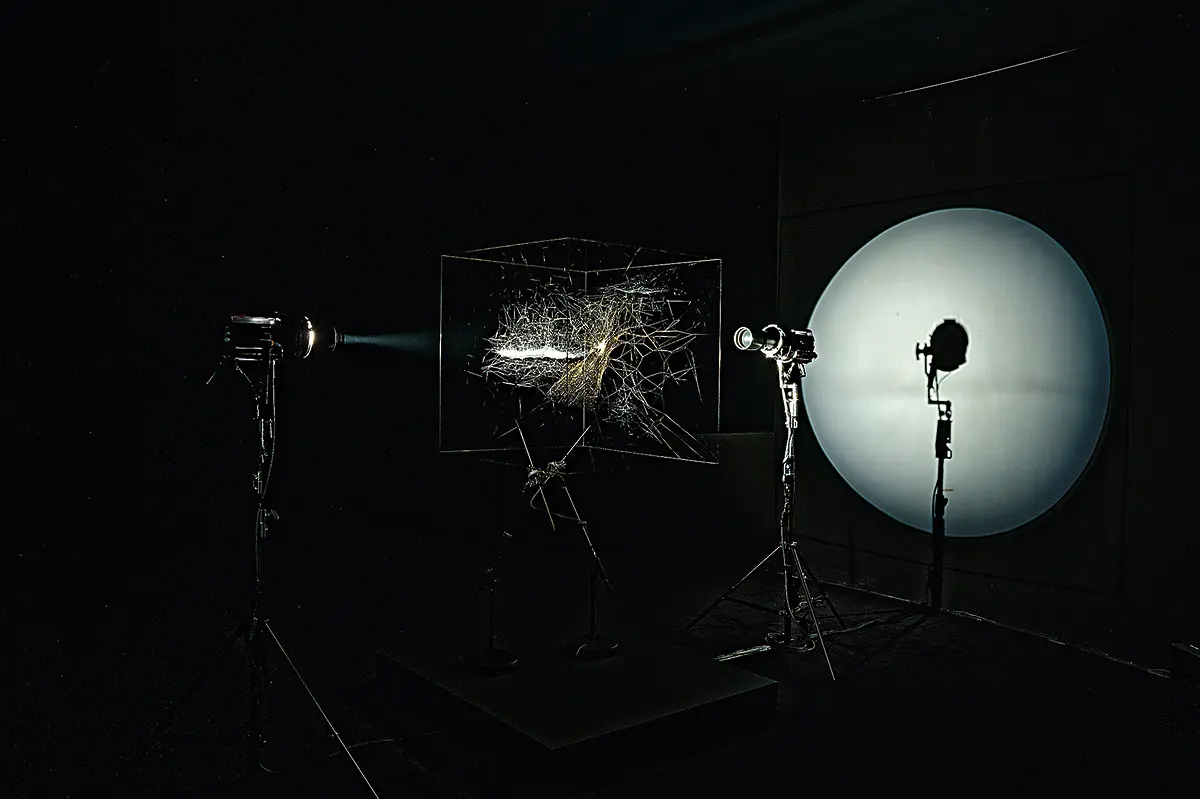
Argentina’s Tomás Saraceno (1973) completes this Latin American overview in a kind of apotheosis of transparency, flotation, unreality, and permanent transformation. His Interweb of the present, created specifically for the Biennale, connects light—via the presence of light cones—with cobwebs, a live spider, and the vibration of sounds recorded by a space probe around Saturn’s rings. An arrested, timeless atmosphere, strange and fleeting, envelops visitors in a semi-darkness where all shapes are random.
This most recent Lyon Biennale, rich in contents, coherent, inquisitive, and poetic, makes it possible for visitors, as curator Emma Lavigne writes, to feel like “wanderers in a landscape,” and, through the works on display, provokes admiration, drives us to contemplation, raises awareness, and prompts reflection. In the introduction to the catalog, Lavigne cites Swiss artist and curator Harald Szeemann, an emblematic figure of the 1960s art scene. “An exhibition must be filled with associations, evocations, and formal homophonies,” Szeemann wrote on the occasion of his famous exhibition Quand les attitudes deviennent forme (When Attitudes Become Form, 1969, Bern Kunsthalle). “It is a poem in space that allows for free association.” Emma Lavigne was able to integrate this idea into her own museographic reflection, skillfully adopting it in search of a style that in its era changed the notions of art and exhibition, inaugurating new perspectives both for the mise-en-scène and the curatorship.
NOTES
1. Marcelo Brodsky, Damián Ortega, Héctor Zamora, Lucio Fontana, Cildo Meireles, Ernesto Neto, Rivane Neuenschwander, Fernando Ortega, Lygia Pape, Tomás Saraceno, Ícaro Zorbar.
2. Radôme 1957, Centre Georges Pompidou collection, Paris.
CHRISTINE FRÉROT
Critic and art historian, member of AICA.