Invisibles Palpables is the name of the exhibition by Guatemalan artist Luis González-Palma (Guatemala City, 1957) presented at the Blanca Berlín Galería in Madrid. In this exhibition, González-Palma resumes the exploration that has marked part of his artistic production: the deconstruction of forms and a profound inquiry into the potential of images.
The pieces at the Blanca Berlín Galería surprise us because they mark González-Palma’s turn towards abstraction inspired by old photographs from the Centro de Investigaciones Regionales de Mesoamérica (CIRMA) in Antigua Guatemala and the Obervatorio Astronómico de Córdoba in Argentina.
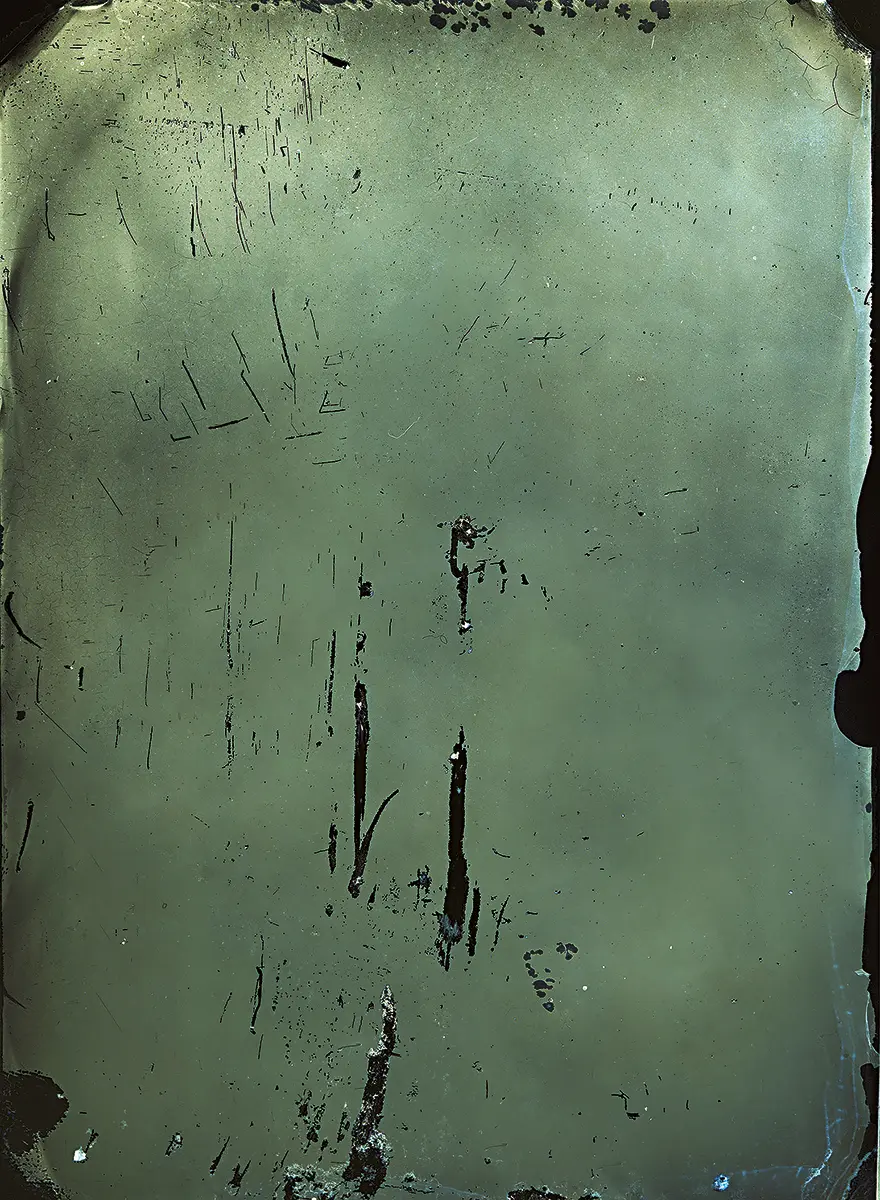
The process employed by González-Palma in this first section of works is as follows: he takes photographs by Juan de Jesús Yas—a Guatemalan photographer from the end of the 19th century—and eliminates any iconographic traces (portraits of priests and religious images) in order to reveal the hidden archeology of photography: marks and traces left by the silver, changes in temperature or the human touch. It is a sort of palimpsest that, in addition to telling the object’s story, also addresses the visual history of Guatemala. The use of photography, not only as a device at the service of something external but also as material in itself able to generate its own body, its alterations, and transformation, is very interesting. As a result, invisible stories are favored and “those things not told” in the official story—namely, emptiness, silence, and omission as historiographical material.
In González-Palma’s own words: “From the beginning, my work has been a reflection on perception. How are the eyes that unflinchingly stare at us constructed in our internal experience? How are shadows, glows, and the entire geography implicit in every photograph interpreted and developed in us? If our way of looking at things is shaped by social and cultural contexts, then we can conclude that all perceptions are political and all artistic production is subjected to that judgment. It is about the gaze as a form of power. From this perspective, I feel that the work of art is a way to evidence this, to question our way of looking at things, to make inquiries into the history that has produced all these calibrations of the gaze and, therefore, the ways in which we react to the world. Through the years I have developed scenes and modified certain faces with the goal of creating images that allow for other perceptions of the world, other forms of understanding and modifying it internally.”1
Applying this approach to the exhibition at the Blanca Berlín Galería yields amazing results. In Retrato de Medio Cuerpo de Sacerdote Anciano (Mid Shot Portrait of Old Priest), for instance, any semblance of the human body has been removed. Instead, we can only discern marks, traces of that which appear to be “unavoidable accidents” within the photographic medium. It is therefore a lyrical abstraction that, far from being cold and incomprehensible, is instinctively assimilated.
The photographs from the Astronomical Observatory in Córdoba, Argentina, do not capture things occurring on Earth, but in the sky. They are images about comets, the Moon, the Sun, and eclipses intervened through the technique of collage. The series titled Spectrum is based on the capturing of spectral lines and proposes alternative visual forms. On the other hand, there is also the series Cosmic Dust, about particles found across the entire solar system. González-Palma proposes here a series of geometric drawings inspired by the movements of those particles. The result is once again unexpected: the piece titled Luna (Moon), for instance, in which we cannot really tell what it is that we are looking at is more similar to a readymade than to conceptual work. In addition, the set is completed with the strong significations of the stars offered by Pre-Columbian symbology and the visual tradition of Latin America.
All the series in this section gain some degree of significance when connected to the post-colonial gaze. It must be noted that the Astronomical Observatory in Córdoba was the first such institution inaugurated in the Southern Cone with the objective of offering a center for astronomical observation. Therefore, the works also reflect on inherited knowledge and propose reinventing codes and merging them with autochthonous knowledge or with other cultures. In fact, the concept of Kōan (which, according to Zen philosophy, is a question without a logical answer whose purpose is to break with any normal patterns of thought to become engulfed by a sudden awareness of illumination). Based on this koan, González-Palma proposes to rethink the things that we observe as well as those that we do not, to reflect on the image as a space of conflict, of power, but also as something full of aesthetic possibilities.
NOTE
1. www.gonzalezpalma.com. Statement by the artist.
ANA FOLGUERA