Georges Didi-Huberman said in an interview, in connection with the Sublevaciones exhibition, that “the human body is the oldest thing we possess, older than a fossil or an ancient Greek artwork, it is our antiquity. All of that is anachronistic.”
And even though bodies are limited in their extension, the body of Liliana Maresca (1951- 1994) appears as an apt prototype for the consummation of every possible expansion and the loud proclamation, almost into infinity, of the expressive need: the engine of art. Maresca’s machinery unfolded and adopted every position through the use of her entire body, steeped in a unique beauty all of her own.
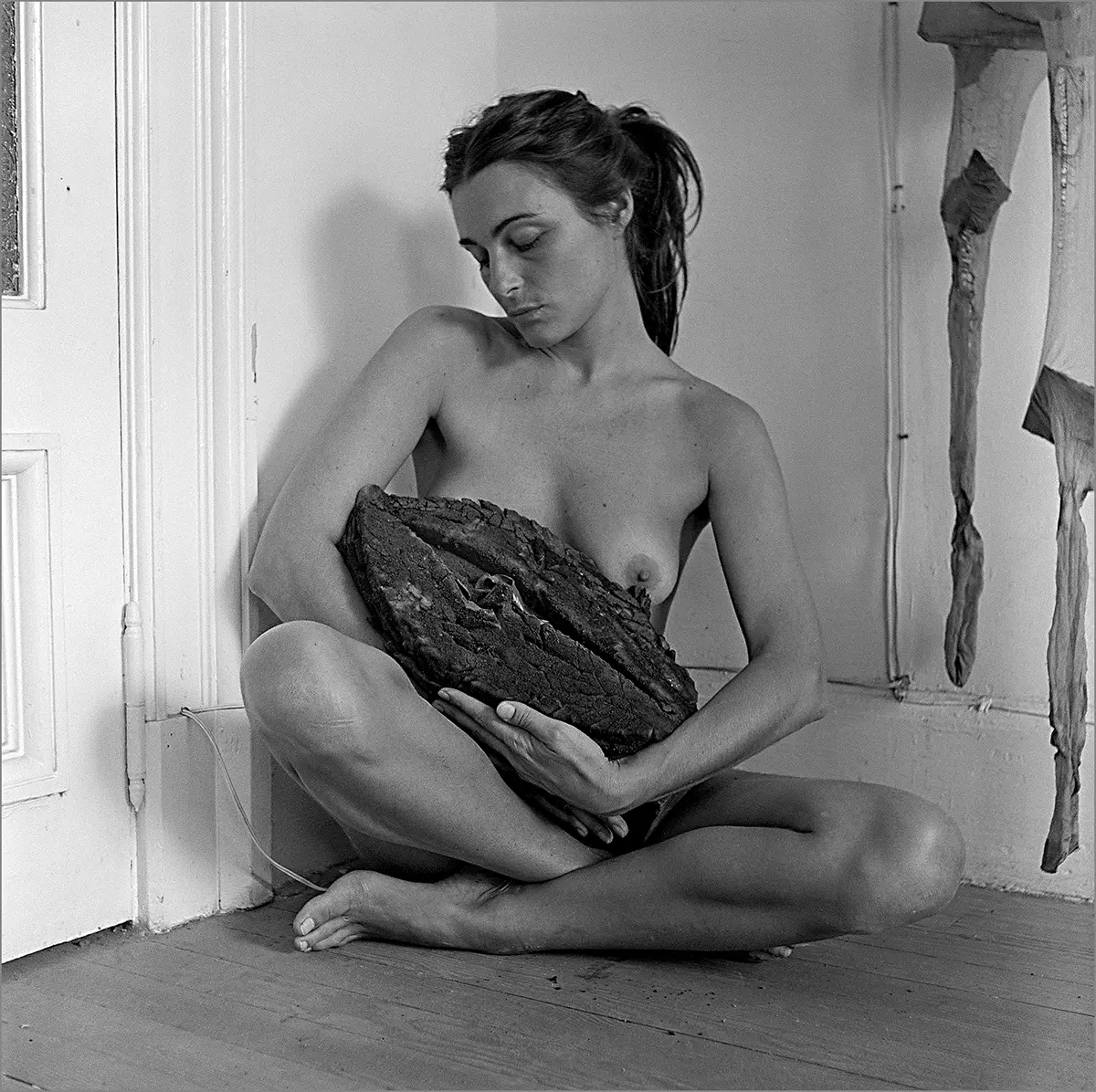
But a body is also a group of people forming a community, an association. Maresca’s body was not only a vessel for her art but also a “center and amalgam for the visual arts scene of the 1980s and 90s,” according to Javier Villa, curator of the comprehensive exhibition El ojo avizor. Obras 1982-1994 (The Watching Eye. Works 1982-1994).
The display of the body, the issue of the public and the private, is not the cause of discrepancies in Maresca’s work. The “anthropological machine” that Agamben speaks of in The Use of Bodies is dismantled, and so are “the divisions that characterize Western thinking: animal/human; subject/object; public/private; essence/existence; potential/act.”1 On the contrary, all of these instances come together to intensify the artwork’s striking first effect. In Maresca, what cannot be said with words is declared suddenly, like a pulse that arrives and pushes us to follow its play. Also, a dream seems to be coming true, the Hegelian realization of Spirit in Matter: body and object, vitality and garbage, are mutually realized in the same plane; everything could (and asked to) be traversed by a single enthusiasm: to change the world.
Liliana Maresca seems to have been born with her third eye fixed on a single point—her third eye, her watching eye, like a beam of light that made possible for her the many disparate things that the world brings to us. Maresca overcame the condition in which the things of the world can only be seen “through” something else, be it a point of view, the “tint of one’s glasses”, fear… Maresca listened to herself and acted in consequence, with no filters. “I believe there are things in reality that affect me, things that I can not see… so, I look for answers and become wholly involved, body and soul, and open myself up,” she declared. If the opportunity didn’t come to fruition for reasons, not under her control, she would correct course without detracting from the luster of the idea as originally conceived. She moved forward with poetry and politics in her body. She continued with the creation of her oeuvre through the end of the military regime in Argentina, the return to democracy, the Menem era. In 1993, the magazine El libertino published a series of photographs taken by Alejandro Kuropatwa in which the artist appears partially nude. Under the title Maresca se entrega a todo destino (Maresca Gives Herself to Every Destiny), she offers up her body for the establishment of telephone connections with strangers, thinking that eroticism is the most basic communication: “With my work, I am talking about love, about encounters…” She wanted to convince her interlocutors that her openness had a universal meaning, although the first reaction the announcement provoked was erotic in nature.
The following year, her health took a turn for the worse (she had been diagnosed HIV positive in 1987.) The unavoidable frailty of her body did not preclude her from continuing to work and produce. Her final work was a series of small portraits, her Mascaritas (Little Masks), made in small formats on notebooks and pieces of cardboard, and under the effects of a much-diminished sense of sight as a consequence of her illness.
Liliana Maresca was born in 1951 in Avellaneda. She married twice and had a daughter from her second marriage. She was also a teacher, a stage designer, a performance artist, and a sculptor. She helmed a space for the visual arts and she presented shows and productions in art-world and non-art world locations.
Her feminism was pure, uncontaminated by stereotypical posturing and mannerisms, fresh, and it was combined with a purpose that was both political and poetical. Her acts of insurrection made her forcefully unique as an artist.
And as I come to the end of this note (only for reasons of space; there is so much more to say about this show and this life), I run across this, in the Facebook wall of critic Juan Laxagueborde: “Genius is that presence that understands before the demonstration and formulates before the analysis, thus expressing an evidence of the identity between the laws of human logic and the directions of the universe of phenomena” (Leopoldo Lugones, Elogio de Ameghino).
NOTE
1. From a review of Georgio Agamben’s El uso de los cuerpos.
www.lanacion.com.ar/2051886-resena-el-uso-de-los-cuerpos-de-giorgio-agamben.
VIVIANA SAAVEDRA