In the world at large, and particularly in Brazil, uncertainty has become an underlying feeling in today’s daily life. Notwithstanding advancements in the fields of medicine, technology, and other areas of scientific and humanistic knowledge, we are experiencing a period in which the producers of all those achievements—we, mankind—are also the most efficient executioners of our fellow men. Terrorist attacks spreading throughout the planet, the emergence of xenophobic and fundamentalist groups, and the destructive use of natural resources, are some of our perverse creations worldwide. In Brazil, in particular, the mirage of political and economic stability suddenly vanished along with the apparent tolerance towards the opening of our culture that we projected locally and abroad. Faced with this mirror, we had to witness the emergence of the most rotten elements of our system of government, nourished by a society more preoccupied with attacking those with opposing political views than working towards a sustainable future that is good for everybody. We are precariously balancing on a tightrope and tomorrow is not a sure thing.
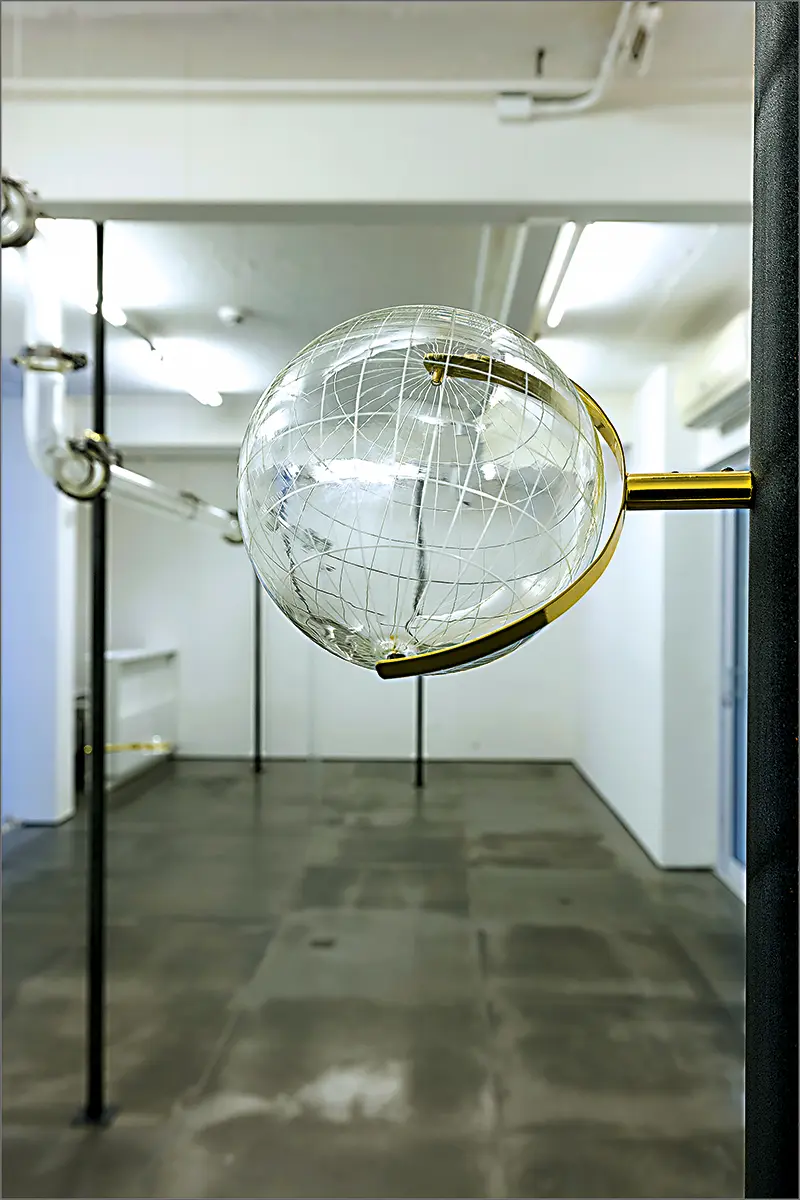
Cut to the art world. It is unusual that Laura Vinci announces any political or anthropological motivations a priori as the creative driving force behind her works. Her poetic has always relied on the intrinsic quality of the materials that she employs. Beginning with her interventions of architecture, like the 1997 Art/City project, her installations usually emphasize the sculptural potential of the materials based on their placement in the space, without having to interfere much with the compositions or forms. Be that as it may, given the current state of affairs, it is very difficult to refrain from drawing analogies between her installation Morro Mundo at the Rio de Janeiro space of the Galeria Nara Roesler, and the current environment in Brazil. Her site-specific piece consists of glass tubes that release white smoke when sensors detect visitors approaching. Also in this exhibition are other objects like a scale, a compass, and a globe, in addition to some engravings in which the central figure is an X, like in treasure maps. Vinci’s choice of materials for her works is very elegant: glass, polished brass, and garnet. She has always been known for using few elements, creating economic compositions, in terms of color and texture, and for favoring the use of materials with natural colors, without covering them with other colors and, if anything, only resorting to polishing them.
The experience offered to viewers in the exhibition space occurs in three stages: first, everything is in sight, which offers the comfort of the known. A tubular structure created with see-through glass cannot hide anything. Small objects, also transparent, resting on supports here and there—like a compass, a scale, a globe, and an hourglass—allude to the functions associated with orientation and verification. They are also made of glass like the main tubular structure, but with details in brass—its golden shine will become important later on. Symbolically, small garnet fragments (a mineral that in several belief systems is thought to have the power of easing crises, favoring the successful outcome of actions, and motivating necessary transformations) are inserted in the guidance instruments. Secondly, upon detecting the presence of people, a white fog begins to fill the tubes and it becomes possible to follow its progress as it moves along the tubular structure. Lastly, the gaseous matter escapes through the extremities of the tubes and begins to spread across the space enveloping visitors and the small accessories until the environment is finally overcome with this white mist. Everything becomes practically invisible and viewers are no longer sure of where they are or where they can go as disorientation takes over. The golden shine of the brass in the navigational instruments offers the only possibility of indicating the way. The alternation between orientation and uncertainty offered by the installation compellingly references the way of thing outside the gallery doors. It must be pointed out that it would actually be a great privilege if the disorientation, in reality, were to be as elegant as the disorientation in Morro Mundo.
Two “dialogues” to complement the exhibition have been planned: in one of them, poet and editor, Carlitos Acevedo, proposes an interaction with the space created by Vinci; the other is the presentation of a live-action experiment called World Machines. Developed by Laura Vinci in collaboration with the art group of the Mundana Compañía de Teatro, the work is based on the text titled O Delírio de Brás Cubas (Brás Cubas’ Delirium) by Machado de Assis.
As it usually occurs with the creations by this artist from Rio de Janeiro, the public plays a central role in activating the work. And there is also the element of time, which enables viewers to do more than contemplating and become part of an experience. In the words of renowned Catalonian multidisciplinary installation and multimedia artist Antoni Muntadas: “Perception requires participation.” And this solo show by Laura Vinci does precisely that.
SYLVIA WERNECK