A “sentimental education,” that process focused on the shaping of a person by means of their emotions, gave its title to Colombian artist Juan Mejía’s exhibition at the Museo de Arte Moderno de Medellín (MAMM). The show was part of the Revisiones (Revisions) program, launched by MAMM in 2015 and devoted to the work of mid-career artists. In this third edition, Mejía’s oeuvre, which treads between autobiography, cultural history, and education, was presented as a recapitulation of more than twenty years of activity in the field, a kind of semi-retrospective that sought to prompt dialogs, not necessarily chronological, between the works on display.
It must be noted that Educación sentimental is not only a reference to the literary theme best known from Gustave Flaubert’s 1869 novel of the same title; it is also the title of a work in progress that Mejía has been developing for several years. In it, he documents, as a list, the books he has read since his youth; a bonsai tree and a painting depicting Walt Disney’s Pinocchio complement the list. This work perhaps summarizes many of Mejía’s concerns in the course of his career: intellectual history, cultural consumption, the aesthetic that emerges in school contexts, accumulation, collecting, and inventories, among others. In any case, a sentimental education always involves an internal transformation, something that has also been inescapable in the life of many artists throughout history.
One of the works that deserve special mention in the context of this exhibition is Historia natural II (Natural History II). In it, Mejía puts on display a series of portraits of intellectuals, accompanied by various plants set on the floor. The portraits depict bearded men, as though a beard were a defining feature for those who operate in the intellectual realm. There, the contrast between culture and nature is given by the vertical growth of both elements: while a beard extends towards the floor as it grows, plants in their own growth process move upwards, defying the laws of gravity. We must note that, although intellectual history is a recurring theme in the works featured in this exhibition, these are not erudite or clever assertions on the part of the artist, but launching into circulation that, in a playful key, connects information that recurs in educational processes.
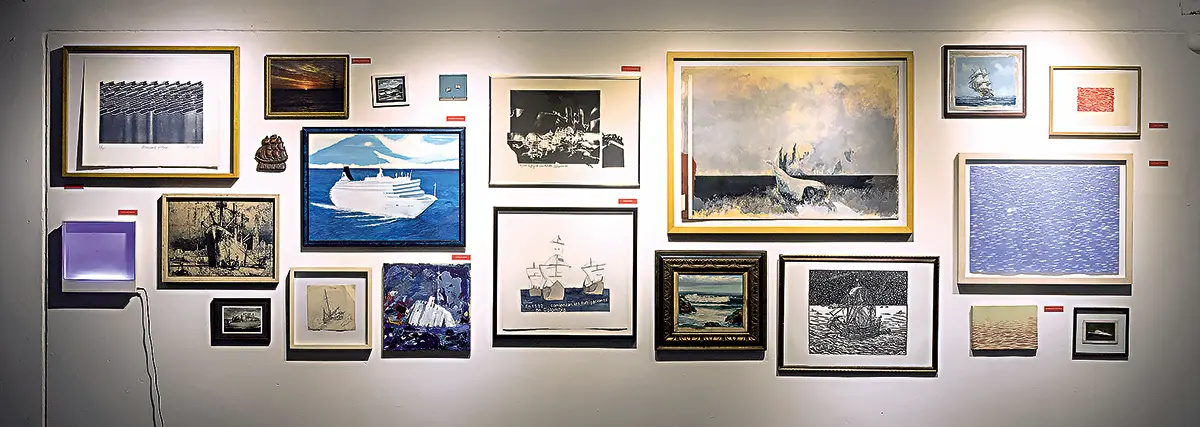
In parallel to the show at MAMM, and in collaboration with Universidad de Antioquia, Hacia un lugar común (Towards a Common Place) was on exhibit in the basement of the Antioquia building, former headquarters o the old Naviera Grancolombiana. This work, winner of the Luis Caballero Prize in 2015, encompasses three interrelated elements, traversed by the idea of failure: a series of paintings of shipwrecks, a room filled with accumulated objects, and a video where Mejía interprets ballads as a possible solution for common failures in the lifeworld if we are permitted to use an expression of Heideggerian vintage. The version presented in Bogotá in the context of the Luis Caballero Prize was held at the Museo de Arte Moderno de Bogotá, which suggested a strong critique of the decay of an institution during the late Twentieth Century played a dominant role in the Bogotá art system. The Antioquia Building’s similarities resulted in significant resonances with the original version.
Both exhibitions reveal the artist’s versatility in terms not only of discourse but also of technique, since while at Antioquia Building trial and failure find a site of enunciation, at MAMM education is the central focus, with outlets ranging from video to painting and installation.
JORGE LOPERA