The Museu de Arte Moderna de Río de Janeiro (MAM) presents Fluxo Bruto (Brute Flow), an exhibition of works by Rio artist José Bechara. The show was curated by Beate Reifenscheid (Director of the Ludwig Museum in Koblenz, Germany), Fernando Cocchiarale, and Fernanda Lopes, and was organized with the support of the General Consulate of the German Federal Republic in Rio de Janeiro, the Goethe-Institut of Pestana Rio Atlántica, and the Marilia Razuk Gallery.
The exhibition brings together large-scale, three-dimensional works in aluminum, marble, wood, and flat glass, as well as paintings. José Bechara (Rio de Janeiro, 1957) celebrates his 60 years of age with this exhibition, marking a career in the arts that began in 1992 and has brought him to a deservedly prominent place in the Brazilian art scene.
Bechara began his career as a painter using a language committed to concrete-art aesthetics, and he has stayed the course to this day. Geometric shapes gained prominence in his three-dimensional compositions in a gradual way.
Bechara’s intention in Fluxo Bruto was to reflect on his own creative processes and their constant shifts. In their raw state, Bechara’s works are the result of a stirring in the course of the production process, which is to conclude in the next item, according to the author.
Setting aside the paintings, the works on exhibit were created and built in the museum space during the exhibition run, on the basis of choices in the face of the site’s spatial relationships and the interactions between the works themselves; in this process, one work causes the conception of the next one, and the production of meaning is wholly anchored between the artist’s intention and the space he was offered.
The works are organized on the basis of a process in which their production results from a sequence of trials and experiments, where what matters is to feel and experience the space physically. That process is based on the harmony between the volumes, which impose themselves against gravity. They are very weighty yet are placed in a state of suspension. For the artist, this experience is mysterious and woeful. Carrying forward his proposal, Bechara “congeals time and space until the nature of his construction ‘explodes’ and stays frozen in mid-air.” The work just finished brings forth the next one, which is to say, the finished work opens crevices for another one to emerge, in a kind of eternal return.
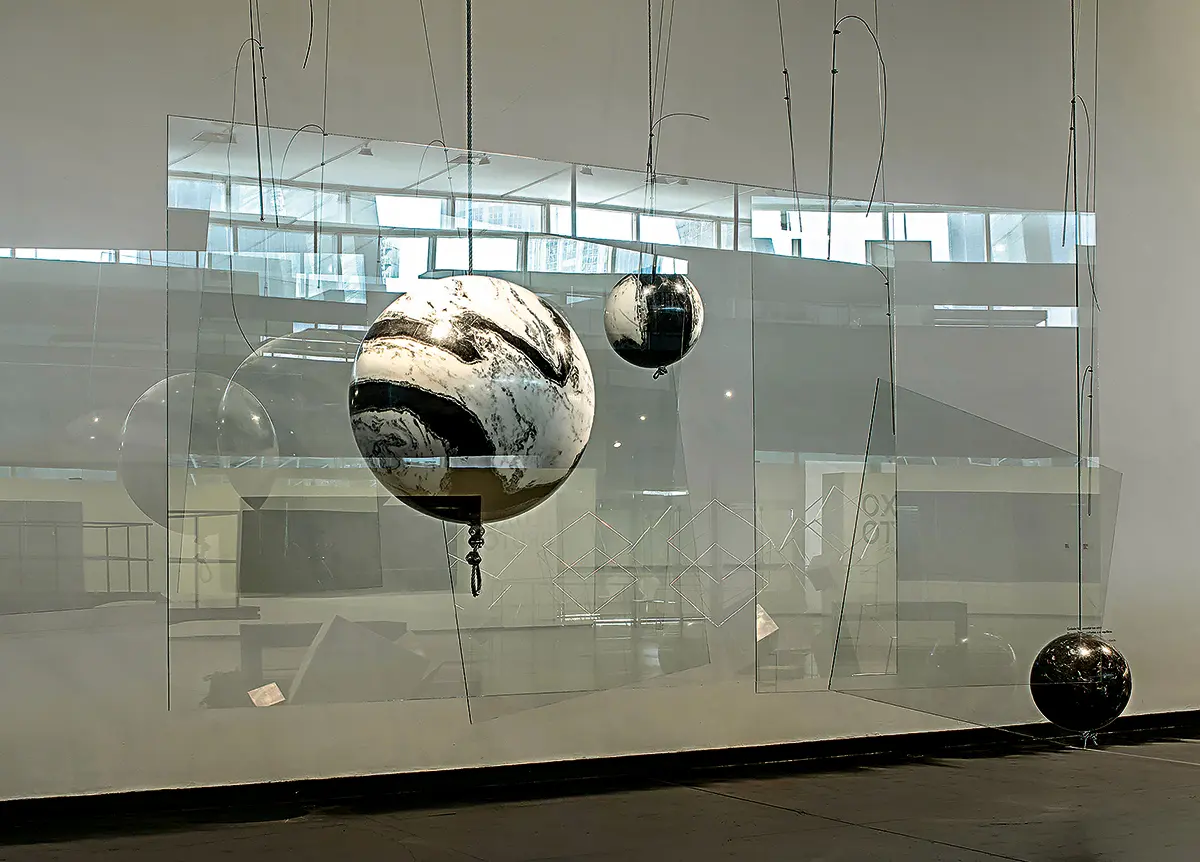
On display on the Monumental Gallery’s large, 30 meter-long white wall are three different works in flat glass, part of the artist’s most recent line of research.
The glass items integrate themselves into space by taking advantage of the third dimension just as they nullify it by means of the invisibility of their matter: transparency obliterates any barrier between the viewer and spatial context and even sweeps aside our perception of the spatiality that was offered to the artist for the creation of his works. It was precisely that duality that prodded the artist because that is how he perceived human beings: beings who produce such beautiful things as poetry but are also capable of interacting with the world in profoundly savage ways.
Apparently, such contradictions provoke questions about the strategy that Bechara combines with the glass plaques, like, for instance, a red fence, a subtle contrast between the transparency and the violence implied in the gaudy hue. These relationships are made explicit by the transparency of the glass and the use of cast metal, which makes space and time inherent to each other, and prompts a reflection about the relationships between the third and fourth dimensions: the concrete and the ephemeral. Bechara brings us to a world where time and space are in suspense since what emerges is the essence, the soul that fluctuates in the environment in which the installations materialize.
Bechara’s levitated works seem to defy gravity.
Some works from Bechara’s recent production were highlighted in this solo exhibition: the diptych Visto de Frente é Infinito (Seen Frontally and Infinite, 2010), from the Dulce and João Carlos Figueiredo Ferraz collection, and two paintings (1995) from the Gilberto Chateaubriand collection, as well as a new version of the installation Miss Lu super-super, which was expanded to occupy the central space of the Monumental Hall. Also included in the selection are two never previously exhibited canvases and the large installations titled Ângelas, comprised of three solid marble spheres—the largest weighing 1.8 tons—and the large glass plates, suspended and with elements anchored by steel cables.
HÉLCIO MAGALHÃES