The term Inflationary space designates the theory that attempts to explain the universe’s constant expansion since the initial second, the Big Bang, the great event that set in motion the implacable machinery of time and, in consequence, made space appear. This astrophysical concept—one could be forgiven for thinking it comes from contemporary economics—is also the starting point, and the title (Espacio inflacionario), of Colombian artist Mario Ortiz’s most recent exhibition, held at Lokkus. Arte Contemporáneo de Medellín, where the architecture of the building itself became an integral part of the intervention proposal.
As is also the case with the capital-centered economy, the growth of the universe seems boundless, while the environmental resources are finite. It is well known that the action of inhabiting a world is not only founded on the optimization of resources but also achieved through the technical and theoretical certainties reached by previous generations in their quest to transform the world and rendering it more benevolent for humans. In that sense, the most extraordinary civilizations, which were able in less than five centuries to encompass the entire globe, have developed diverse and ingenious ways of inhabiting their environment, as well as the ability to make poetry from their fears and encode them in all manner of mythologies intended to explain what is hidden from view, the very same things that over the course of time have been systematically demystified by science, an effort, it would seem, with no end in sight.
Limited to 13 m2 in a foreign land, during a residence in 2016 at Berlin’s ZK/U (Zentrum für Kunst und Urbanistik), John Mario Ortiz began to give shape to an inquiry that uses the most universal language of all, math, in an attempt to interrogate space and our relationship with it as we try to dominate rather than inhabit it.
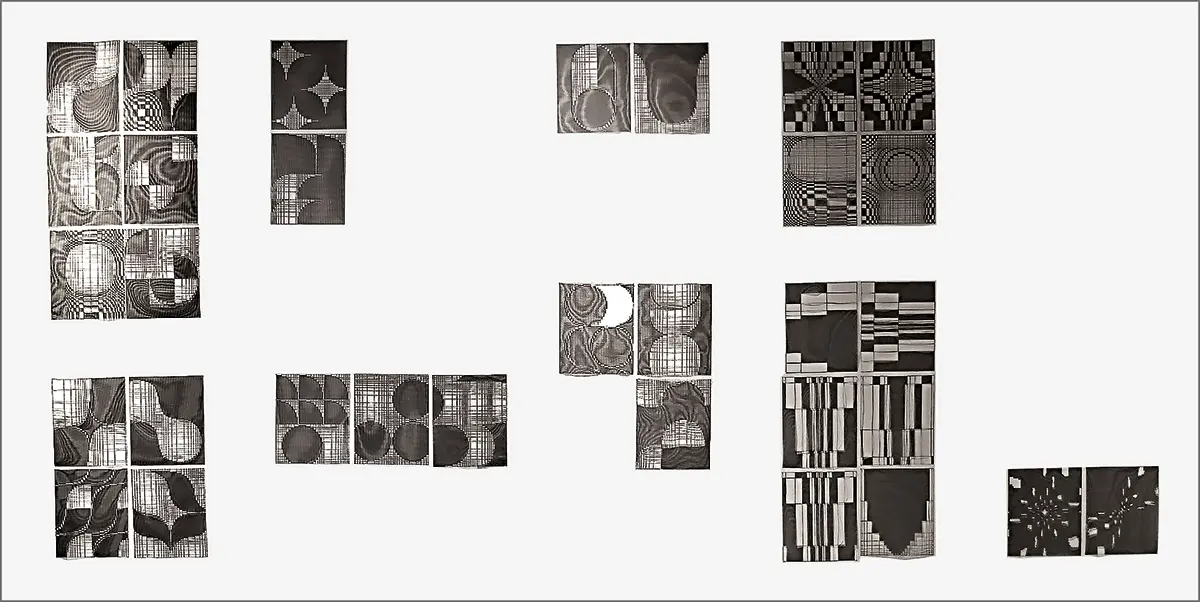
Ortiz’s site of habitation was an architecturally reconfigured silo with a cylindrical base. The influx of Euclidean geometry and the Cartesian plane—widely engaged by the artist in prior works—quickly took over the experimental scene during Ortiz’s residence. Calculation methods, arithmetical series, logarithms, statistical diagrams, and function diagrams are part of the grammar of Espacio inflacionario. The exhibition’s poetics fluctuates between the realism achieved by the two-dimensional models that result from the mathematical functions represented and the abstract-leaning allegory of the manufactured series of drawings deliberate worked in white and black materials, ciphered in a diagram of filled and empty spaces, making use of an austere yet clearly efficient binary dialectic.
As stated above, the container of the exhibition was activated as an essential part of the proposal. The gallery is located inside a modernist building that evokes the work of Le Corbusier, specifically the Sainte Marie de La Tourette priory. The title of Ortiz’s intervention on the exterior part of the gallery’s perimeter window is Paneles ondulatorios (Undulant Panels). Ortiz added layers of fiberglass mesh, commonly used in construction projects, carefully trimmed and placed in reference to the priory’s slanting glass-stained windows. With arithmetic exactitude the superposition of layers generated a grid that, depending on the saturation, allowed external light to gradually filter through; this process was reinforced using LED tubes to emphasize the gesture and enhance the moire effect, which produced in viewers an atypical visual sensation, rather akin to kinetic art.
Inside the gallery, Espacio inflacionario unfolds in three distinct series of drawings: Modelos de expansión especial (Models of Special Expansion), Diagramas logarítmicos (Logarithmic Diagrams), and Barras (Modulor) (Bars (Modulor)). In each series, Ortiz explores interconnecting relationships between the notion of “inhabiting” and “art”, “mathematics” and “architecture”, respectively. The whole, given the presence of Paneles ondulatorios, encodes the experience and reverts it towards a phenomenological plane that challenges visitors to discover, and even invent, interpretative patterns, or simply to enjoy the incidence of light that affects the space in shifting ways.
The drawings are built using unconventional materials. Two of the series use Modulor-brand fiberglass mesh, and the last one uses acetate formats for architectural projects of the same provenance. With precise cutting, all excess material is eliminated in order to optimize the filled and empty spaces that, like zeros and ones, give rise to a seemingly hermetic language where geometry reinforces the lyricism of the resulting abstractions.
Art, mathematics, and architecture are brought to light in this inflationary space, and we can see how their shadow, which will forever remain mysterious, recreates our idea of inhabiting a world that seems to have demystified all things. Yet, a new body found by science in this vacuum expanse, which widens the gap between sidereal bodies and the mysticism of the unknown, once again launches us in an arduous race to understand that which we have never even felt, beyond the undeniable forces of gravity and the power of light. This exhibition is a window open towards science from the standpoint of art, aesthetics, and phenomenology; it directs our gaze towards the origin of all that exists, the Big Bang, and so towards the insignificance of humanity’s presence in the cosmos and its frantic efforts to complete its accomplishments.
OSCAR ROLDÁN-ALZATE