For the first solo show in France by Colombian artist Johanna Calle (Bogota, 1965), Spanish curator Helena Talay chose to exhibit works created between 1995 and 2015. It is a selection that despite containing a variety of formats, supports, and techniques, still manages to offer a clear and light walk through an exhibition whose coherent marriage of concept and form facilitates a better understanding of accessible, and yet difficult, work. While Johanna Calle’s work explores fields of knowledge whose words and texts, just like the images it contains (engravings and photographs), are the very texture of her aesthetic and political reflections, her approach is nonetheless discrete and subtle. It is a “Silent prose of the world,” as Alain Rouquié writes in the catalog introduction, without deafening screams and yet loquacious; beautiful and seductive with its quasi-monochrome of blacks and whites and “elective affinity” for paper.
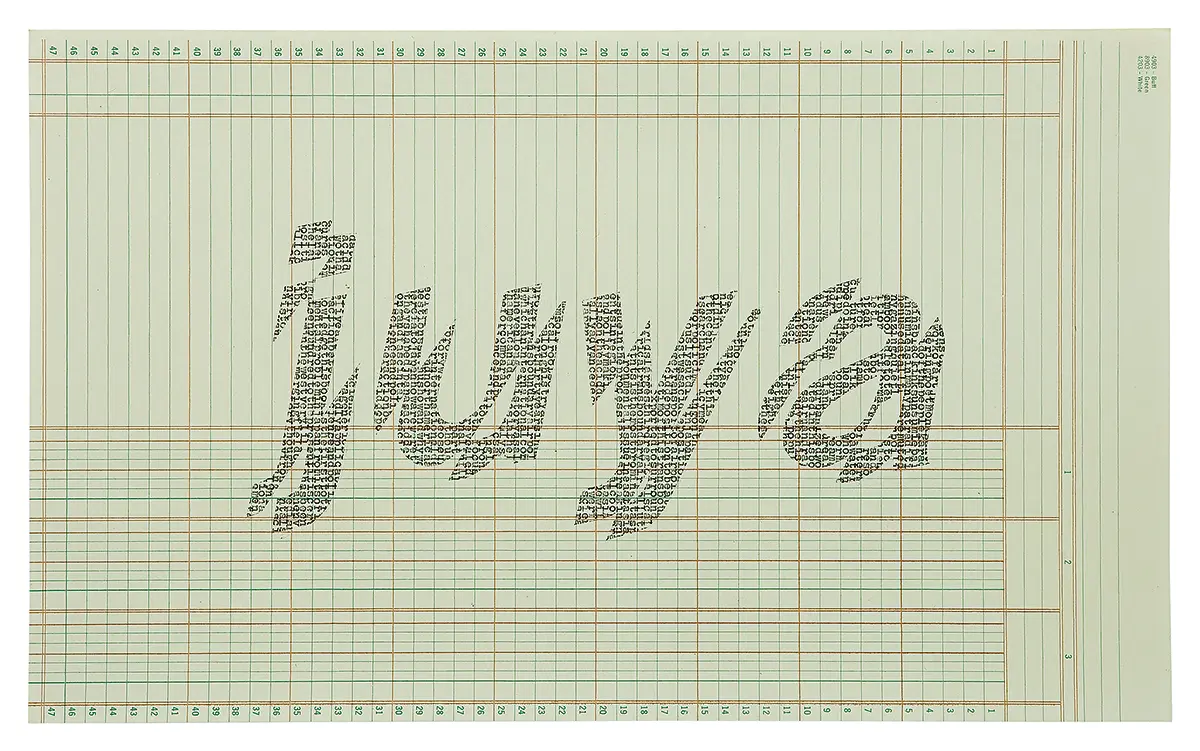
Indeed, both sensitive and intellectual walk through the exhibition introduces certain problematics—especially from Colombia’s past and present—associated with language and anthropology, water and botany, science and literature, as well as history and politics. With delicacy and poetry, with a sharp sense of observation, an awareness of her surroundings, and the immediate questions that it poses, Johanna Calle puts things into perspective by integrating the theme that she wants to defend in an aesthetic dimension. She recovers, documents, photographs, transcribes, cuts, reshapes, perforates, and connects. She often draws, sometimes prints, and manipulates images and words through the use of a traditional typewriter adapted for her specific projects. In this slow, patient, meticulous, and almost obsessive, exercise of memory, where time becomes an essential factor for the development and completion of the works, Calle does not forget that beauty is compatible with history. Both a researcher and an artist, she knows how to combine two seemingly antinomical attitudes in order to present her case, weaving the thread of a different type of knowledge, outlining a different visual language with black ink, going from words to drawings and from drawing to meaning. Calle invented aesthetic writing—that is both calligraphy and topography, arabesques and weave, reticle and mocárabe—to discretely and subtly express the avatars and reverses of the history that she interrogates, to draw our attention, to point and condemn unjust or dangerous situations.
From the moment one enters the exhibition, the gaze is simultaneously attracted to the right and to the left by two large trees rendered with translucent and arachnoid silhouettes. A “drawing” created with a typewriter is placed on support fashioned by assembling blank land register pages (3 × 4-meter panels) in which Calle reproduced the text from Colombia’s 2011 Victims and Law Restitution Law. Both from 2014, the two omnipresent and phantasmagorical trees, titled Perímetro (Ceiba), located on the left, and Perímetro (Sangregado), on the right, compete to draw attention towards extinct species; shadows brought back to the present in order to remind us about the past. The tone of the exhibition is nothing short of majestic, as it is also revealing of all the preparation work that Calle had to put into the project: surveys, readings, photographs, questions to several sources of information thoroughly researched and compiled. Calle is looking for a way to marry what she wants to say and the technique used in order to achieve her intellectual and artistic objective.
We once again find Calle’s same patient and time-consuming conscious process in the smaller works displayed in the exhibition rooms in the lower level of the gallery. Here Johanna Calle expresses with sensibility her ability to associate formal awareness, commitment, and care in series like The Translations (13 drawings from 2009) about quinine trees, based on the botanical drawings and their classifications by Hermann Harsten to denounce the exploitation of these plants through various interpretations from different periods; the series Endemic (7 drawings, 2006-2007), consisting of a galvanized wire mesh from which seven aquatic macroinvertebrates in danger of extinction were cut; the beautiful group Strange Sky (12 drawings, 2001), depicting blue planes flying over a sky covered with the entire text of Night Flight by Antoine de Saint-Exupéry, handwritten by Calle with blue ink. The series of five crushed bird cages titled Perspectives (2006-2008, metal), translates a simple aesthetic preoccupation without losing sight—a few steps further—of Colombia’s exceptional political moment with the agreement reached between the government and the FARC (Revolutionary Armed Forces of Colombia).
Two installations in the last exhibition room confirm Calle’s rich discourse. A long white display cabinet contains the 2009 series Networks (21 drawings and 1 handwritten notebook), in which texts associated with the rampant growth of Bogota are transcribed as the city’s illegal urbanization appears before our eyes in a crumbling thread that combines relevance and conviction, softness and violence. Drawn with India ink on a special paper outlined like a web, the first large installation titled Ciudades Urgentes (Urgent Cities) contains the transcription of a text by anthropologist Margarita Ruiz-Rogers. The second large installation titled Lluvias (Rains, 97 drawings, 2012-2013) phonetically reproduces words that evoke water and rain in the 68 living languages spoken in Colombia, 64 of which are Amerindians, indigenous, and mestizo. Addressing the lack of water and the extinction of those languages—most of them exclusively passed on through oral tradition—this group of works by Calle closes this journey of awareness and aesthetic exploration aimed for the most part at giving meaning to form.
This exhibition by Johanna Calle not only reflects on the themes it presents but also enriches the gaze that focuses on a singular artistic proposal in which commitment and beauty coexist in silence.
CHRISTINE FRÉROT