The underlying motto for the exhibition Home–So Different, So Appealing, presented at LACMA, could be “Home, not so sweet home.” The show is one of seventy such events programmed as part of a mega-project, mostly sponsored by the Getty Foundation in an attempt to bring together over one thousand Latin American and US Latino artists, on the occasion of Pacific Standard Time Los Angeles. Latin America (PST/LA LA). The idea is to foster a dialog between North, Central, and South America in reference to the migratory flow/axis South-North that promotes and idealizes the American Dream, even if reality turns out to be very different. Home–So Different, So Appealing was organized by the Chicano Studies Research Center of the University of California-Los Angeles, and curated in collaboration by Mari Carmen Ramírez, Pilar Tompkins Rivas, and Chon Noriega, the Director of UCLA’s Chicano Studies Research Center and adjunct curator at LACMA.
Home–So Different, So Appealing gathered approximately one hundred works of art, dated from the late 1950s onward, by some forty artists from several generations and from across the continent. The exhibition is based on a wide spectrum of conceptual divisions and eight thematic sections constellated around the main topic: Model Home; Archaeology of the Home; Mapping Home; Recycled Home; Home as Form; Embodied Home; Troubled Home; and Going Home. The exhibition deals with such complex topics as colonialism, migrations, architectures, periphery and center, and many others that were engaged on the basis of different strategies and media, and which added to the notions of Latin American, Latino, and American.
Home, above all, in the present, past, and future tenses; belonging and displacement; and a reflection that ranges from the minute to the massive, from the individual to the social, from the permanent to the ephemeral, from the local to the global. The show does not follow pre-established topics but attempts to have the artworks formulate the vast transversal conversation between space and time, between policies, emotions, economies, and rhizomatic constructions that seek a plurality of gazes, and, precisely in that manner, this wants to be an inexhaustive course through the exhibition.
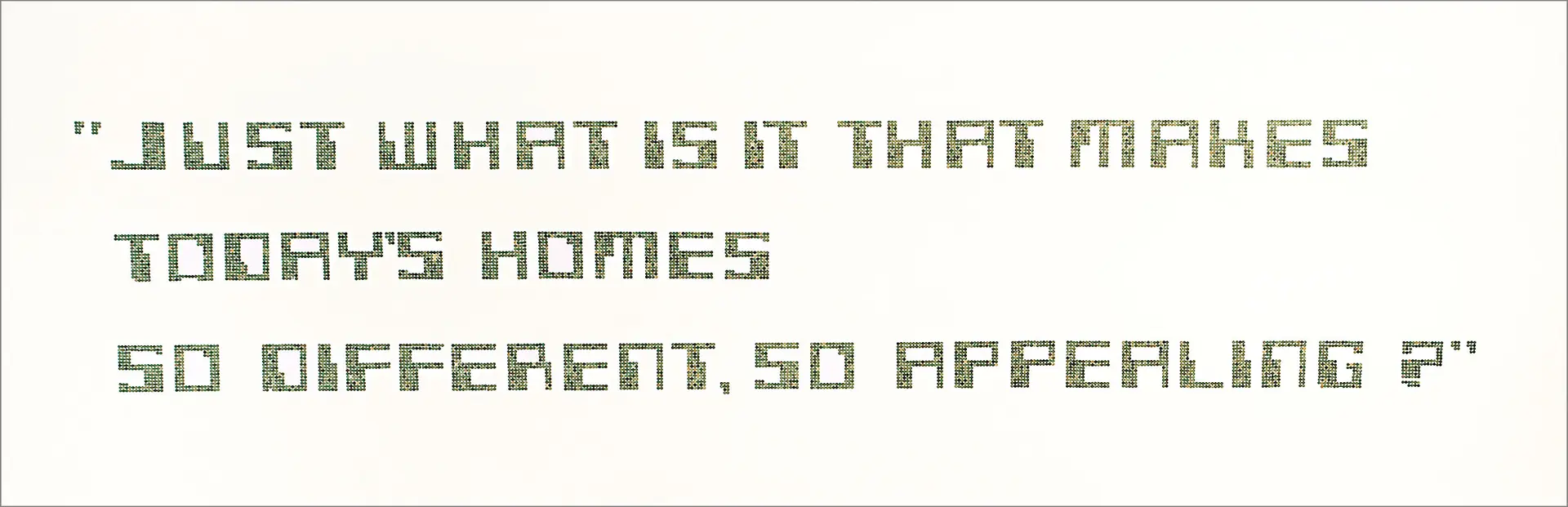
The exhibition starts with the question that inspired its title, taken from a collage by British Pop artist Richard Hamilton, written on the wall using coca leaves by his Colombian colleague Miguel Ángel Rojas: “Just what is it that makes today’s homes so different, so appealing?” Next to it, we find Daniel Joseph Martínez’s monumental The west bank is missing: I am not dead, am I? (2008), which consists of two octagonal aluminum wheels inside which are a kind of urban maps cast in plastic, in reference to the utopia of urban planning and the prefab homes found in some US cities that supposedly standardize low-cost housing structures. This urban-planning model has been adopted massively across the planet, but in the West Bank, it has been used for settlements that displace Palestinian populations.
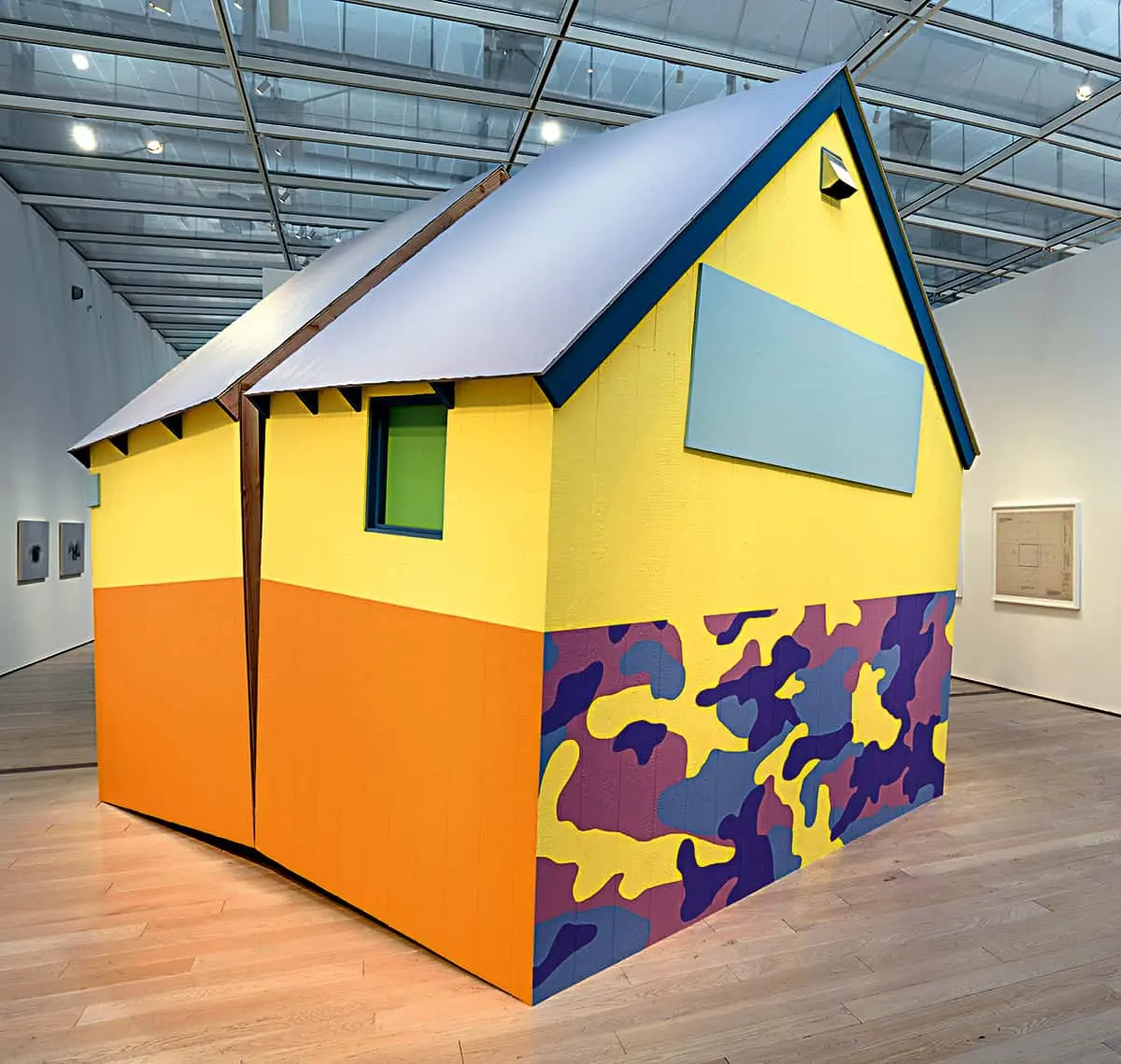
A second work by Martínez, titled The House America Built (2004-2017), is on display next to the last exhibition gallery. It is a single-room home, a replica in the scale of the hut in Montana where the infamous mathematician and anarchist terrorist Ted Kaczynski—alias “Unabomber”—secluded himself in a failed attempt to prove himself self-sufficient and live in perfect communion with nature. In that hut, in turn, modeled on Thoreau’s Walden Pond, Kaczynski wrote his manifesto Industrial Society and Its Future, while preparing and executing his attacks. Martínez’s home is cut in half and about to fall down. Outside it is painted in pastel colors taken from Martha Stewart’s Spring season palette: ochre, lilac, and green. These individuals, Stewart and Kaczynski, represent opposite poles of American society: wild consumerism on the one hand and a profound contempt for society on the other. Yet, Kaczynski’s story, unlike Stewart’s, is one of deep disturbance, and at the same time, the replica of his hut does not represent the weight of his theories or what the terrorist experienced there: Martínez trivializes Kaczynski’s hut with Stewart’s chromatic range, which in the end is akin to what happens in an era when news and events, circulating massively in social media, turn ephemeral and trivial.
These works by Martínez are two of the exhibition’s major axes, as they powerfully summarize the notion of home: one from the artifact and the other one from the concept. Between them, we find another key work around the idea of a home conceived from a critical and political position, one that probably provided Martínez with inspiration: Gordon Matta-Clark’s Splitting (1974), a video in which the artist records how he cut in two an abandoned house using a saw. These three works weave the show’s conceptual grid in terms of the notions of division, displacement, breakage, and fracture of our contemporary lives, ideas that acquire great importance and function as a referential framework for our apprehension of the exhibition.
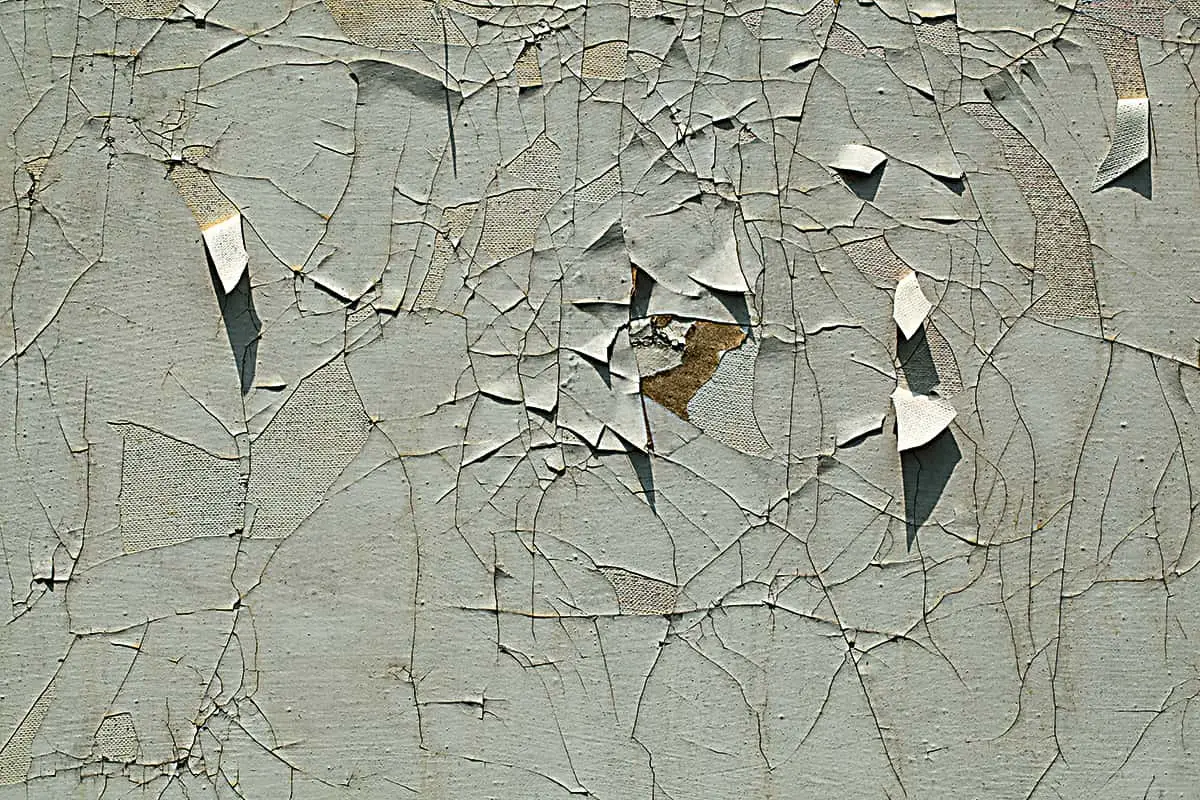
The room devoted to Archaeology of the Home combines Raphael Montañez Ortiz’s massive sculptures—made from recovered 1960s heavy furniture—with Colombian artist Leyla Cárdenas’ subtle installation Extracción (Extraction, 2012), a delicate and poetic installation that consists of a 4-inch cut of a Twentieth-Century Bogotá home, erected at the center of the exhibition space as a historical exercise and a palimpsest of the histories of a home, a reflection of the past. In an ideal counterpoint, Pomona 36 IID (2012), by Mexican artist Gabriel de la Mora, presents a piece of roof from 1904, all its cracks and layers of paint visible, which has been removed from a house and placed on an aluminum frame.
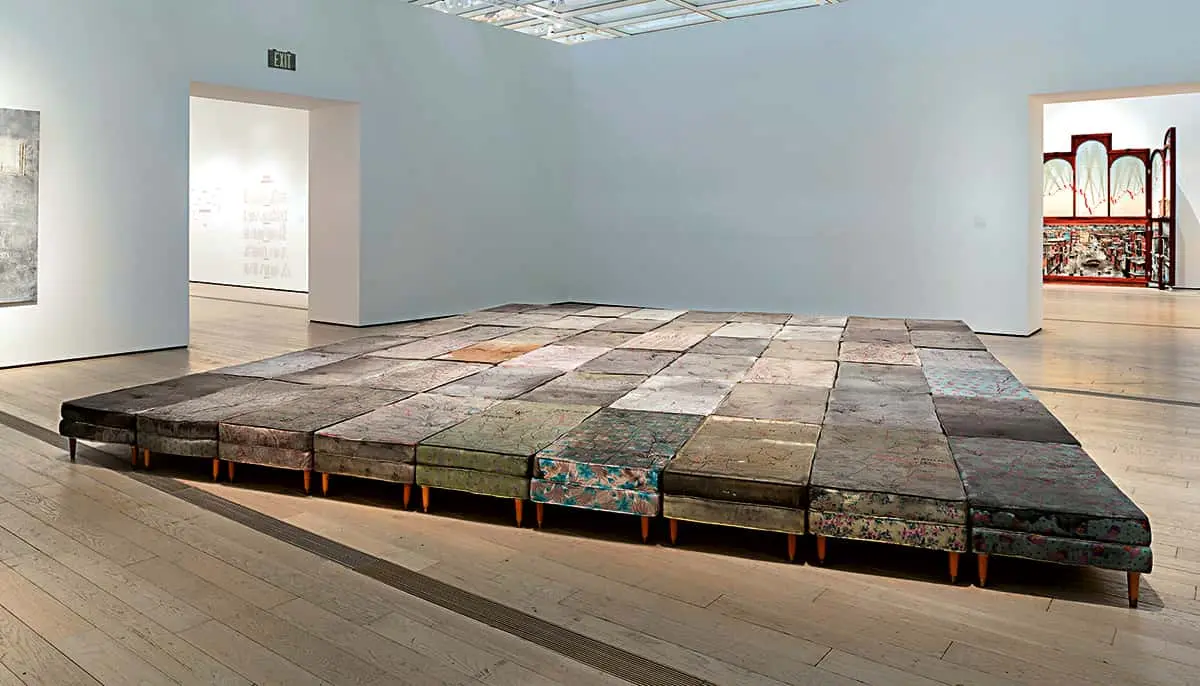
Following into the section Map of the Home, we encounter Le sacre (1992), by Guillermo Kuitca, a large room with mattresses on which maps have been printed, combining themes of domestic geography, architecture, and cartography that trace the borders between the private and the public. Other artworks and installations included in the exhibition also function as intersections between the idea of home and the socio-economic and political conditions that govern it. That is the case of El barrio (The Neighborhood, 1980) by León Ferrari, produced in the context of the dirty war against leftist dissidents carried out by the Argentinean armed forces; it presents detailed zenithal drawings of a neighborhood, including human figures, as an early artwork on the topic of surveillance.
Mexican artist Abraham Cruzvillegas’ installation Autoconstrucción (Self-Construction, 2010) occupies one gallery almost completely. It is a large house made using found objects and inspired on the artist’s childhood in Colonia Ajusco, an occupied community in the southern section of Mexico City; it evokes informal constructions based on recovered materials and represents the notion of home as urgency, as a situated resource for survival and community. Next to it, the video performance presented by Colombia’s María Teresa Hincapié at the 1996 São Paulo Biennial, Una cosa es una cosa (A Thing is A Thing), records the artist narrating the action of organizing her personal effects in the borrowed space of the gallery.
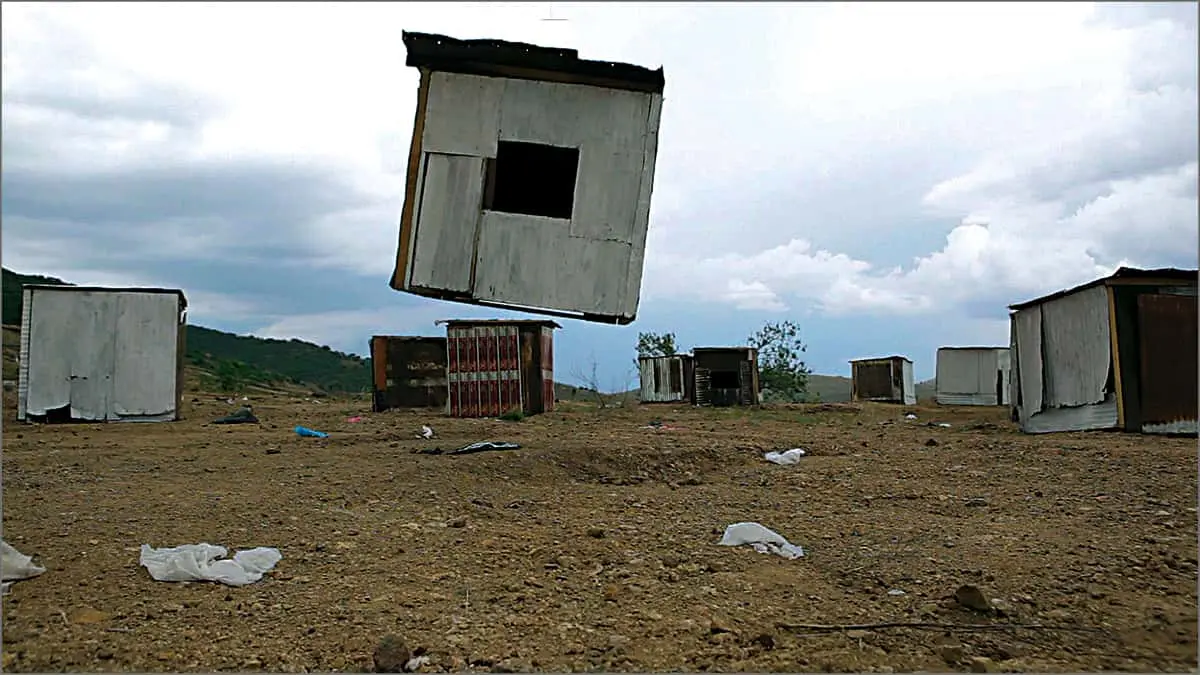
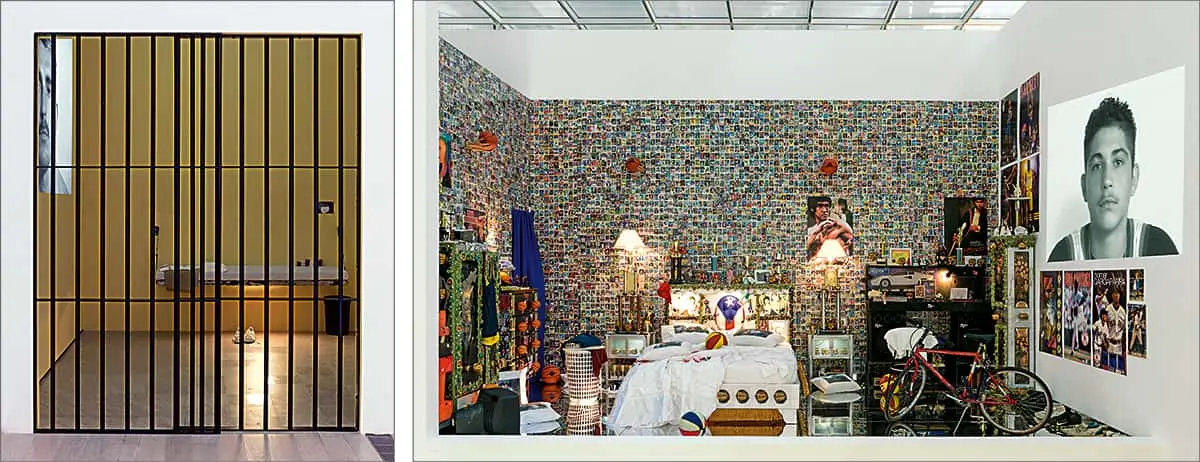
One of the most striking and important works in this exhibition is El fantasma de la modernidad (lixiviados) (The Ghost of Modernity [Leachates], 2012), a video by Miguel Ángel Ríos, an Argentine artist who lives and works between Mexico and New York. The video was recorded in a landfill/desert near Oaxaca, Mexico. There, many structures of the tin-shack kind fall from the sky and take their place on the ground. The term lixiviado (leachate) refers to the putrid liquid that results from the passage of water through decomposing garbage, which flows into the rivers and ecosystems throughout the region, contaminating them. The artist suggests in this way that humans are the ones who leachate. In the video, the falling structures evoke implanted cityscapes and informal architectures. A transparent Plexiglas cube, moving autonomously, flies over the scene like a ghostly surveyor of the crude reality on display, representing, as the artist puts it, the European gaze, the cultural element of the cube, in ironic contrast, as a commentary on the supposed meeting of cultures. Birds of prey, landfill, meat drying under the sun, street sweepers appear and disappear to contrast with the lightness of the transparent cube. This is a forceful, poetic, and terrible work of art that describes different strata of humanity from a critical standpoint, as is also the case of Medalla de honor (Medal of Honor, 1995), by Puerto Rican artist Pepón Osorio, which explores the real-life case of a father and son and their permanent or temporary lodgings. The father converses with the son from an austere jail cell, and the son responds from a baroquely adorned room filled with baseball souvenirs and thousands of consumer objects.
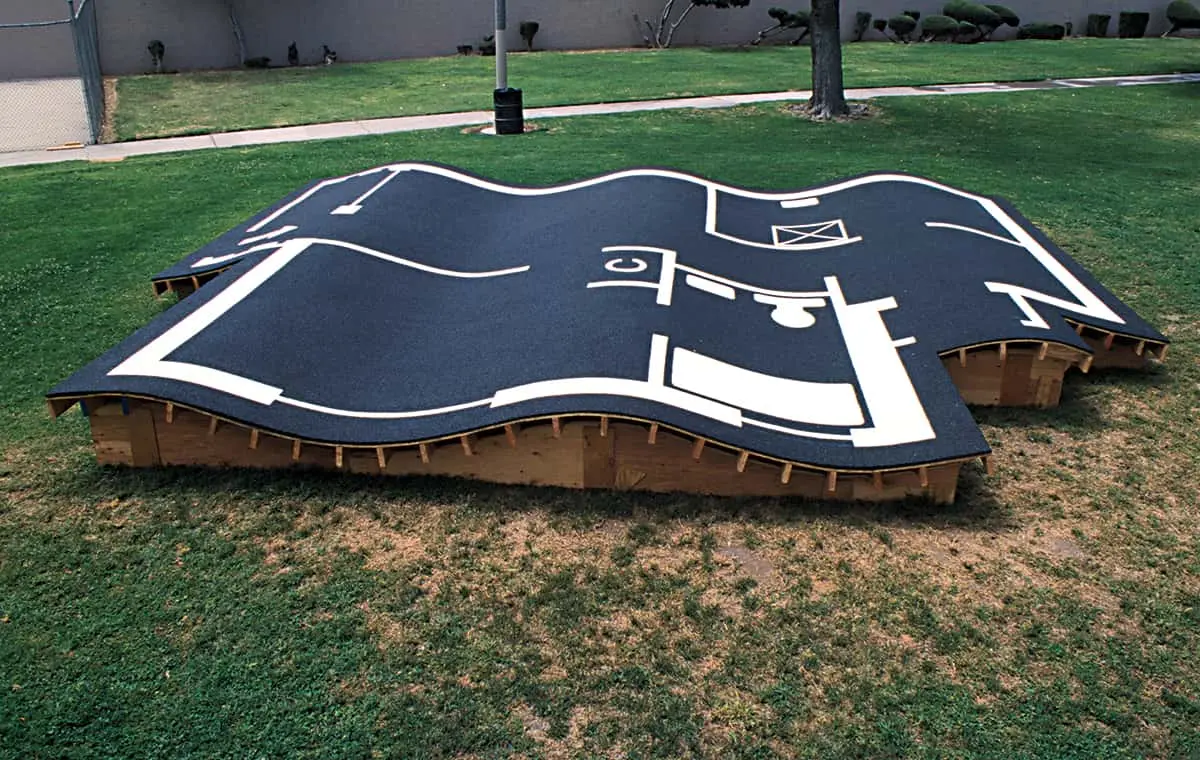
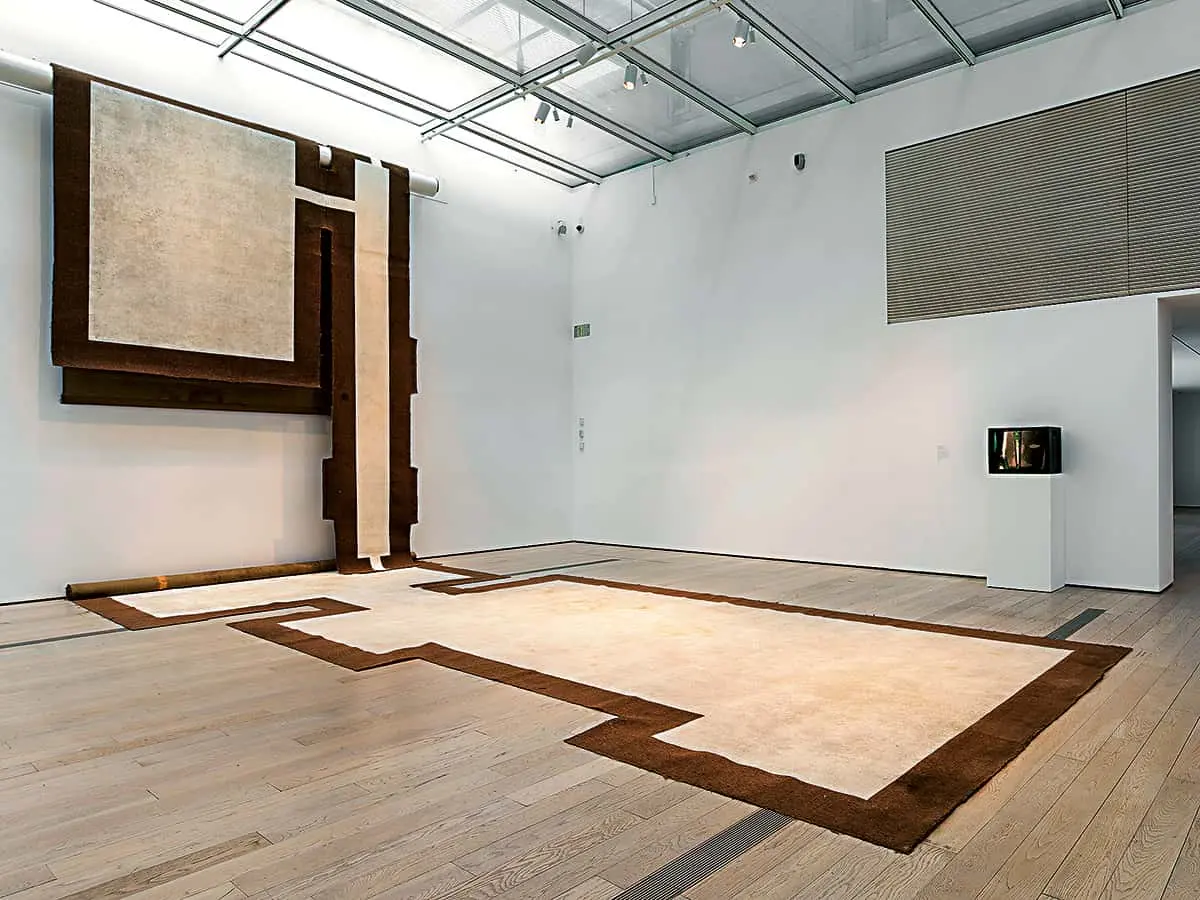
In the section titled Home as Form, Carmen Argote explores domestic space and sculptural space with her installation 720 pies cuadrados: mutaciones del hogar (720 Square Feet: Mutations of Home, 2010), which uses the entire carpeting from her childhood home. Painted white with a brown border (its original color), the carpet becomes an architectural plan, as well as a memory, displaying traces and stains that function as witnesses to the, lived home, the inhabited space, a family’s story. In the same spirit of the plane that becomes volume, the work of Cuban artist María Elena González, Alfombra mágica/hogar (Magic Carpet/Home, 2003), extends a wavy blueprint of a public housing project on a dais outside the museum, like a children’s playground.
Echoing the selection of works that speak rather from a standpoint of silence and subtlety, an important highlight is Johanna Calle’s Obra negra (Black Work, 2007-08), a large-format installation comprising nearly eighty drawings in galvanized wire, copper, and ink on paper. In it, Calle deconstructs elements of informal architectures and connects them to the drawn bodies of children. Calle’s sewn drawings are based on photographs taken in poor neighborhoods in Colombia, later hand-drawn and sewn with wire. On the basis of the austerity and the hurt of the material itself, Calle contrasts opposites and connects bodies (legs) supporting volumes and homes. Destroyed homes, fences, streets, represent the fragility and the strength of the natural (human) and the built, attempting to reflect, on the basis of silence, the terrible reality of poverty in Colombia and the unplanned growth of the country’s cities.
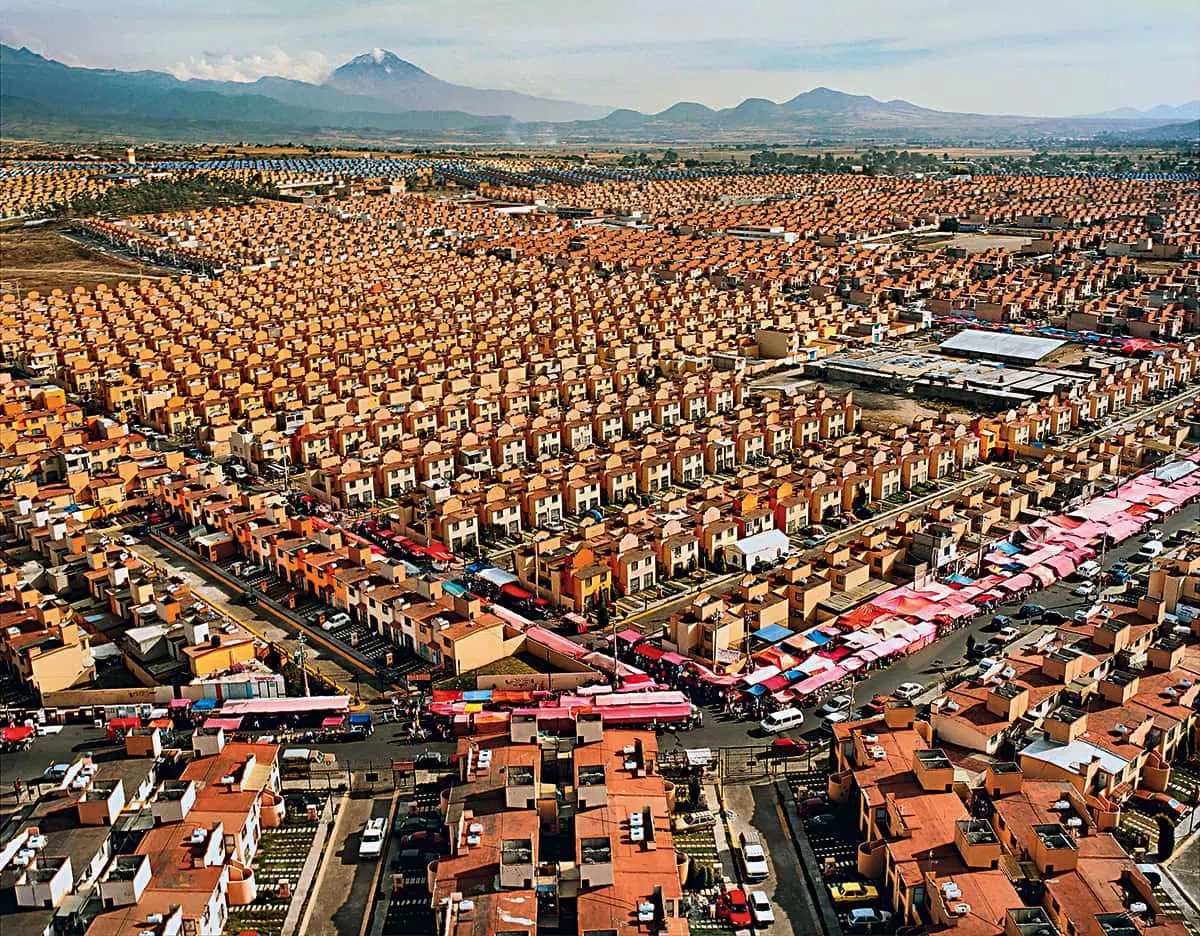
In the words of Chon Noriega, it was not from the start an explicit component of the planning for the show, but it ended up being key for weaving some more urban and private ideas, such as those in Ramiro Gómez’s María esperando por su cheque (Maria Waiting for Her Check, 2013), with the massive public housing constructions that is more in evidence in images by Mexican artist Livia Corona Benjamín, 47.547 hogares (47.547 Homes, 2009), about the projects built during the Vicente Fox administration, which speak forcefully of the standardization, the utopianism, and the political relationships present in social-interest architecture.
There are other, more private examples, like Laura Aguilar’s nude self-portrait En la habitación de Sandy (In Sandy’s Room, 1989), or La gran expedición de María (María’s Expedition, 1995-96), a series where Christina Fernández tells an alternative story of her great-grandmother’s migration in seven images that evoke her journey from Morelia, through a number of intermediate cities, to her final destination in San Diego, over the course of 40 years. Also, Venezuelan artist Jorge Pedro Núñez’s photocollages El sueño de una casa (The Dream of a Home, 2011), which bring to light conflicting conceptions of comfort, nostalgia, landscape, utopia, identity, and home.
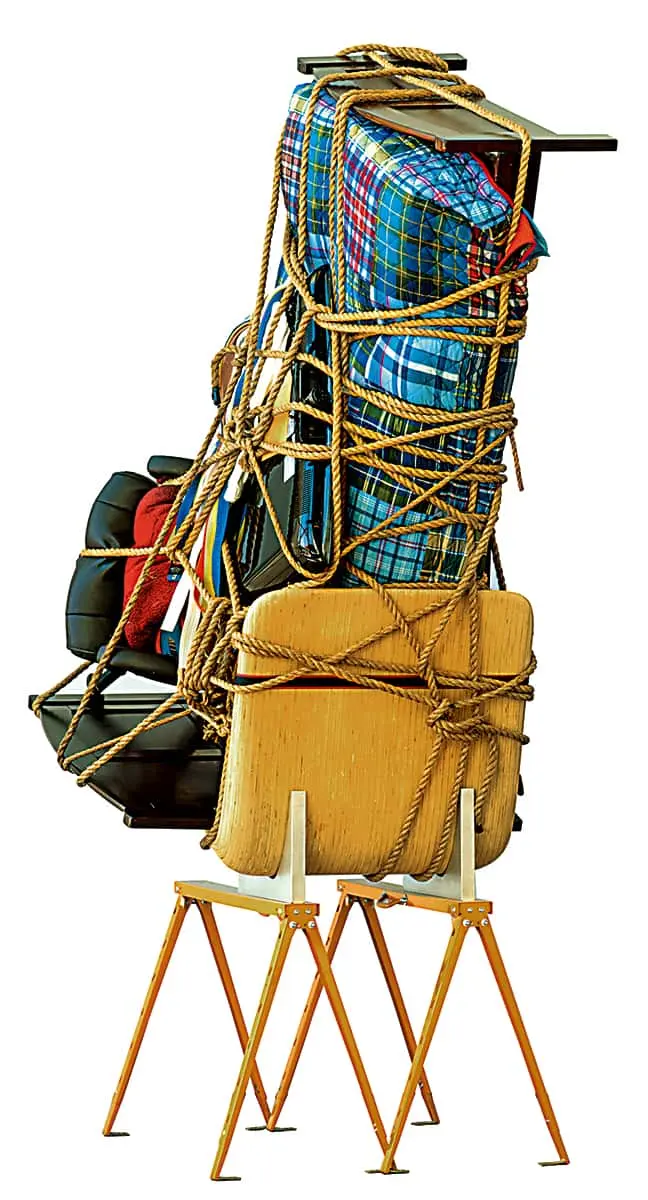
The exhibition ends with a gaze beyond, always towards the unknown, in Félix González Torres’ Sin título (norte) (Untitled [North], 1993), which depicts the electric lights of the North seen from the South, as one “begins to arrive” to the destination, to the new home. Forced displacement, voluntary migration, the ideas of shelter, diaspora, exile, exodus, and permanence, space, architecture, represent the last stage in the journey, Going Home. As we leave the last gallery, back in the entrance lobby, we encounter Temporary Storage: The Belongings of Juan Manuel Montes (2009-2017), an installation by Mexican artist Camilo Ontiveros (1978), who gathered and tied together household items belonging to Juan Manuel Montes, a recent deportee from the United States. Thus ends, Sisyphus-like, our journey through exhibition Home–So Different, So Appealing; it ends and starts again with the idea that the home in reference is not the one that provides us with shelter, but the one we carry on our back, wherever we are.
AMALIA CAPUTO