From the beginning of his career, in the late 1970s and early 1980s, Gustavo Acosta (Havana, 1958) has developed a marked sensibility for exploring the changes and the continuities of architecture and urban space in their conflicted relationship with being and its urban habitation. In schematic terms, this interest could be sketched in three periods or moments, with their respective poetic and discursive attributes The first is when Acosta, on the basis of a figurative language anchored on draftsmanship, explores the perception of the city where history and personal memory intertwine. Emblematic plazas, streets, and colonial-era buildings of his native city as in, for example, the drawings Plaza Vieja (Old Plaza), Teatro Principal (Main Theater), and Mercaderes (Merchants), all from 1982. These small-format drawings, in graffito and color pencil on paper or cardstock, eschew academic techniques. A draftsmanship of loose tracings and a certain expressionistic tilt seems to float on the plane, where blurry images emerge from the haze of the chiaroscuro. Constructions that unfold into landscapes in perspective, with skies and ground formed by zigzagging lines and strokes that spread that gray, aged-seeming light that tints the viewer’s own gaze. In works like these and like Trece escalones (Thirteen Steps, 1986), light unfurls and at the same time absorbs time as its jets brighten the spaces, constructions, and locations.
In the 1990s, Acosta’s work tends more towards large-format painting. Draftsmanship continues to be an important expressive key in his work, but it is in painting that the artist explores new poetic and discursive pathways. In terms of the poetic element, for instance, his neo-figurative is more forcefully realistic; the grayscale remains central, but it is now contrasted with reds, blues, and yellows whose light define the planes of the object, volume, and space with greater precision. Acosta’s realistic neo-figurative painting pushes the support and the photographic nature of its technique in order to look deeply into the structures, into the details, into the architectural hollows that weave the urban space. But the deployment of color does not exempt these paintings from a dusky appearance or a cold, solitary, even dreary atmosphere. In these large-format paintings, one notices Acosta’s pleasure in urban streets, plazas, and locations with a Renaissance or Neo-Classical architectural bent. This is the case, for example, of works like Sin querer, estamos dentro (Unwittingly, We Are Inside, 1991), Mil novecientos noventa y dos (Nineteen Hundred Ninety-Two, 1992), 38 Grado centígrado (38 Degree Celsius, 1994), Aliens (Aliens, 1999), and Alucinación (Hallucination, 2000), among others. In them, the image reveals a desolate cityscape, as desolate as Acosta’s own gaze, which “brightens” and “dims” as though wanting to exorcize, between shadows and lights, the profound rootlessness of these sites.
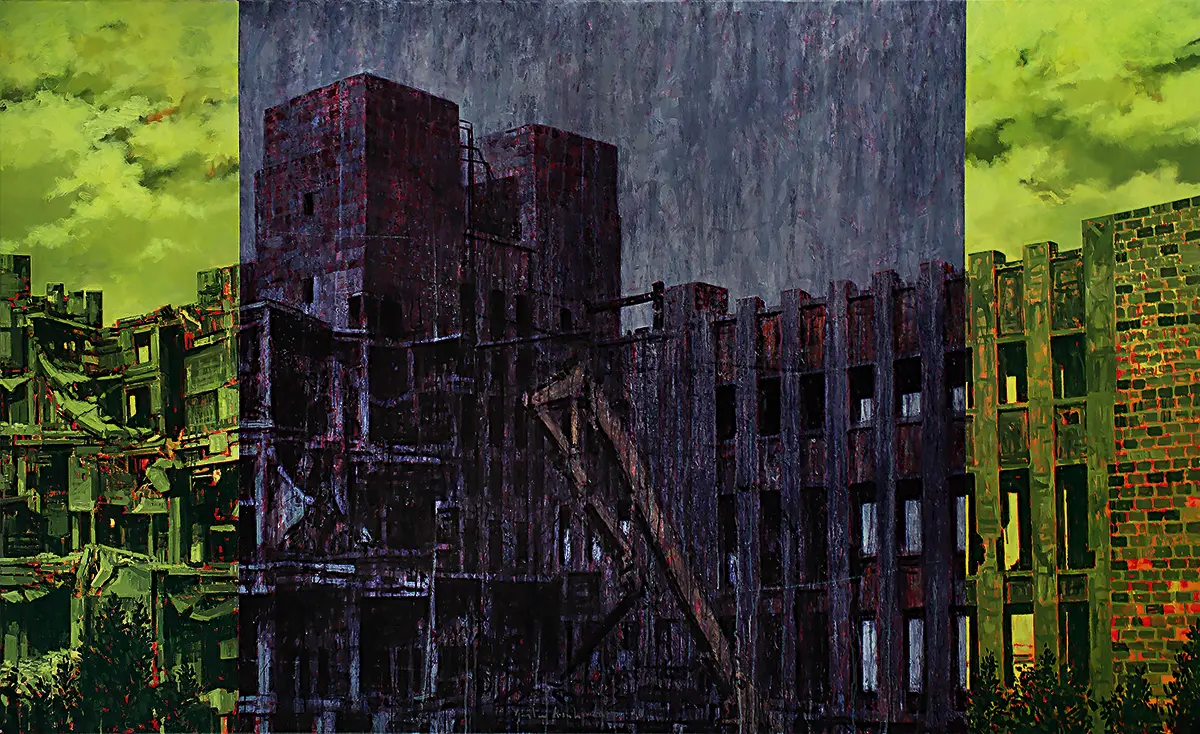
In his current period—its most recent point of reference being the exhibition Inventory of Omissions at Thomas Jaeckel Gallery, N. Y., in 2017—Acosta has been able to interweave the symbolic capitals of both his poetic and discursive arsenals. In terms of the poetic element, it is noticeable how he coherently braids together the expressive resources of painting, drawing, and photography, deploying them in a realistic neo-figurative key. In discursive terms, meanwhile, what stands out is Acosta’s engagement of urban and architectural history—and the social and personal memory implied therein—via his treatment of buildings and monuments that have been emblematic in (mostly) Havana’s urban development. Significant in this context is works like Eclipse; Catalog of missing parts; Building site; Auto de fe; Sixteen flags and a tropical landscape; all from 2017, and also Introducción (Introduction, 2016). What they have in common is their reference to pre-revolutionary buildings. Eclipse, to the Municipal Children’s Hospital (renamed by the revolutionary Regime as the Pedro Borrás); Auto de fe, to the Riviera Hotel; Introducción, to the Ciudad Deportiva; and Catalog of missing parts II, to the José Martí memorial at Plaza de la Revolución.
These works affect an immersion in the neo-figurative pictorial language via the use of an equivalent to what would be the application of photographic filters to the pictorial surface. “Filters” that color different sections of a single landscape in different hues and open windows that describe and signify the same reality in different ways. In these works, images flash and darken in unison, veiling and at the same time revealing elements about the landscape. These images that, in the very instant we see them, seem to be looking at us as well. The effect is similar to what Georges Didi-Huberman describes, in his Ce que nous voyons, ce qui nous regarde (1992), as the contrasting of two kinds of evidence. On the one hand, “optical” evidence; on the other, “presence.” And in contrast to this evidence, Acosta’s works underscore the fact that the act of seeing is not the act of providing visible evidence. “Making see,” says Didi-Huberman, “is always to unsettle seeing, in its act, in its subject. Seeing is always a subject operation, and as such a cleaved, unsettled, shaken, open operation.”
In the operation of “dyeing” different portions of the same reality, the same object, Acosta finds inspiration in a common sight in Cuban homes of the 1980s, where pieces of translucent acetate of different colors were placed on the screens of Soviet-made black-and-white TV sets. The effect was a strange image, a mixture of the same old black-and-white with the blue, green, and yellow of the acetate. A startling visual product, halfway between, on the one hand, a documentary, dry, forensic, surveillance-like image and, on the other, a warm image, clandestine in its visuality, brightening landscapes, objects, and things that, now recognized under a new aura of color and light, transmitted other attachments and other sensibilities about what was seen.
There is in these works by Acosta, as was also the case with those acetate sheets plastered onto Cuban TV screens, a will that, while cognizant of a given reality, refuses to accept things as they are. A will (rendered as visual action) that sought to color a gray and impoverished reality, as impoverished and decayed as Havana, appears today due to the revolutionary project’s inability to generate an architectural and urban legacy for its own times. On the contrary, the Revolution’s architectural and urban inheritance is now a landscape in ruins. Confronted with this, Acosta’s works in Inventory of Omissions, inspired on iconic buildings of the pre-revolutionary era, would seem to “color” the gaze of an artist intent on recovering, by means of memory and remembrance, a lost splendor, the contemporary image of which is Havana’s derelict landscape.
DENNYS MATOS