Surreptitious Stripes, the most recent exhibition of works by Francisco Masó (Havana, 1986), curated by North-South Curator (a collective formed by Katherine Chacón and Jim Peele) is a kind of trompe l’oeil. While it might appear—from a formal point of view—as though we were in the presence of a proposal inscribed in the ample tradition of Concrete Art, Masó’s work keeps a significant distance from the self-referential concerns that, as a general rule, characterize that school, initiated by Theo van Doesburg in 1930.
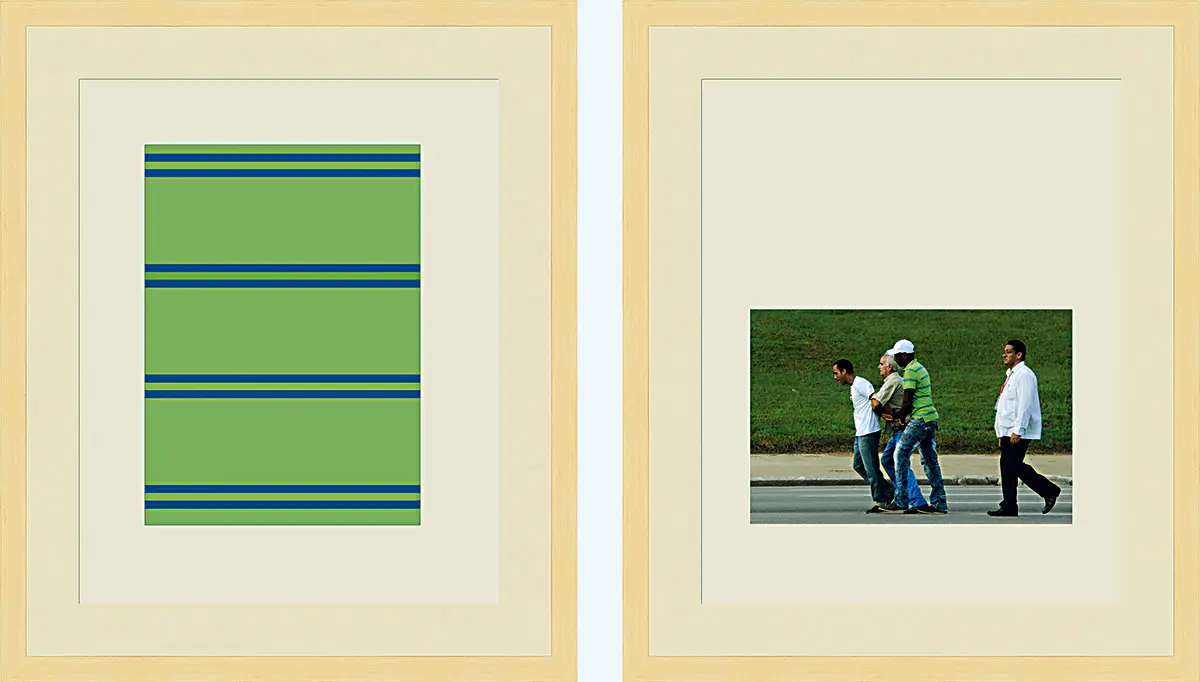
Surreptitious Stripes features 20 items (patterns) from the series Registro estético de Fuerzas Encubiertas (Aesthetic Record of Undercover Forces, 2017). Masó’s refined series is based on a rigorous conceptual process of documentation, analysis, and disarticulation of the concrete social phenomenon that prompts it, contingency being essential in connection to the reality referred by the work.
For this series, Masó starts with documentary registers (photography and video) that denounce clashes between opponents to the current Cuban regime and undercover government forces working to repress any expression against the existing order. In the face of the general crisis in the country, the Cuban government has resorted, as a palliative and bribing mechanism, to giving out scant “free modules” containing clothes and other basic necessities to certain sectors of the population, among them the leadership class, members of the military, and the regime’s various undercover agents. One of the most distinctive elements found in these modules is the shirts (striped or plaid) that serve as the starting point for Registro estético de Fuerzas Encubiertas.
Organized in volumes, Registro estético de Fuerzas Encubiertas encompasses a catalog of the motifs that recur in striped pullovers and checkered shirts used as “camouflage” by government forces in “civilian” confrontations. In this way, the aesthetic register that the series contains becomes an instrument for the detection of undercover agents while at the same time shedding light on the underhanded militarization of social society in Cuba today.
Like every proposal by Francisco Masó, Surreptitious Stripes is not driven by the self-referential interest that characterizes, in a general way, the Concrete school of abstraction, but instead responds to a line of inquiry deeply anchored on the current local context, specifically the mechanisms of surveillance and control that have gained such preeminence in contemporary Cuban society. Registro Estético de Fuerzas Encubiertas, the series of abstract-geometric paintings that comprise this exhibition brings to the fore the hidden powers of domination that the Cuban state exerts on civil society, and in that endeavor, each of the works on exhibit is aided by the documentary register that supports it.
Educated beyond the traditional training in the fine arts, Francisco Masó’s proposals are always undergirded by a trans-disciplinary vocation intent on seeking new methodologies to apply to the surrounding reality. Of transcendent importance in that sense was his passage through the Cátedra de Arte de Conducta (2008-2009) organized by Tania Bruguera, where Masó took part in critique and production workshops held by such renowned artists as Artur Żmijewski and Rirkrit Tiravanija, who imparted instruction in the exercise of art as an instrument for ideological change via the use of tools like statistical data and confidential sources that weigh towards the aesthetic sense of extra-artistic charges and concrete social application.
It would be extremely reductive to describe Masó’s proposal as abstract, given the weight of the conceptual element it contains. In that sense, it is important to trace the unavoidable links that distinguish this proposal from other “uses” of abstraction in the context of contemporary Cuban art. Specifically, the adoption of abstraction as a hard conceptual line, the consequence or the result of conceptual-like inquiries. This tendency first became evident in the late 1980s, a time when censorship in the visual arts was an inescapable landmark. For these artists, the obsolete schematics of figuration/non-figuration play merely as “instrumental baggage.” Two essential currents connect here: first, the proposals of artists whose deployment of abstraction is systematic, such as José Angel Vincench or Ruslán Torres, interested in concrete socio-ideological processes in Cuba; second, artists who engaged abstraction at a given point in their careers as the aptest among the available languages to serve as a vehicle for conceptual proposals that are deeply rooted in the Cuban context of the era (Flavio Garciandía, Arturo Cuenca, Glexis Novoa, or José Ángel Toirac, to mention but a few). Inscribed in this second current was the epochal group exhibition Es solo lo que ves (It’s Just What You See, 1988), which brought together the majority of the protagonists of the Cuban art scene of the 1980s into a kind of collective manifesto of a return to abstraction given the impossibility of expression in the critical climate of censorship of those years. Even though the exhibition never actually opens (such impossibility is, precisely, the show’s conceptual foundation), Es solo lo que ves appears in the CVs of every one of its participants.
Surreptitious Stripes is a clear example of all this. For an artist like Masó, interested in the dismantling of the unconscious processes of contemporary society, abstraction becomes the ideal vehicle for the development of transdisciplinary projects for which the art institution is only one of several possible spaces for circulation and resignification. Surreptitious Stripes is a greatly cohesive and pertinent exhibition.
JANET BATET