An exhibition that seems strictly modernist, focused on kinetic art, is key to study and understand the range of Federico Silva’s oeuvre. The exhibition Arte cinético - Momento de un principio de investigación (Kinetic Art – The moment at the start of an investigation) comprises twenty-seven works that subtly anticipate what decades later will be installations and atmospheres. Those familiar with the artist’s trajectory will visit this exhibition for the opportunity to encounter works exhibited only once before, in 1970, at the Museo de Arte Moderno in Mexico City. Silva had traveled to Europe the year before, and in Paris, he had established a fluid communication with the artists of the moment, the kinetics. The moment at the start of an investigation, the exhibition’s subtitle sheds light on that circumstance: a self-taught painter focused on social issues returns to his native country and launches into explorations that will transform him into a sculptor-builder-electromechanical researcher-discoverer of the features of the moment.
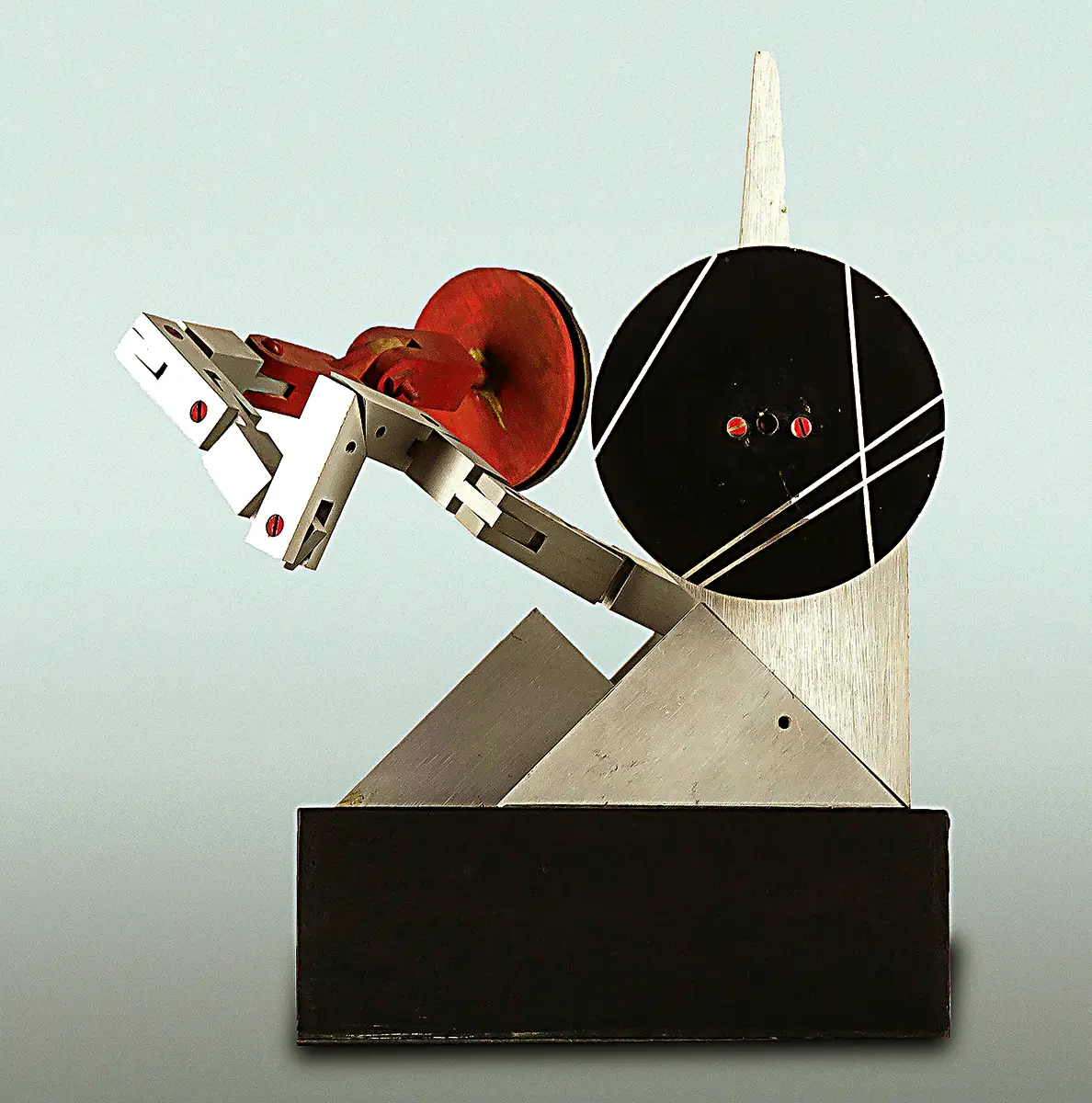
In his passage from a pictorial practice influenced by Mexican muralism to the experiences with motion, light, and sound he encountered in Paris, Federico Silva received a significant energy charge and reached an understanding of how society was changing at the time. His radical turn did not raise much interest in Mexico, although that initial moment in his process situates the artist in an authentic conceptualization of origins. Although not an engineer, he creates objects that move, throws gesticulating lights, and produces rhythmic, loud motion. Echoing the postwar era, machinery and the participation of survivors in the appreciation of art—and art with several options, the standouts among them being things moved by motors, or things that sway lightly as viewers pass them by. These constructions—some with titles like Alborada (Daybreak) or Emisor de constelaciones (Emitter of Constellations), although most are labeled simply Aparato cinético II (Kinetic Device II), III, etc—are made using electromechanical systems, screws, levers, wood, metal, mirrors, acrylic, and glass, with the occasional addition of paper and lithographic pens.
As we move through the excellently museographic sections in semi-darkness, the scenes alternate with dry swaying movements, others with color circulation, and yet others with intense black and white contrasts. The devices privilege emphatic volumes with which the works are produced. These are not large-format sculptures, but rather large infrastructures for actuating the kinetic proposals. The works range in size between 34 x 22 x 30 cm and 259 x 204 x 243 cm. In each one, however, one notices an approach towards the monumental, encompassing the visual element, the mechanical part, and the covers. The geometry of triangles, parallelepipeds, and oval-circular shapes predominates. From the neo-realism of Silva’s early paintings to what he exhibited this year at the Museo de San Luis Potosí—a selection of works finished between 1969 and 1978—there are essential vectors. Silva’s interest in color does not fade away; he has acquired a new power for three-dimensional synthesis and has discovered ancestral indigenous builders. The butterflies of kinetic art will become stony monumentalities, giving rise to birds, shapes in flight, and totems. The electromechanical infrastructure gave way to more primitive-looking yet contemporary solutions. Metal became an accessory, while stone gained centrality and came to the encounter of concrete, the quintessential postmodern material, which evokes ancestral roots and makes it possible for Federico Silva to reach his unequaled sculptural monumentality.
Monumental is indeed the term that best describes the interior and each one of the sculptures permanently housed in the outstanding Sculpture Museum in San Luis Potosí, named after this Mexican artist intense in his activity and discreet in his public life: Federico Silva (Mexico City, 1923), a numerary member of the Mexican Academy of Fine Arts, Sculpture Section, since 1992, Doctor Honoris Causa by UNAM and the Universidad de San Luis Potosí, recipient of the National Science and Arts Award in 1995, among other honors. A self-taught artist, his early period as a painter, sculptor, and author of digital prints is well known. Before devoting himself to the arts, he studied anthropology, veterinary medicine, and law, later working as an assistant to David Alfaro Siqueiros while deepening his knowledge of pictorial technique through books and the friendship of Diego Rivera, Pablo O’Higgins, and Leopoldo Méndez. His murals and public sculptures are found in several Mexican states, as well as in Europe, the United States, Jamaica, and Japan. Three words outline a portrait of this artist: a sculptor and monumental muralist who focuses on similar proportions and elaborates on color in motion. This exhibition is exemplary, didactic, and documentary. Independently of the temporary exhibition on the calendar, this museum is a mandatory visit.
GRACIELA KARTOFEL