The exhibition titled Yare, Yare, Yare by Colombian artist Ernesto Soto (Bogota, 1947) is a window into the explorations of this young artist that is similar to a self-portrait articulated through ideas, brushstrokes, and interests that gradually outlines his point of departure.
Although young, Soto’s artistic career is no longer an emerging one, dating back to, among other events, several group exhibitions in 2010 at the Galería El Garaje. This is his first solo show and, as such, is an exploration of intentions. Everything here is rooted in his obsession with snow, which is turned into an excuse for exploring it as a formal resource. The whiteness of the snow as a point of departure is the basis for everything that unfolds across the two exhibition rooms of the gallery. On the one hand, it elicits the invention of an underlying narrative involving a skier whose connecting thread is his relationship with the countries where snowfalls.
Soto introduces his character along with the possible environments that he has experienced, even the food that he may have eaten and the fires that have kept him warm. It then becomes possible to walk through the exhibition in unison with the skier’s story, following a path full of anecdotes—which occasionally even lead the artist to more conceptual or sculptural pieces—and small autobiographical notes with hidden references to the artist’s partiality towards the progression of time in nature, across mountains.
Naively and unprejudiced, the skier leads the way towards an uncertain path in which we are not certain what we may find. This is suggested by the random and invented title of the exhibition, which nonetheless offers connections between the word used in it and its possible signification when performing an online search. While the word may not exist, it can however offer an idea of its possible meanings.
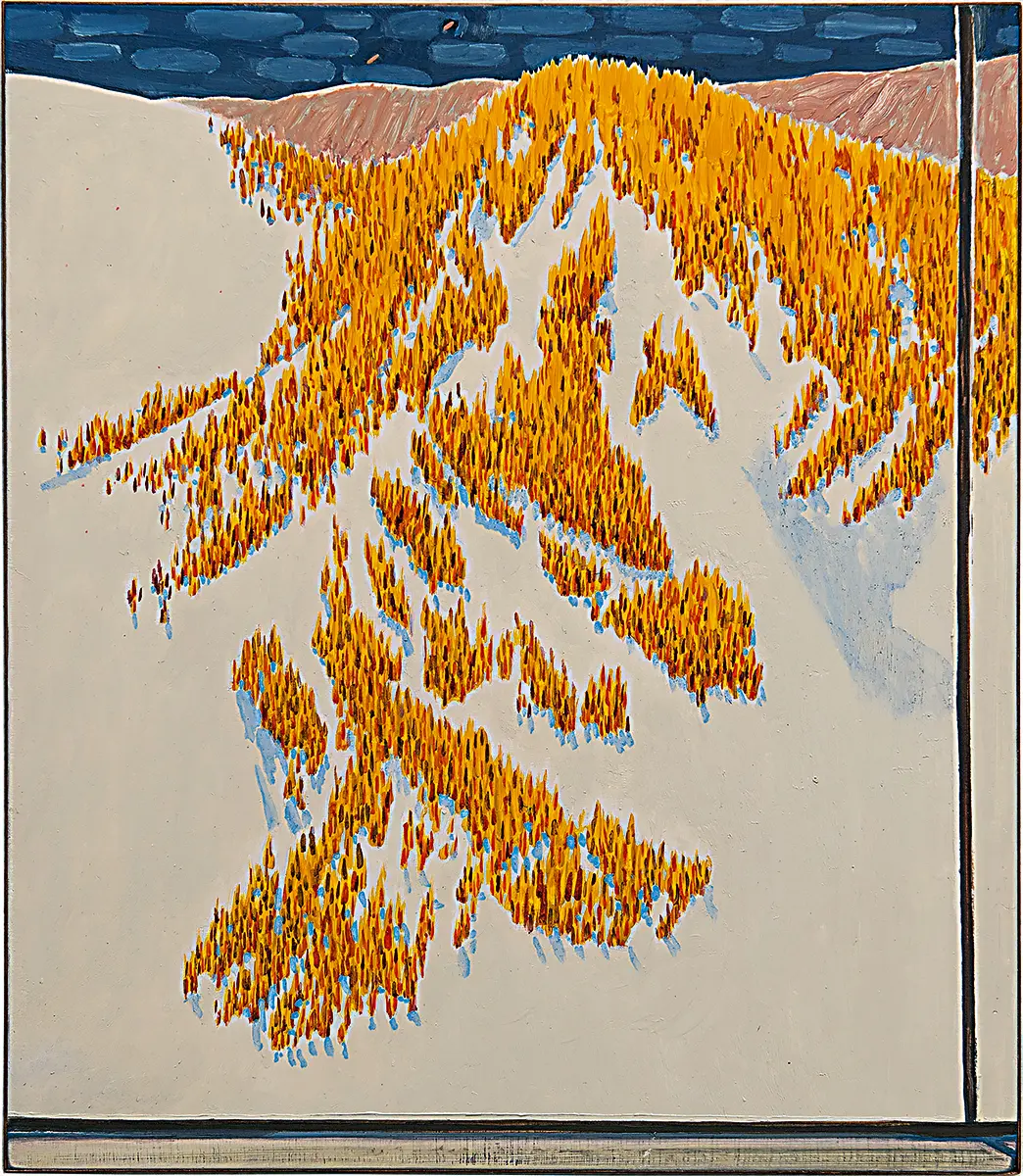
On the other hand, the playful aspect of following or taking into account a story is occasionally expressed concurrently with a second way of pursuing the exhibition’s connecting thread—this time by delving into formal elements that are of interest to Soto, through an argument centered on the poetic of white as support and basis for the few elements that Soto works on. Plentiful are the brushstrokes that render tree after tree to create depth with a single gesture. The trees become fully immersive landscapes seen from up close, where the distance between the image and the viewer is almost nonexistent, like in the work Bosque (Antes de la Tinga) [Forest (Before Tinga)]. In other works is as we were observing through a window from afar and the window frame was the element that separated us from the illuminated interior, like in Vista del Norte (Las Tingas) [View of the North (Las Tingas)]. Sometimes there is sun, other times the sun has been replaced by grey, winter landscapes, like in El Gran In, or by a higher line in the horizon, like in La Pinacoteca (The Pinacotheca). In those instances, more than brushstrokes or gestures, we observe various ways of creating light and changing the nature of the landscape our skier is going through. Every painting represents the possibility of a landscape created with minimal resources.
Taking into account these two extremes, namely the always figurative nature of the narrative and the context, and the formal proclivity towards abstraction, it is possible to see that Soto always fluctuates between those extremes—perhaps more clearly in the latter and in more uncertain terms in the former—in order to always leave an open end full of possibilities. In addition, the collection of perspectives, points of view, and interpretations turns this exhibition into a comprehensive exercise of the gaze. Such variations and constant changes invited viewers to gaze at different, highly cinematographic, pictorial frames.
This “catalog for the gaze” is perhaps what evidences Soto’s formal education as an art historian and also his great knowledge of the history of cinema, two disciplines that exert great influence in the conceptualization and execution of his work. Despite being works finished for an exhibition that has concluded, they could very well represent a collection of images that explain how the work by Soto was constructed and developed. In Vistas del Norte (Las Tingas) the window’s framing allows us to establish a certain distance with the landscape, align the gaze with the skier’s, who is resting, looking outside, towards the landscape that will surround him upon leaving the comfort zone.
It is possible that by focusing on pines, mountains, cliffs, and light, the works by Ernesto Soto become an exercise in leaving that comfort zone behind in order to confront uncertainty face to face. But the fact that the landscapes are imaginary and do not rely on any reality-based referents, makes it impossible to feel safe about leaving any pre-established plans behind.
CARIDAD BOTELLA