Certain exhibition contexts help a work of art, and vice versa: there are works that give their contexts a new direction, or enhance the original one. Museo Cabildo is not a white cube. Its historical charge, having been the site of some of Uruguay’s most significant political and social events, is extremely weighty, but it can also serve as the foundation for a lighter, more abstract, or poetic experience. Cuando las palabras ardan en la chimenea (When Words Burn in the Fireplace), by Elián Stolarsky, fulfills that premise to perfection. By means of printing on a variety of transparent surfaces, Stolarsky is able to elevate drawing in a way that is, if not evanescent, at least light and fragile, establishing a dialog between the certitude of the exhibition space, the ground, or the fireplace (to which the title makes direct reference), and the daintiness of her proposal. Two large mixed-technique murals, depicting peddlers sitting on a bench and workers posing proudly in a moment of rest, are accompanied by portraits—fragments and gazes that also appear in the murals—on glass, where the line and the stroke are visible against invisible support.
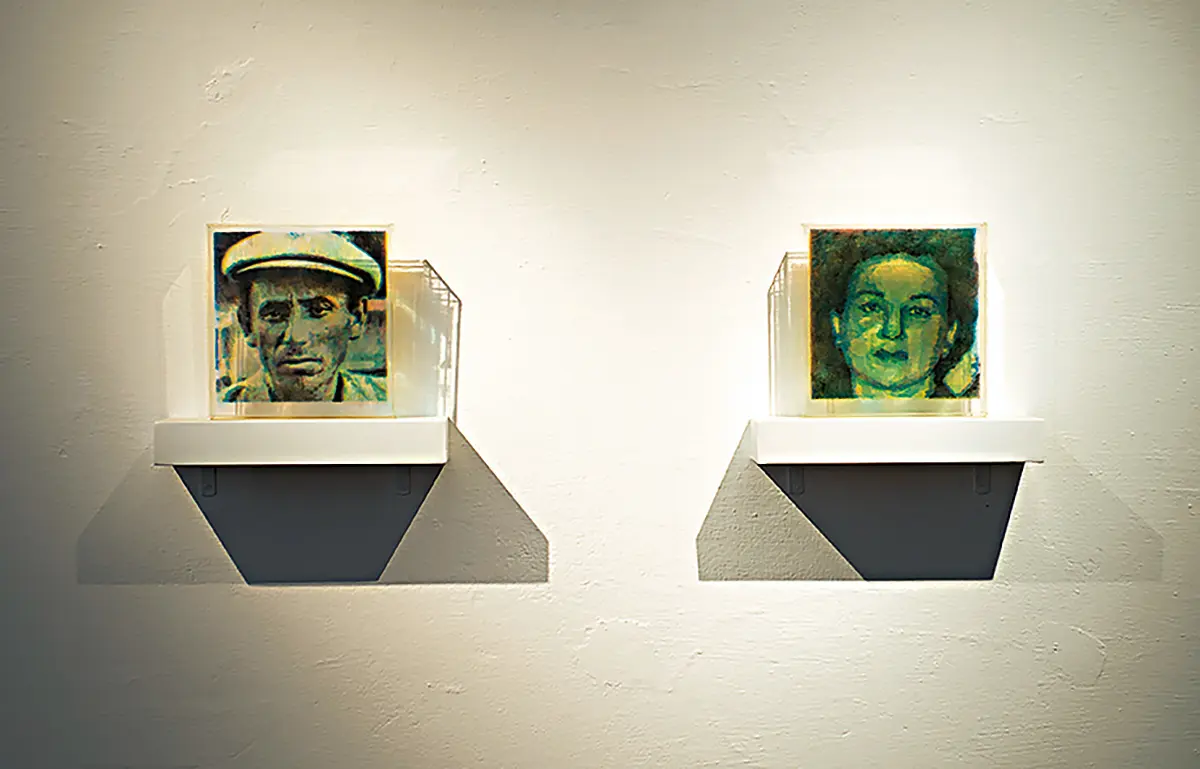
Memory is Stolarsky’s raw material and craftsmanship of her instrument, and several additional clues are provided for our understanding of the exhibition. The gallery text alludes to Oyfn Pripetchik, a Yiddish song by M. M. Warshawsky (1848-1907) that is still sung in Jewish nurseries, which tells the story of a Rabbi teaching students the alphabet (“Fire in the hearth, we feel the heat/ of a flame that burns/ today the teacher gives children/ their ABCs”). The connection between the homey element in the exhibition space (the fireplace), the title of the installation, and the works themselves becomes clearer. In order to understand more precisely, we need to look at the artist’s still effervescent trajectory. Her work focuses on biographical—often, autobiographical—elements in their most ghostly, latent, or effusive version. Following the few clues provided in the text the fractured way in which the image is presented alludes to that seeming disconnect that occurs when one is submerged in remembrance. Individual and collective memory fluctuate in this revision of a history of immigrants, or promises and dreams, that is now revealed in this expanded jar, in a glass tapestry that functions as a canvas for invocation.
The mural’s material similarity to an illustrated tile coheres perfectly with the Cabildo hall, in the walls of which the echo of past events continues to resonate. Anyone tempted to connect this individual memory with the collective one will find no end of stories of history and history of stories. Jewish immigration in Uruguay was sizable since colonial times and increased considerably after the great European wars, racing to its zenith in the 1960s. Today, Uruguay has the third-largest Jewish population in South America. Their journey and their settlement in a foreign land is a common legacy that, thanks to the community’s cultural contributions, has been integrated with great ease. Stolarsky’s exploration, driven by lines and shadows, sustained by painstaking draftsmanship (a very demanding effort, if we take into account the final dimensions), is in synch with that personal reading that becomes communal, with that alphabet that a child learns in order to, years later, give shape to expressions of the profound.
JUAN JOSÉ SANTOS